FOB Price per Unit Sheet Mask OEM 5000 Units China 2026 Lead Time
August 31, 2026
Skincraftlab
B2B Skincare Manufacturing Expert
-主图1.jpg)
What Is This Guide About?
Real FOB pricing for 5,000-unit sheet mask OEM runs in China for 2026, with lead times, GMP compliance, and audit checklist.
Category
FOB price sheet mask
Audience
Brand owners, procurement, R&D
Updated
August 2026
For a 5,000-unit sheet mask OEM run from China in 2026, you should budget $0.18–$0.55 FOB per unit depending on film type, formula, and packaging. Standard lead time is 25–40 days after sample approval, or 15–25 days for stock formulas. Chinese GMP-compliant factories follow ISO 22716 or GMPC; requesting a certificate alone is insufficient—you need to verify organic certification, verify the production premise, and request a batch of manufacturing records (BMR) before selecting a partner. This article explains the FOB cost structure and certification verification framework for procurement managers.
What Drives FOB Price per Unit for Sheet Mask OEM in 2026
FOB price for a sheet mask covers four major cost buckets: film, of which only the kraft paper box represents a small number of units. The actual price breakdown depends heavily on the mask substrate and serum concentration of active ingredients like PDRN or niacinamide. A basic 25g cotton fiber mask with a hydrating formula will cost approximately $0.18–$0.25 FOB. A bio-cellulose mask or hydrogel mask with high-load actives like hydrogel sheet masks will cost $0.35–$0.55 FOB per unit.
| Cost Component | Basic Cotton Mask | Bio-Cellulose Mask | Hydrogel Mask |
|---|---|---|---|
| Film substrate | $0.06–$0.09 | $0.18–$0.25 | $0.15–$0.22 |
| Serum/formula + actives | $0.04–$0.08 | $0.06–$0.12 | $0.07–$0.15 |
| Aluminum foil pouch + printing | $0.05–$0.07 | $0.05–$0.07 | $0.05–$0.07 |
| Filling/labor/QC overhead | $0.03–$0.06 | $0.05–$0.08 | $0.06–$0.09 |
| Total FOB per unit (approx.) | $0.18–$0.30 | $0.34–$0.52 | $0.33–$0.53 |
These ranges assume a standard 25–30 ml fill weight and a volume of 5,000 units per SKU. The FOB price per unit sheet mask for 5,000 units in China includes raw materials, labor, utilities, standard export carton, and factory profit. It excludes sea freight, customs brokerage, import duties, agent commission, and ODM design fees.
2026 Lead Time: From Purchase Order to Port
China 2026 lead time for a 5,000-unit sheet mask OEM order depends on whether the formula is pre-existing or custom. If you choose a stock formula, the factory can start production almost immediately after the packaging design is approved. The typical schedule for stock formula orders is 15–20 days for raw material procurement, 3–5 days for production, and 5–7 days for QC and export documentation.
For a custom formula, add 10–20 days for formulation stability testing (28°C and 48°C oven stability for 4 weeks) and preservative efficacy testing. Total lead time from PO confirmation to port readiness is typically 25–40 days. Note that Chinese New Year (late January–February) and Golden Week (October) can add 10–20 days to production schedules regardless of the factory's capacity.
When procuring a private label clay mask or a sheet mask, request the factory's production slot availability before signing. In 2026, capacity for serum-based sheet masks is tight in Q3 due to peak export demand for Amazon FBA and holiday retail. Booking production slots 3–4 months ahead reduces the total lead time and prevents delays.
How to Verify GMP Certification on a Chinese Factory (Not Just the Paper)
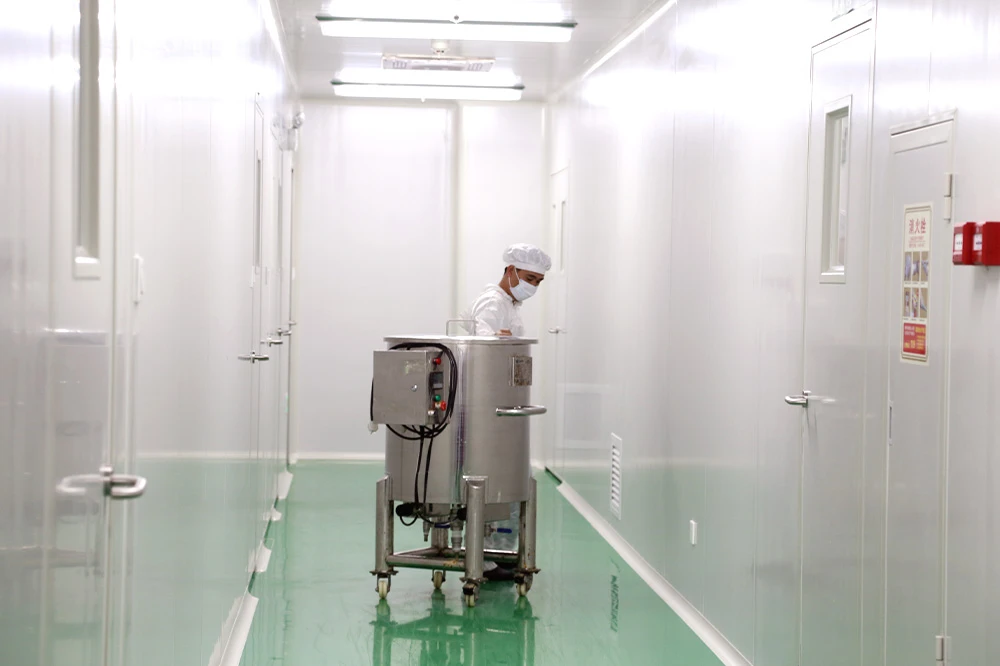
A GMP certificate alone is not a valid verification of a factory's compliance level. The supply chain includes many audits and checks; you must understand the difference between a certified workshop and a certified company. Ask for the factory's ISO 22716 certificate (cosmetics GMP) or GMPC (US standard). Verify the issuing body is an accredited third party—look up the certification body's own accreditation status. Do not accept a photocopied certificate without a QR code or verifiable certificate number.
More importantly, request a batch manufacturing record (BMR) for a past sheet mask run. A BMR should list the exact raw material batch numbers, formulary weight, manufacturing steps, and QC release test results. You must also verify that the factory's facility address on the certificate matches the factory's actual physical address for production. Visit the factory or hire a third-party pre-shipment inspector to check production cleanliness (dust control in the filling room), water quality (purified water system logs), and whether they have separate cleanrooms for wet processing.
A common failure in certification verification is checking the certificate's validity: Certificates expire (usually every 3-5 years) or get downgraded. Use the certificate number on the issuing body's website to check active status. If the factory claims GMPC but hasn't passed a recent CBAM or BRC audit, request the latest unannounced inspection results.
Additionally, confirm the factory's export history with your target market. A factory producing sheet masks for the US must comply with FDA cosmetics labeling (ingredients in INCI, net weight, manufacturer address, and proper allergen advice) and may require a drug listing if the product makes anti-acne claims (e.g., salicylic acid ≥ 2%). For the EU, a responsible person is required and the formula must comply with Annex IV/VI preservative limits. The Chinese factory's GMP certificate is no substitute for your market-specific regulatory compliance.
Third-Party Inspections and Quality Control Before Putting Money Down
Always place a trial order of no less than 500 units to observe quality variations per batch. A quality factory will have a clear AQL (Acceptable Quality Level) inspection standard—typically AQL 2.5 for major defects, 4.0 for minor defects—and will allow your inspector to visit the production line. During the visit, check the filling machines (weight accuracy ±0.1g), dust-proof environment, and the packing line (speeds of 15–25 pcs/min for sheet masks).
Ask for the COA (Certificate of Analysis) for each batch of serum and mask film. Verify that your active ingredients' concentration matches standard claims. For example, if your formula claims a 1% concentration of niacinamide, the COA must show the actual assay results (typically 90–105% of label claim). Verify heavy metal content (lead, arsenic, mercury, cadmium) against the standards of your target market—China's limits (≤10 ppm total lead for cosmetics) are not identical to EU limits.
For a smoother procurement process, request a pre-production sample of 5–10 sachets, sealed and tracked. Test the shelf life by pressing the sachet to check for leaks, and perform a 48-hour fridge/freezer cycle test to confirm the pouch doesn't leak at low temperatures. If you cannot visit the factory, use a third-party QC firm in Guangdong that offers factory audits and batch testing for SKUs.
Cost Breakdown: What Is Hidden in Non-FOB Costs
When quoting FOB, remember that the final landed cost per unit adds 15–35% to the FOB price depending on shipping route and duty. For the US market, ocean freight and customs duties add about $0.05–$0.10 per mask unit for small volumes. Brokerage fees and FDA filing add another $250–$500 regardless of order size. For EU, add import VAT (17–27% depending on country) but for smaller shipments, you may be below the VAT threshold.
For a 5,000-unit order, the total out-of-pocket cost usually falls between $1,000 and $3,500 for freight (LCL sea), $300–$1,500 for customs brokerage, and $200–$500 for labeling and registration preparation. Allocate 5–10% of the total budget for failed first production runs, especially if the formula includes actives that can degrade (like vitamin C).
Sample Approval and Specifications Agreement (SA) Before Mass Production
Once you've selected a factory, ensure the manufacturing contract includes a detailed Specifications Agreement (factory spec sheet). This document must list: the exact formula (with INCI ingredients and %), the packaging material spec (pouch size and material thickness), and the manufacturing environment limits (microbiological quality — e.g., bacterial count ≤100 CFU/g). Also specify the minimum tolerance for cost variations; the factory cannot change raw material suppliers unless the quality matches the initial COA.
Define the return policy for defects: a standard Chinese supply agreement includes a 3% defect rate allowance where the factory replaces defective units. For sheet masks, common defects are leaking pouches, improper sealing, misalignment of the mask, and contamination. Set the defect rate threshold at 0.5% (or negotiate a 1% replacement rate). Include penalties for delayed shipping: request a credit of 0.5% per day late beyond 7 days.
FAQ
Q: What is the FOB price per unit sheet mask OEM 5000 units China 2026 lead time?
The FOB price per unit for a 5,000-unit sheet mask OEM order in China ranges from $0.18 to $0.55 depending on film type and formula. Basic cotton masks cost $0.18–$0.30, bio-cellulose masks $0.34–$0.52, and hydrogel masks $0.33–$0.53. Production lead time from PO to port is 25–40 days for custom formulas and 15–25 days for stock formulas, excluding Chinese public holidays. Prices 2026 have not increased sharply due to stable raw materials (PET film, cotton fibers) and container shipping; however, formula actives like PDRN or argireline push the upper end.
Q: How long is the 2026 lead time for a sheet mask OEM order of 5,000 units from China?
For 5,000 units with stock formula and standard packaging (foil pouch + printed box), lead time is 15–25 days from PO to shipped. A custom formula adds 10–20 days because of stability testing (4 weeks usually) and preservative challenges. Total 2026 lead time averages 25–40 days, plus 3–10 days for ocean transit to the US or EU east coast. During Chinese New Year (late January–February) and Golden Week (October), add 10–20 days.
Q: Which sheet mask film type gives the lowest FOB cost for a 5,000-unit order?
A basic cotton or Tencel sheet mask film gives the lowest FOB cost at $0.06–$0.09 per unit for the substrate. Combined with a simple hydrating formula (glycerin-based) and standard pouch, the total FOB drops to $0.18–$0.25 per unit. Hydrogel or bio-cellulose films cost 2–4x more but justify a premium price point for retail; for a first order with 5,000 units, a cotton mask is the most capital-efficient choice.
Q: Do I need a separate GMPC or ISO 22716 certificate for each factory in China producing my sheet mask?
Yes, each manufacturing site must hold its own GMPC/ISO 22716 certification. The factory you contract for filling and assembly requires the certificate. However, if your film manufacturer and filling factory are separate, both must be audited. A common cost-saving approach is to use one contract manufacturer that handles both film lamination and filling; they must hold a single GMPC covering the entire process. The certificate must be traced to the exact physical address where the production occurs.
Q: What hidden costs are NOT included in the FOB price for a sheet mask OEM order?
FOB excludes ocean freight, customs duties, import taxes, destination warehouse fees, and your in-country labeling/registration costs. It also excludes overruns: factories usually ship ±5% more units but charge the same per unit; for small orders of 5,000 units that's ±250 extra units you may need to absorb. Additionally, FDA cosmetic registration for the US or CPNP notification for the EU (via responsible person) costs $200–$800 per brand, not per SKU. Allocate 10–15% above the FOB quote for incidentals.
Q: How do I verify a Chinese sheet mask factory's GMP certificate is valid and not counterfeit?
Run the certificate number through the issuing body's public database (e.g., SGS, Intertek, or TÜV; inspect the certificate's QR code). Look for the certification date—the factory must have an ongoing annual surveillance audit. Contact the issuing body directly via email with the certificate number to confirm active status. Also request a copy of the last surveillance audit report; a valid certificate has a regular surveillance cadence, not a one-time audit. Confirm the factory's production address matches the certificate's address and that the certificate covers the specific production lines for your product type (e.g., filled sheet masks).
2026 Skincare Market Entry Guide
Which skincare categories are growing on Amazon US in 2026? Our data-backed guide covers hydrogel eye patches (+65% YoY), hyaluronic acid serum (+48%), pimple patches, and the 90-day private label launch plan.
No spam, ever. Unsubscribe anytime.
Key Information at a Glance
| Topic | Details |
|---|---|
| Category | FOB price sheet mask |
| Focus | FOB price sheet mask, sheet mask OEM 5000 units, China 2026 lead time |
| Audience | Brand owners, procurement teams, R&D |
| Last updated | August 2026 |
How to Apply This Guide: Next Steps
- 1Use the details above to shortlist the formulas, certifications or processes relevant to your brand.
- 2Note your target market and volume, then visit the products page to see matching categories and MOQs.
- 3Send your brief through the inquiry form — mention this guide and our team will respond with a tailored proposal.
- 4Request samples (3–7 days), approve the formula, and move into pilot production.
Why Brands Choose Skincraftlab as Their OEM/ODM Partner
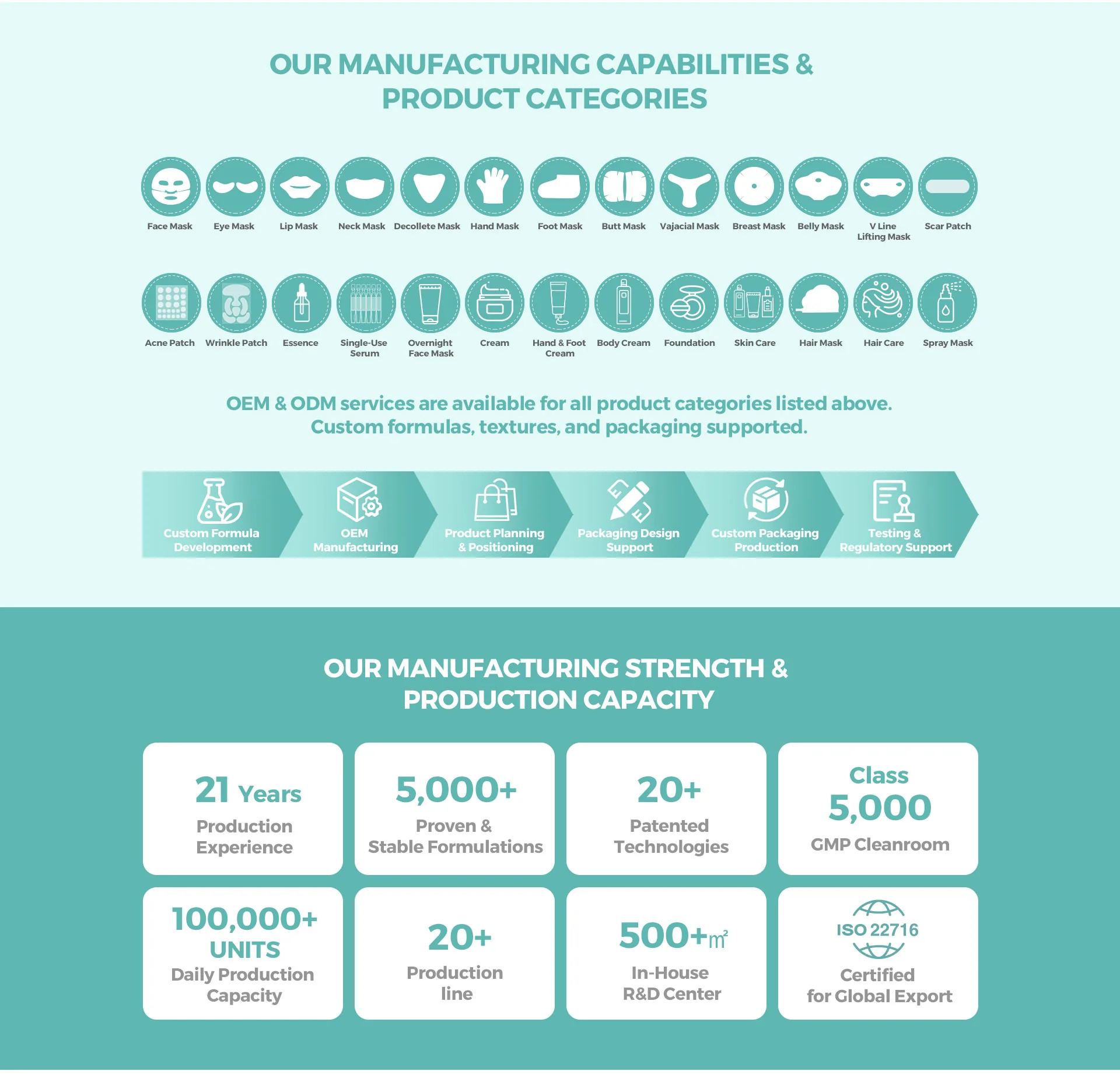
Skincraftlab is a skincare OEM/ODM contract manufacturer based in Zhongshan, Guangdong, China, operating since 2007 and serving 2,000+ brands across 30+ countries. The company offers private label face masks, serums, eye masks and more from a 5,000 m² GMP-certified factory, with standard minimum order quantities from 1,000 units — low enough for startups and e-commerce sellers to test a market. In-house R&D supports both OEM production to your formula and ODM custom formulation, with 90+ ready face mask formulas, 239 OEM/ODM products and stability testing included. Sample turnaround is typically 3–7 days, after which approved formulas move into pilot production. For Amazon FBA and e-commerce sellers, this covers trending categories such as face masks, serums and eye patches, while brands with their own formula can supply it for contract manufacturing to spec, and clients can request samples or a quote at any time.
Frequently Asked Questions
What is the FOB price per unit sheet mask OEM 5000 units China 2026 lead time?
How long is the 2026 lead time for a sheet mask OEM order of 5,000 units from China?
Which sheet mask film type gives the lowest FOB cost for a 5,000-unit order?
Do I need a separate GMPC or ISO 22716 certificate for each factory in China producing my sheet mask?
What hidden costs are NOT included in the FOB price for a sheet mask OEM order?
How do I verify a Chinese sheet mask factory's GMP certificate is valid and not counterfeit?
Related Posts
Yoni Sheet Mask OEM/ODM/Private Label Manufacturing Guide
Learn how to source yoni sheet masks through OEM/ODM/private label manufacturing. Covers product forms like Korean jelly sheet and hydrogel, MOQ of 1,000 units, 30–45 day lead times, GMP & ISO certifications, and step-by-step launch guidance.
Foot Mask Wholesale: MOQ, Pricing & OEM Guide
Foot mask wholesale buyer's guide: MOQ, FOB pricing, formulation, regulatory compliance for US/EU markets.
Foot Mask Manufacturer: How to Choose a Private Label Partner
Compare MOQs, FOB pricing, and regulatory compliance when choosing a foot mask manufacturer for your private label brand.
Related Products
.jpg)
Pads for Collagen Foil Umder Gelly Eye Patches Enjoying Hydrogel Korea Skin Care
Premium pads for collagen foil umder gelly eye patches enjoying hydrogel korea skin care — OEM/ODM available, MOQ from 1,000 units
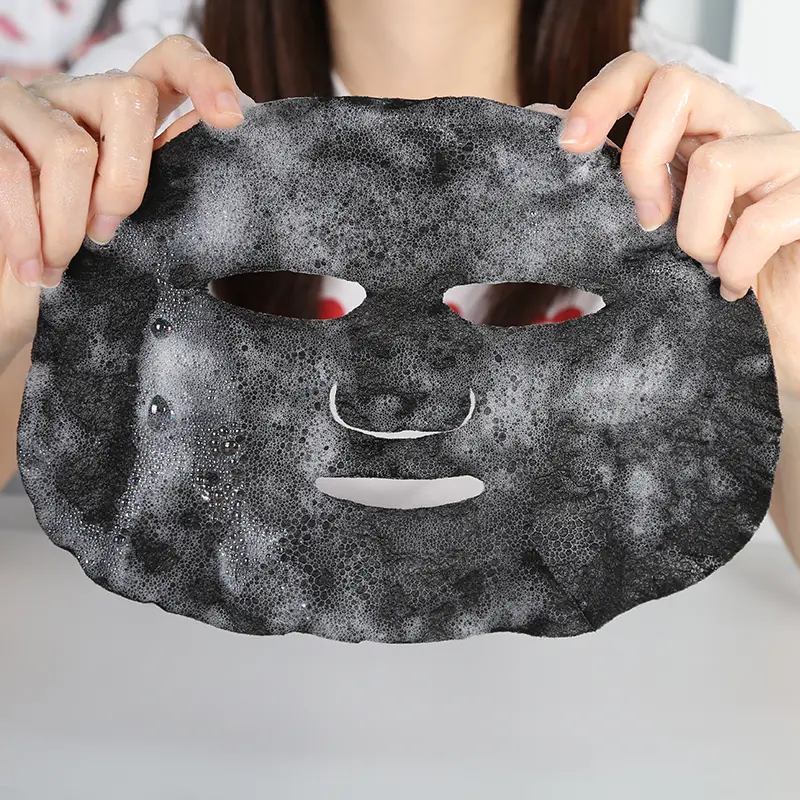
Single Use Mud Mask
Fresh, potent clay in single-dose packets—build your brand with zero waste, full customization, and travel-ready appeal.
.jpg)
24k Gold Bio-Cloud Hydrogel Face Mask
Premium hydrogel face mask with 24k gold & hyaluronic acid — OEM/ODM available, MOQ from 1,000 units
.jpg)
Eye Patch Crystal Gel Collagen Eye Mask
Premium private label eye patch crystal gel collagen eye mask white for anti dark circle hydrogel eye patches — OEM/ODM available, MOQ from 1,000 units