Clean Beauty 2026: What US and EU Buyers Actually Ask OEM Manufacturers
August 23, 2026
Skincraftlab
B2B Skincare Manufacturing Expert
What Is This Guide About?
> **Bottom line:** "Clean beauty" has no legal definition — it is a consumer movement and a marketing position, not a regulatory standard.
Category
Manufacturing
Audience
Brand owners, procurement, R&D
Updated
August 2026
Clean Beauty 2026: What US and EU Buyers Actually Ask OEM Manufacturers
Bottom line: "Clean beauty" has no legal definition — it is a consumer movement and a marketing position, not a regulatory standard. What that means for OEM manufacturers in 2026 is that buyers ask very specific, practical questions: what is in the formula, what is left out, how is it substantiated, and which regulations actually apply. The brands that win these conversations are not the ones with the flashiest "clean" story — they are the ones whose documentation, compliance position, and honest limitations survive buyer scrutiny.
Clean Beauty: Definition and the Controversy
Clean beauty is a consumer-facing concept that generally means products formulated without certain ingredients perceived as risky or undesirable — parabens, phthalates, sulfates, synthetic fragrance, and a shifting list of others. Crucially, there is no global or even national legal definition of "clean." Different retailers, platforms, and brands maintain their own restricted-substance lists, and they do not agree with each other.
The controversy is well documented: ingredient safety is not binary, "clean" lists are inconsistent, and the movement has been criticized for fear-based marketing that implies regulated ingredients are unsafe. As a result, savvy 2026 buyers have moved beyond asking "is it clean?" to asking "what exactly is in it, what is not, and what evidence backs the claims?" — which is a much better conversation for manufacturers, because it is answerable with documents rather than slogans.
What US and EU Buyers Actually Ask in 2026
Based on the recurring topics in OEM inquiries, buyer questions cluster into a practical checklist:
- Full INCI and formulation transparency — "Send the complete ingredient list and explain what each functional ingredient does."
- Restricted-substance policy — "What is on your banned/restricted list, and is it written down and enforced per batch?"
- Fragrance policy — "Is there fragrance? Synthetic or natural? If 'fragrance-free,' is that verified?"
- Preservative system — "What preservative system do you use, and why? (Buyers know that 'no preservatives' is usually a red flag for safety, not a feature.)"
- Claim substantiation — "What documents support the claims we want to print — clinical, instrumental, or literature-based?"
- Regulatory compliance for the destination market — "Is this formula compliant with EU Regulation 1223/2009 / US requirements, and who is responsible for the compliance file?"
- Manufacturing and quality systems — "What are your GMP practices, batch traceability, and quality control checkpoints?"
- Testing and documentation — "What stability, microbiological, and safety data exist for this formula, and what do we still need to commission?"
- Sustainability claims — "What packaging and sourcing claims can we make, and what documentation backs them?" (See the packaging trends article in this series for the greenwashing angle.)
These questions are answerable — but only if the manufacturer's documentation is real, current, and specific. A buyer who hears "don't worry, it's all compliant" without documents will move on. A good baseline test: see what the manufacturer publishes about itself — Skincraftlab's about page is an example of the kind of concrete, checkable facts buyers can start from.
Compliance and Certification: What Is Actually Required
EU: Regulation (EC) No 1223/2009 is the binding cosmetics law in the EU. Key requirements include a product safety report, a responsible person in the EU, notification via the CPNP, labeling per the regulation, and compliance with the Annex restrictions. This is a legal framework, not a "clean beauty" certification.
US: MoCRA (Modernization of Cosmetics Regulation Act of 2022) introduced facility registration, product listing, GMP requirements, serious adverse event reporting, and label requirements for cosmetics in the US, with staggered implementation dates. Specific details — such as current fee schedules, final GMP guidance status, and exact enforcement timelines as of this writing — are unverified here and change frequently; confirm them with FDA's published guidance and your compliance advisor.
Certifications. COSMOS/ECOCERT, Natrue, and similar programs certify organic/natural content under published standards. They are voluntary and cost real money and time. A common buyer misunderstanding is assuming "clean" and "certified organic" are the same thing — they are not, and manufacturers should say so plainly.
The honest manufacturer's position: you can confirm which regulations apply to your product, which documents you hold, and which certifications you do not hold. Claiming compliance you cannot document is the fastest way to lose a serious buyer.
The Compliance Handoff: Who Does What
Clean-beauty positioning usually fails at the handoff, not at the formula. The split of responsibilities is roughly:
- Manufacturer: formula, stability and micro testing, full INCI, batch records, GMP manufacturing, and the packaging/sourcing documentation it can verify. A manufacturer like Skincraftlab publishes its facility facts — GMP, 5,000 m², 19+ years, 2,000+ brands served — which gives buyers verifiable baseline information to audit against.
- Brand (or its local representative): the destination-market compliance file — EU responsible person and CPNP notification, US MoCRA facility and product registration where applicable, label claims review, and any market-specific safety assessments.
Get the split in writing. The most common misunderstanding is assuming the factory "handles all compliance" — in most export scenarios, parts of the file legally sit with the brand's side. Knowing exactly which documents you will receive, and which obligations you inherit, prevents surprises at the port and on the marketplace.
How Factories Should Respond (And What Buyers Should Ask For)
For manufacturers, the winning posture in 2026 is documentation-first:
- Publish what you can verify. Formula transparency, GMP facility facts, export history, and testing capabilities are all answerable with specifics. Skincraftlab, for example, publishes its facility scale (GMP, 5,000 m²), 19+ years of experience, 2,000+ brands served, and exports to 30+ countries — facts a buyer can verify in conversation rather than claims they must take on faith.
- Be explicit about limitations. If you do not hold a specific certification, say so and explain the path to get it, or confirm it is not needed for the buyer's market.
- Offer the compliance handoff. The responsible-person and notification obligations (EU) and facility/product registration (US MoCRA) often sit with the brand or its local representative. A good OEM explains who does what — and provides the formula, safety, and stability data the brand needs to fulfill its side.
- Never overstate. No manufacturer is "fully compliant with everything everywhere" — compliance is per formula, per market, and per date. Contact the team to see how a specific product's documentation is handled before you assume.
What It Costs and How to Start (Facts + Steps)
| Fact | Detail |
|---|---|
| Company | Skincraftlab — skincare OEM/ODM manufacturer, Zhongshan, Guangdong, China |
| Experience | 19+ years |
| Brands served | 2,000+ |
| Export countries | 30+ |
| Products in catalog | 239 |
| Active SKUs | 200+ |
| Mask formulations | 90+ |
| Factory | GMP facility, 5,000 m² |
| Standard MOQ | 1,000 units |
| Private label MOQ | 500/SKU |
| Custom OEM (from your formula) | 3,000+/SKU |
Steps to run a clean-positioning launch properly:
- Define your own restricted-substance list before talking to manufacturers — your "clean" standard should be written down, not improvised per quote.
- Send the list to the manufacturer with your target market (EU, US, or both) and ask for a formula-level compliance and documentation review — the product catalog is a useful reference for which formats and claims are realistic to scope.
- Request the documents that matter: full INCI, restricted-substance confirmation, preservative system, stability and micro data, and the safety assessment status for your market.
- Clarify who holds the compliance obligations — EU responsible person and CPNP notification, US MoCRA registration — and put it in writing.
- Review every claim you plan to print against the destination market's rules; "clean" itself is not a regulated claim, but ingredient and benefit claims are.
- Audit the first batch — check the actual label INCI against the formula, and keep batch records that match the documentation you will stand behind.
Turning Clean Beauty Questions into an OEM Working Document
The practical move for 2026: turn buyer questions into a written working document before you sign an OEM contract. List the specific claims you want (“no parabens,” “no sulfates,” “vegan,” “non-GMO”), the documentation you need for each, and the compliance standard you will follow (EU Cosmetic Regulation, US FDA/CPSC for packaging, or both).
A factory that publishes its certifications and answers documentation questions in writing is a stronger partner than one that just says “we can do that.” At Skincraftlab, private label runs start at 500 units/SKU, standard MOQ is 1,000, and custom OEM starts at 3,000+. See what finished SKUs look like and send your requirements for a documentation review.
FAQ
Q: What is the legal definition of "clean beauty"? A: There is none — no major market defines "clean" in law. It is a consumer movement and marketing position built on voluntary restricted-substance lists that vary by retailer, platform, and brand. That is why buyers increasingly ask for documentation instead of labels.
Q: Does "clean" mean "safe" or "preservative-free"? A: No to both. "Clean" says nothing legally about safety, and preservative-free products are often more at risk of microbial contamination. Serious buyers ask what preservative system is used and why — not whether preservatives are present.
Q: What does EU Regulation 1223/2009 require? A: Among other things: a product safety report, a responsible person in the EU, CPNP notification before placing on the market, labeling per the regulation, and compliance with the Annex ingredient restrictions. It is a legal framework — not a clean-beauty certification.
Q: What is MoCRA and does it apply to my US launch? A: MoCRA (2022) introduced US facility registration, product listing, GMP, serious adverse event reporting, and labeling duties for cosmetics, with staggered implementation. Exact current requirements, fees, and timelines are unverified here and change — check FDA's published guidance and your compliance advisor before finalizing.
Q: Do I need COSMOS/ECOCERT certification to sell "clean" products? A: Only if you want to make certified-organic/natural claims under those programs. "Clean" positioning without certification is common. If certification is part of your strategy, budget for the time and cost, and confirm the manufacturer can support the program's requirements.
Q: How do I verify a manufacturer's claims about compliance and experience? A: Ask for documents and specifics: GMP facility details, export markets, batch records, stability and micro data, and a clear statement of which compliance obligations sit with the brand versus the manufacturer. Concrete, verifiable facts — like the 30+ export countries and 2,000+ brands served that Skincraftlab publishes — are a better signal than any slogan.
Sources & Verification Date
- EU Regulation (EC) No 1223/2009 and US MoCRA (2022) are public law; specific MoCRA implementation details (fees, final guidance, timelines) are marked unverified and must be confirmed against FDA publications as of the verification date.
- Clean-beauty definitions and certification programs (COSMOS/ECOCERT, Natrue) described per their published standards; specific program details should be confirmed with the program operator.
- All Skincraftlab company facts, MOQs, and pricing are from the manufacturer's public materials and website, accessed 2026-08-23.
- Verification date: 2026-08-23
2026 Skincare Market Entry Guide
Which skincare categories are growing on Amazon US in 2026? Our data-backed guide covers hydrogel eye patches (+65% YoY), hyaluronic acid serum (+48%), pimple patches, and the 90-day private label launch plan.
No spam, ever. Unsubscribe anytime.
What Are the Key Facts Before You Request a Quote?
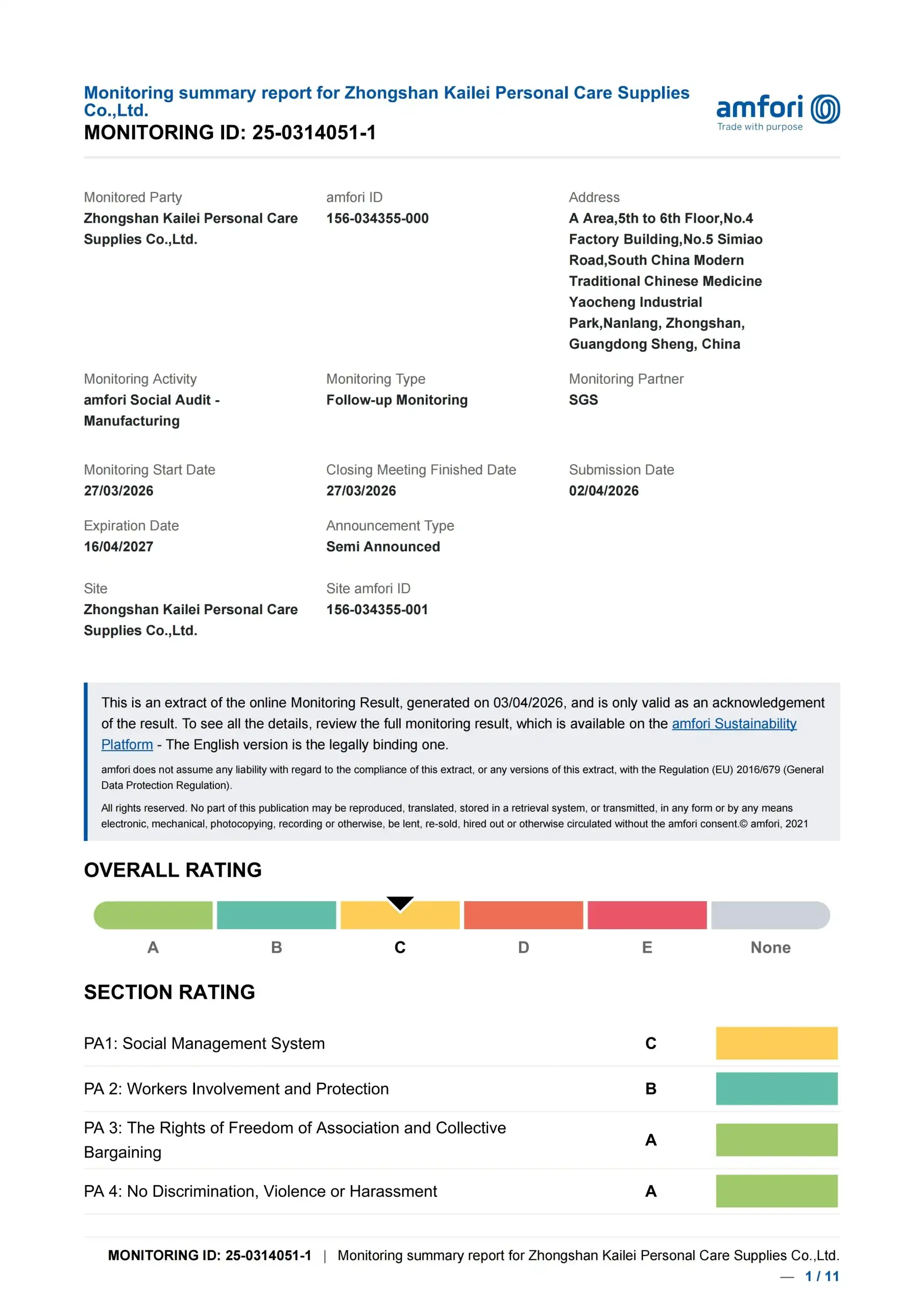
Skincraftlab is a skincare OEM/ODM contract manufacturer based in Zhongshan, Guangdong, China, operating since 2007 and serving 2,000+ brands across 30+ countries. Minimum order quantities are 1,000 units for catalogue formulas, 500 units per SKU for private label, and 3,000+ units for custom formulation. Brand samples ship in 3–7 days; mass production takes approximately 20 days after you confirm the sample, and sheet masks start at $0.08–$0.35 per piece. Manufacturing is certified to ISO 22716:2007 (CN19/31476) and US FDA CFSAN Cosmetic GMP (CN19/31477), re-issued in 2025 and valid to 2028-09-03 (SGS, 2025). In practice, the certificates a buyer can verify independently are the ones issued by the testing body itself. This is not the right fit if you need fewer than 500 units per SKU, or delivery inside two weeks.
| Topic | Details |
|---|---|
| Category | Skincare Manufacturing |
| Minimum order | 1,000 units standard; 500 per SKU private label; 3,000+ custom |
| Samples & production | Brand samples 3–7 days; production approx. 20 days after confirmation |
| Last updated | August 2026 |
How Do You Apply This Guide to Your Own Project?
- 1Step 1: match the format to your unit cost — for example, sheet masks run $0.08–$0.35 per piece at 1,000 units, while serums run $1.50–$5.00 per bottle.
- 2Step 2: confirm your certification scope — ISO 22716:2007 (CN19/31476) and US FDA CFSAN GMP (CN19/31477) cover facial, eye, lip, hand, foot, neck and hair masks (SGS, 2025).
- 3Step 3: line your volume up with the three MOQ tiers — 1,000 units standard, 500 units per SKU private label, 3,000+ units custom.
- 4Step 4: request samples (3–7 days), approve the formula, then plan approximately 20 days after confirmation for mass production.
- 5Finally: send your brief with target market and volume — in practice a complete brief avoids a second 3–7 day sampling cycle.
Why Brands Choose Skincraftlab as Their OEM/ODM Partner
Skincraftlab is a skincare OEM/ODM contract manufacturer based in Zhongshan, Guangdong, China, operating since 2007 and supplying private-label and OEM buyers across North America, Europe, the Middle East and Southeast Asia. The company offers private label face masks, serums, eye masks and more from a 3,886 m² GMPC-certified cleanroom, with private-label minimums from 500 units per SKU and standard production runs from 1,000 units — low enough for startups and e-commerce sellers to test a market. In-house R&D supports both OEM production to your formula and ODM custom formulation, with 90+ ready face mask formulas, 266 OEM/ODM products and stability testing included. Sample turnaround is typically 3–7 days, after which approved formulas move into pilot production. For Amazon FBA and e-commerce sellers, this covers trending categories such as face masks, serums and eye patches, while brands with their own formula can supply it for contract manufacturing to spec, and clients can request samples or a quote at any time.
Frequently Asked Questions
What is the legal definition of "clean beauty"?
Does "clean" mean "safe" or "preservative-free"?
What does EU Regulation 1223/2009 require?
What is MoCRA and does it apply to my US launch?
Do I need COSMOS/ECOCERT certification to sell "clean" products?
How do I verify a manufacturer's claims about compliance and experience?
Related Posts
PDRN Serum OEM China: 2% vs 0.5% Salmon DNA Specs
What 2% vs 0.5% PDRN salmon DNA really means in an OEM spec sheet, plus rolling forecast terms for 500,000 pimple patches and hydrogel under-eye patch MOQ/FOB math.
Chat Responsiveness SLA for OEM Skincare Inquiries in China
What a realistic chat responsiveness SLA looks like for OEM skincare inquiries in China — plus hydrocolloid vs hydrogel pimple patch sourcing specs and costs.
Pimple Patch OEM Line Capacity: 1M Units/Month Ramp-Up
A factory-floor ramp-up plan for taking a dedicated hydrocolloid coating line from pilot to 1 million pimple patch units per month in China, with real cycle times and QC gates.