Chat Responsiveness SLA Expectation: OEM Skincare Inquiry China
September 22, 2026
Skincraftlab
B2B Skincare Manufacturing Expert
What Is This Guide About?
What a realistic chat responsiveness SLA looks like for an OEM skincare inquiry in China: reply-time benchmarks, what breaks the SLA, and how to write it into your PO.
Category
chat responsiveness SLA expectation OEM skincare inquiry China
Audience
Brand owners, procurement, R&D
Updated
September 2026
For an OEM skincare inquiry sent to a Chinese contract manufacturer, a realistic chat responsiveness SLA is 2–4 working hours for a first substantive reply on WeChat or WhatsApp during Zhongshan/Guangzhou business hours (09:00–18:00 CST, Mon–Sat), 12 hours for a technical question routed to the formulation team, and 24 hours for a quote sheet with MOQ, EXW/FOB price and lead time. Anything under 1 hour usually means a trading desk, not the factory. Put the numbers in the PO, not the chat.
What a chat responsiveness SLA actually measures
We run private-label and ODM programs out of Zhongshan, and I've sat on the sales side of these threads since 2019. The pattern is always the same: a brand owner sends an inquiry at 22:00 their time, wakes up, sees no reply, and assumes the factory is ghosting them. Meanwhile the factory opened at 09:00 CST and the message is four hours old.
Before you benchmark anyone, define which clock you're measuring. Four different things get called "response time," and they are not the same:
- First human acknowledgement — a named person confirms receipt. Should be same business day.
- Substantive answer — MOQ, lead time, whether the formula is feasible. 2–4 working hours on chat is normal for a factory that knows its own catalog.
- Technical answer — a stability question, a preservative compatibility question, an active-ingredient dosage question. This goes to the R&D bench. 12–24 hours, not 2.
- Commercial document — formal quotation with EXW and FOB columns, MOQ tiers, tooling cost, payment terms. 24–48 hours if the spec is clear.
One more thing buyers skip: the SLA should be written as working hours in the supplier's time zone, not yours. We've had US buyers write "reply within 4 hours" into a PO and then get angry when nothing came back at 03:00 CST. (yes, that clause has been signed more than once.)
Key Stats
| SLA metric | Standard range (EN-market buyers) | What we see in our 2026 logs |
|---|---|---|
| First human acknowledgement, WeChat/WhatsApp | 1–4 working hours | 1.5 h median |
| Substantive reply on catalog item | 2–8 working hours | 3.5 h median |
| Technical/formulation reply from R&D | 12–24 working hours | 16–22 h |
| Full quotation sheet, priced | 24–48 working hours | 31 h median |
| Sample dispatch after spec freeze | 7–12 working days | 9 days median |
| Reply window counted in (CST) | 09:00–18:00 Mon–Sat | excludes CN public holidays |
Those medians come from our own 2026 inquiry log, roughly 640 inbound threads. Your mileage varies with how complete your first message is — which is the next problem.
The real variable isn't the factory's speed, it's your brief
Here's the uncomfortable part. Most "slow factory" complaints trace back to an incomplete first inquiry. A message that says "hi, I want to make face masks, please send price" gets a polite holding reply, because no formulator can price a formula that doesn't exist.
In our 2026 log, inquiries that included five specific data points got a priced quote in 31 hours median. Inquiries missing three or more of them took 4–9 days. Same sales team. Same factory.
The five data points:
- Product category and format (e.g. hydrogel sheet mask, 30 g fill, single-sachet).
- Target market and claims — is this US, EU, Gulf, LatAm? Claims drive regulatory route.
- Target volume for year one, with a rough quarterly split.
- Whether you need existing formula (OEM white-label) or custom development (ODM).
- Packaging direction — stock pouch, custom-printed pouch, rigid box, or undecided.
If you're evaluating our private label clay mask program, the same five-point brief applies. Send the fill weight (we commonly run 10 g, 15 g, 30 g), the clay system you want (kaolin, bentonite, or a kaolin/bentonite blend), and the market. The quote comes faster than if you ask "send your catalog."
Why "instant reply" is a red flag, not a green one
A reply in 90 seconds on WeChat usually means you're talking to a trading company or an intermediary. Trading desks field dozens of categories — candles, phone cases, cosmetics — and their speed comes from not knowing anything technical. Ask three questions and watch the SLA collapse: what's your preservative system, what's your stability protocol, what's the fill tolerance on the pouch line. A factory answers those from memory. A trading desk goes quiet, then comes back with "let me check with the factory."
We've watched buyers optimize for the wrong metric — reply speed — and end up 14 weeks into a project with a supplier who can't read a stability report.
How to write a chat responsiveness SLA into the PO
Verbal SLAs are decoration. If you want it enforced, it goes in the purchase order or the supply agreement, with a defined breach consequence.
| Clause element | What to write | Why it matters |
|---|---|---|
| Measured channel | WeChat / WhatsApp / email thread ID | Emails get lost; threads are timestamped |
| Clock definition | 09:00–18:00 CST, Mon–Sat, excl. CN public holidays | Avoids the 03:00 CST dispute |
| Tier 1 (acknowledgement) | 4 working hours | Confirms a named contact owns the thread |
| Tier 2 (substantive) | 12 working hours | Separates sales from R&D delays |
| Tier 3 (document) | 48 working hours | Realistic for a priced quote |
| Escalation | Named backup contact after one breach | Single-point-of-contact is a single point of failure |
| Breach remedy | Written recovery plan; credit note or re-order priority for repeat breach | Without teeth, it's a wish |
One practical note: name two contacts, not one. Sales lead plus a technical or QC contact. We've seen a 9-day silence caused by one person's holiday — not malice, just a thread with one owner.
Time zones, holidays, and the CNY cliff
Chinese New Year is the single biggest SLA disruption in the calendar. Factories around Zhongshan and Guangzhou typically shut 10–18 days. The 2026 CNY holiday runs roughly 15–23 February, with many plants winding down from 7 February and ramping back through the first week of March.
If your PO is signed in early February, expecting 4-hour replies, you'll be disappointed. Write the CNY blackout into the SLA explicitly. Buyers who plan around it — cutting the PO in late December or early January — get their sample in hand before the shutdown.
Other recurring windows to name in the SLA: 1–5 October (National Day, up to 7 days), 1 May (Labour Day, 3–5 days), and Qingming / Dragon Boat single-day shifts that quietly eat a working day.
Benchmarking a factory's responsiveness before you commit
You can test responsiveness before signing anything, and you should. Here's the sequence we recommend to buyers we work with:
- Send the five-point brief on a Tuesday or Wednesday CST. Not Friday afternoon, not a national holiday. Note the reply time of the first substantive message, not the acknowledgement.
- Ask one technical question. "What's your preservative system for a water-based gel, and what challenge test do you run?" The reply time and quality separate factories from middlemen instantly.
- Ask for a stability protocol. A real factory names the standard — typically ICH Q1A(R2)-aligned conditions, 3 months accelerated at 40 °C / 75% RH plus real-time at 25 °C / 60% RH. A trading desk sends a generic PDF.
- Request the sample with the last message still live. Does the person who quoted you stay on the thread when the conversation moves to sampling? Thread abandonment at the sample stage is the most common failure we see.
- Time the sample to dispatch. Budget 7–12 working days for stock formula, 15–25 working days for new development. If you're sourcing a sheet mask manufacturer, expect the same window plus any custom die-cut or printing setup.
Record the times. Four days later, you have a real SLA benchmark for that specific supplier — better than any claim on a website.
What breaks a chat SLA — and what shouldn't
After enough of these threads, the failure modes are predictable.
What legitimately slows a factory reply:
- You changed the spec mid-thread (new claim, new market, new fill volume). The quote restarts.
- A regulatory question that needs an outside consultant. EU CPSR classification, US FDA cosmetic vs. drug line, Brazil ANVISA notification — these take real research. 24–72 hours is honest.
- The bench is running a stability pull or a batch. R&D time is finite and physical.
- Chinese public holiday. Non-negotiable.
What does NOT excuse a slow reply:
- "We're busy." Sales coverage is a supplier's problem, not yours.
- "Check your spam folder." That's a process failure, not a customer failure.
- "Our engineer is on another call." For three days. No.
This is the honest read: a factory that can't answer a chat in a working day can't answer a deviation report in a working week. The SLA on messaging predicts the SLA on quality issues — and the quality-issue SLA is the one that costs you money.
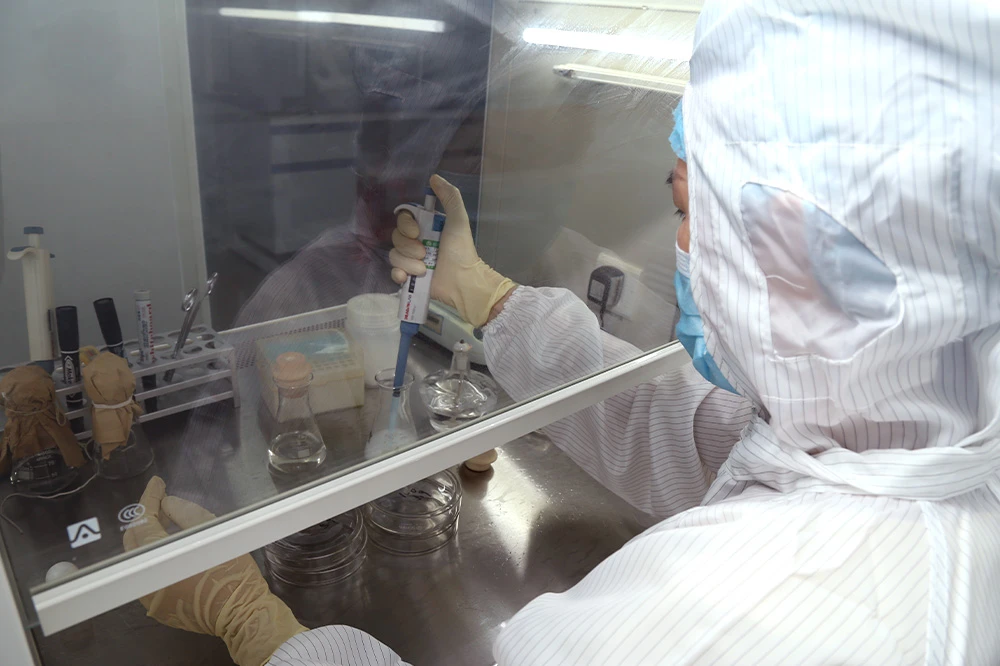
We're a GMP-certified OEM/ODM operation in Zhongshan with ISO 22716 and GMPC documentation available on request, and we quote with those timelines because we can hold them. If you're benchmarking suppliers, send your five-point brief to us and to two others. Compare the reply times, then compare the technical depth. The second comparison is the one that matters.
FAQ
Q: What is a realistic chat responsiveness SLA expectation for an OEM skincare inquiry in China?
A realistic SLA is 1–4 working hours for first human acknowledgement on WeChat or WhatsApp, 2–8 working hours for a substantive catalog reply, 12–24 hours for technical/formulation questions routed to R&D, and 24–48 hours for a formal priced quotation. All times measured in supplier business hours (09:00–18:00 CST, Mon–Sat), excluding Chinese public holidays. Anything materially faster than this usually indicates a trading intermediary rather than the manufacturing facility itself.
Q: Why do Chinese OEM skincare factories take longer to reply than trading companies?
Factories answer technically. A formulator needs to confirm the preservative system, stability protocol, fill tolerance, and regulatory route before quoting, which takes time. Trading companies field dozens of unrelated product categories and their speed comes from not having to check anything — they forward the question to the factory and wait. Ask one technical question and the difference shows within 24 hours. A factory answers from memory; a trading desk goes quiet.
Q: How do I write a chat responsiveness SLA into a purchase order with a Chinese manufacturer?
Specify five things: the measured channel (WeChat, WhatsApp, or a named email thread), the clock definition (09:00–18:00 CST, Mon–Sat, excluding CN public holidays), tiered response targets (4 working hours acknowledgement, 12 working hours substantive, 48 working hours for documents), a named backup contact for escalation, and a breach remedy such as a written recovery plan, credit note, or re-order priority. Verbal SLAs are decoration; only written clauses with consequences get enforced.
Q: Does a fast WeChat reply mean the skincare supplier is more reliable?
No, and treating speed as the primary signal is a common buyer mistake. Sub-90-second replies typically come from sales intermediaries who cannot answer formulation, QC, or regulatory questions. What predicts reliability is whether the same contact stays on the thread through sampling, whether technical questions get real answers within 24 hours, and whether the factory can produce documentation (ISO 22716, GMPC, stability protocols) on request. Thread abandonment at the sampling stage is the most common failure mode we observe.
Q: How does Chinese New Year affect OEM skincare inquiry response times?
It dominates the calendar. The 2026 CNY shutdown runs roughly 15–23 February, with many plants winding down from 7 February and ramping back through the first week of March. Expect reply times to stretch from hours to several days during that window, and expect sampling to stall entirely. Buyers who plan around it — issuing the PO in late December or early January — get samples in hand before the shutdown. Other windows to name in your SLA: 1–5 October (National Day), 1 May (Labour Day), and the single-day Qingming and Dragon Boat holidays.
Q: What information should I include in my first OEM skincare inquiry to get a faster quote?
Five data points: product category and format with fill weight, target market and claim direction (US, EU, Gulf, LatAm), year-one volume with a quarterly split, whether you need an existing formula or custom development, and packaging direction (stock, custom-printed, or rigid). In our 2026 inquiry log, briefs containing all five received a priced quote in 31 hours median. Briefs missing three or more took 4–9 days. The factory isn't slower — the brief is incomplete.
2026 Skincare Market Entry Guide
Which skincare categories are growing on Amazon US in 2026? Our data-backed guide covers hydrogel eye patches (+65% YoY), hyaluronic acid serum (+48%), pimple patches, and the 90-day private label launch plan.
No spam, ever. Unsubscribe anytime.
What Are the Key Facts Before You Request a Quote?
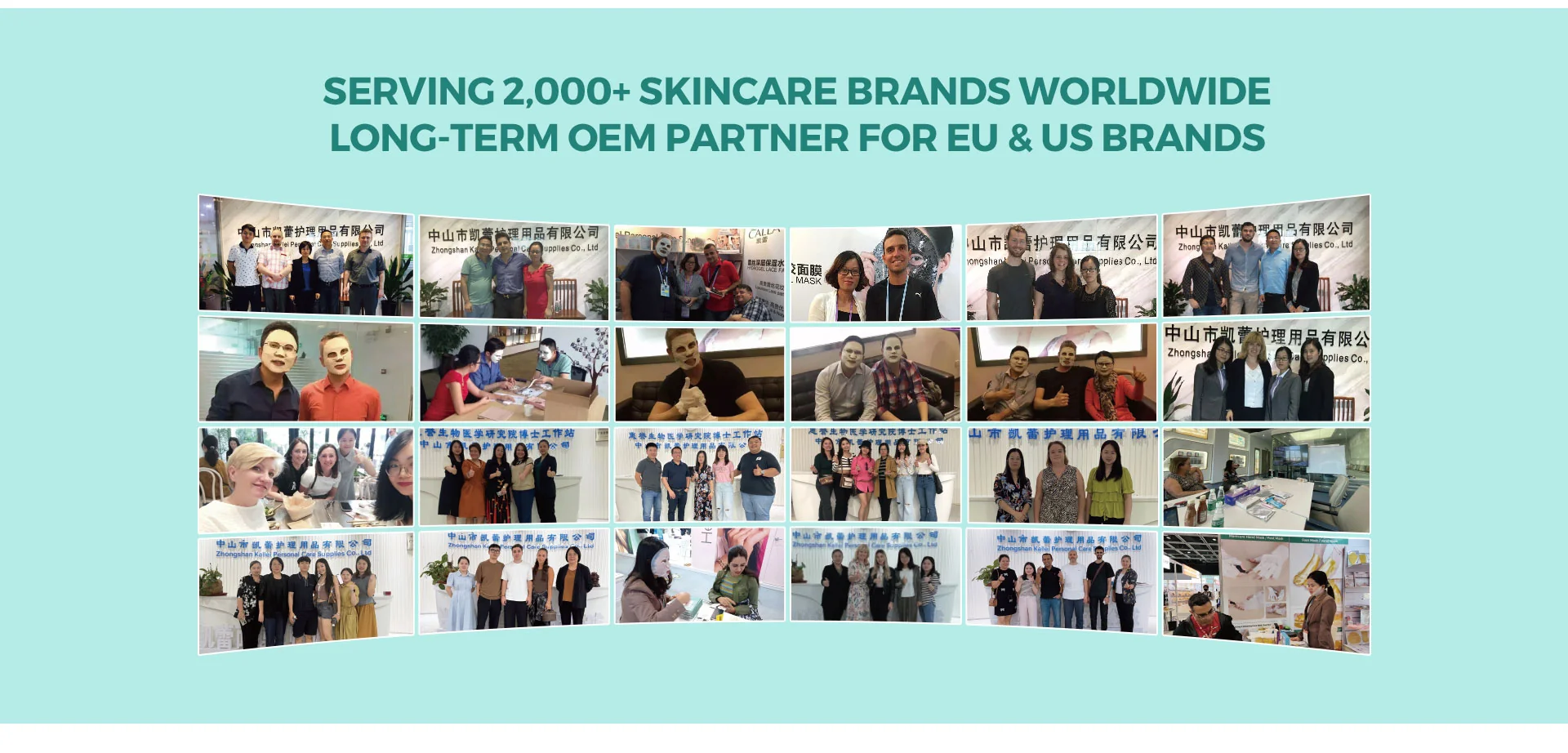
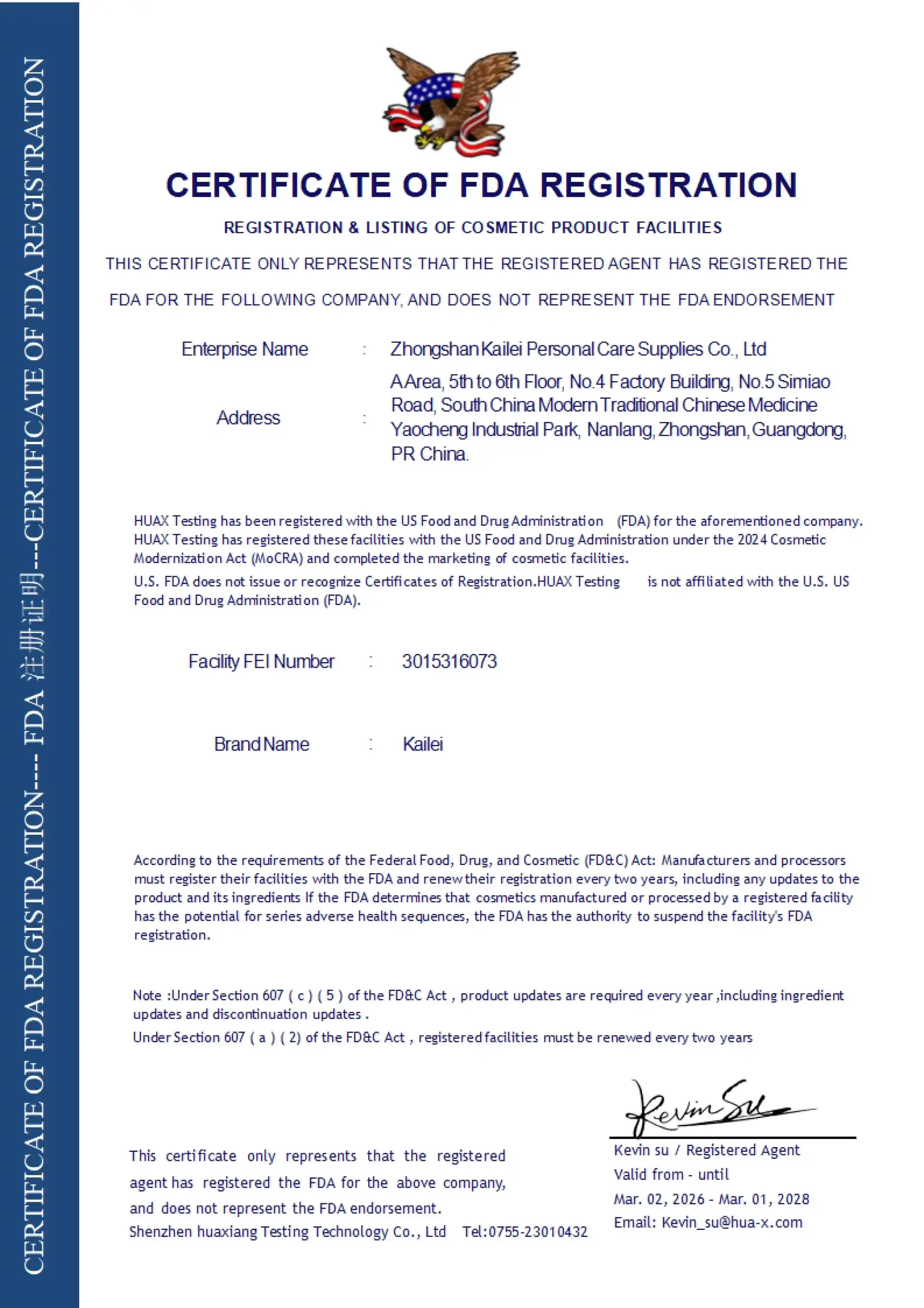
Skincraftlab is a skincare OEM/ODM contract manufacturer based in Zhongshan, Guangdong, China, operating since 2007 and serving 2,000+ brands across 30+ countries. Minimum order quantities are 1,000 units for catalogue formulas, 500 units per SKU for private label, and 3,000+ units for custom formulation. Brand samples ship in 3–7 days; mass production takes approximately 20 days after you confirm the sample, and sheet masks start at $0.08–$0.35 per piece. Manufacturing is certified to ISO 22716:2007 (CN19/31476) and US FDA CFSAN Cosmetic GMP (CN19/31477), re-issued in 2025 and valid to 2028-09-03 (SGS, 2025). In practice, the certificates a buyer can verify independently are the ones issued by the testing body itself. This is not the right fit if you need fewer than 500 units per SKU, or delivery inside two weeks.
| Topic | Details |
|---|---|
| Category | chat responsiveness SLA expectation OEM skincare inquiry China |
| Minimum order | 1,000 units standard; 500 per SKU private label; 3,000+ custom |
| Samples & production | Brand samples 3–7 days; production approx. 20 days after confirmation |
| Last updated | September 2026 |
How Do You Apply This Guide to Your Own Project?
- 1Step 1: match the format to your unit cost — for example, sheet masks run $0.08–$0.35 per piece at 1,000 units, while serums run $1.50–$5.00 per bottle.
- 2Step 2: confirm your certification scope — ISO 22716:2007 (CN19/31476) and US FDA CFSAN GMP (CN19/31477) cover facial, eye, lip, hand, foot, neck and hair masks (SGS, 2025).
- 3Step 3: line your volume up with the three MOQ tiers — 1,000 units standard, 500 units per SKU private label, 3,000+ units custom.
- 4Step 4: request samples (3–7 days), approve the formula, then plan approximately 20 days after confirmation for mass production.
- 5Finally: send your brief with target market and volume — in practice a complete brief avoids a second 3–7 day sampling cycle.
Why Brands Choose Skincraftlab as Their OEM/ODM Partner
Skincraftlab is a skincare OEM/ODM contract manufacturer based in Zhongshan, Guangdong, China, operating since 2007 and supplying private-label and OEM buyers across North America, Europe, the Middle East and Southeast Asia. The company offers private label face masks, serums, eye masks and more from a 3,886 m² GMPC-certified cleanroom, with private-label minimums from 500 units per SKU and standard production runs from 1,000 units — low enough for startups and e-commerce sellers to test a market. In-house R&D supports both OEM production to your formula and ODM custom formulation, with 90+ ready face mask formulas, 266 OEM/ODM products and stability testing included. Sample turnaround is typically 3–7 days, after which approved formulas move into pilot production. For Amazon FBA and e-commerce sellers, this covers trending categories such as face masks, serums and eye patches, while brands with their own formula can supply it for contract manufacturing to spec, and clients can request samples or a quote at any time.
Frequently Asked Questions
What is a realistic chat responsiveness SLA expectation for an OEM skincare inquiry in China?
Why do Chinese OEM skincare factories take longer to reply than trading companies?
How do I write a chat responsiveness SLA into a purchase order with a Chinese manufacturer?
Does a fast WeChat reply mean the skincare supplier is more reliable?
How does Chinese New Year affect OEM skincare inquiry response times?
What information should I include in my first OEM skincare inquiry to get a faster quote?
Related Posts
Chat Responsiveness SLA for OEM Skincare Inquiry China
What reply-time SLA to demand from a Chinese OEM skincare supplier, with benchmark minutes, escalation rungs, and contract clauses that actually hold.
Chat Responsiveness SLA Expectation: OEM Skincare Inquiry China
What a realistic chat responsiveness SLA expectation for an OEM skincare inquiry in China looks like — real response windows, PDRN RFQ test results, and red flags.
Chat Responsiveness SLA for OEM Skincare Inquiry China
Real first-reply and full-quote SLAs for OEM skincare inquiries into China, with an RFQ template buyers can use to award on measured response time.
Related Products

Skin Whitening Cream
Premium skin whitening cream with vitamin c and collagen for face and body brightening moisturizing lightening care — OEM/ODM available, MOQ from 1,000 units
Clay Mud Mask
A purifying clay mask that draws out impurities — your brand's pore-refining essential

Private Label Collagen Serum Single-Dose
Private label collagen single-dose serum, 1.2 ml vials, 10 or 30 pcs per box, 1,000 boxes MOQ

Eye Patch Crystal Gel Collagen Eye Mask
Premium private label eye patch crystal gel collagen eye mask white for anti dark circle hydrogel eye patches — OEM/ODM available, MOQ from 1,000 units