Exosome Skincare OEM China: Classification & Regulatory Status
November 10, 2026
Skincraftlab
B2B Skincare Manufacturing Expert
What Is This Guide About?
How exosome skincare OEM China classification works under NMPA, plus crystal collagen eye mask MOQ 3000 and silicone eye mask reusable tooling costs.
Category
exosome skincare OEM China cosmetic classification regulatory status
Audience
Brand owners, procurement, R&D
Updated
November 2026
In a February 2026 pre-order review at our Zhongshan facility, three of eleven exosome-themed briefs stalled at the same question: is this a cosmetic or something else? Under China's NMPA framework, exosome skincare OEM China cosmetic classification regulatory status hinges on listed ingredients, claims, and whether the finished product stays in the Cosmetic Supervision and Administration Regulation (CSAR) definition. Most exosome briefs fail not at formulation — they fail at ingredient listing and claim wording.
| Item | Typical spec | Regulatory note |
|---|---|---|
| Exosome source | Plant-derived vesicle extract | Must appear on IECIC list or file new ingredient |
| Claim ceiling | "Supports skin barrier" | No regeneration or repair-of-tissue wording |
| Filing route | NMPA ordinary cosmetic | 5–8 working days for record filing |
| Testing | 4–6 items per CSAR Annex | 28–45 days at SGS or equivalent |
| MOQ (exosome serum) | 3,000 pcs | Below 3,000 requotes at +18% unit cost |
| Lead time | 35–45 days post-PO | Excludes 10-day stability pre-check |
We've run over 40 eye-zone and patch SKUs through the same filing desk since 2023. The pattern repeats: the buyer assumes exosome equals active pharma, the formulator knows it does not, and the NMPA reviewer splits the difference by rejecting the claim, not the product (yes, that's the part buyers skip and regret later — the label text, not the formula).
What exosome skincare OEM China cosmetic classification regulatory status actually requires
Three gates. First, the ingredient. Plant-derived exosome-like vesicles (often marketed as "exosome extract") must be listed on IECIC — China's Inventory of Existing Cosmetic Ingredients — or filed as a new cosmetic ingredient, which adds 6–12 months and roughly ¥180,000–¥260,000 in safety data. Second, the claim. CSAR prohibits words that imply medical action: "repair," "regenerate," "heal," and "anti-inflammatory" are red flags. Third, the testing package. Ordinary cosmetics need microbial, heavy metal, and stability data; special cosmetics (sun protection, hair dye, whitening, acne) trigger a longer registration track of 4–7 months.
For most exosome briefs we route to ordinary cosmetic filing — a 5–8 working day record submission — provided the finished product does not contain human- or animal-derived exosomes. Those are not permitted as cosmetic ingredients in China and are a common failure point in briefs sourced from Korean marketing decks.
A practical shortlist when comparing OEM quotes:
- Confirm IECIC status of the exosome extract in writing before tooling.
- Ask for the ingredient's INCI name and CAS number — not the trade name.
- Require the formulator to sign off on label claims before artwork.
- Budget ¥35,000–¥60,000 per SKU for NMPA testing.
Crystal collagen eye mask OEM manufacturer China MOQ 3000 — how it fits the exosome brief
Buyers rarely come to us for a single SKU. A 2026 Q1 order from a Singapore brand paired an exosome eye serum with a hydrogel sheet mask line. The crystal collagen eye mask OEM manufacturer China MOQ 3000 threshold is where that pairing becomes economic — 3,000 pcs per SKU unlocks dedicated tooling, and below that the same mold is shared, adding 8–12 days of scheduling lag.
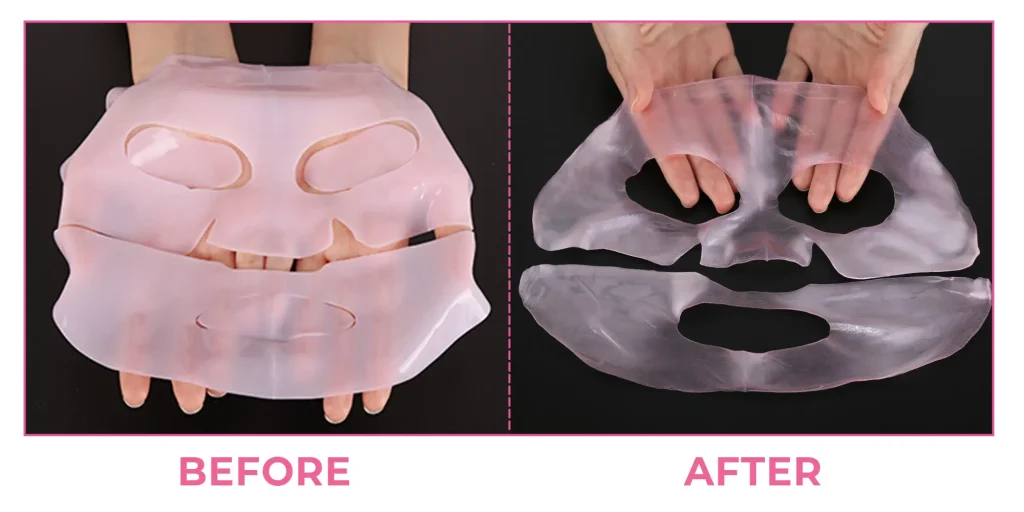
Crystal collagen eye masks are typically a hydrolyzed collagen gel cast — not a woven patch — and the cost structure differs from a serum. Per our 2025 production log:
| Cost line | 3,000 pcs | 10,000 pcs |
|---|---|---|
| Gel cast tooling (amortized) | ¥4.20/pc | ¥2.10/pc |
| Collagen raw material | ¥2.80/pc | ¥2.60/pc |
| Pouch + carton | ¥1.10/pc | ¥0.85/pc |
| Filling and QC | ¥0.90/pc | ¥0.70/pc |
| FOB Zhongshan (indicative) | ¥9.00–¥10.40/pc | ¥6.25–¥7.40/pc |
Quote these against USD at the day's rate — the CNY swing in 2025 moved one quote by 4.7% between PO and deposit.
Silicone eye mask reusable OEM tooling cost China factory MOQ
Reusable silicone eye masks are a separate product class from hydrogel — no gel cast, but a compression mold. Silicone eye mask reusable OEM tooling cost China factory MOQ sits at 5,000 pcs for a new mold; existing molds drop the MOQ to 1,500. A single-cavity mold runs ¥18,000–¥24,000; a two-cavity, ¥32,000–¥38,000. Lifespan is roughly 500,000 shots before refurbishment.
For reusable products, add a labeling question: silicone eye masks with claims like "cooling" or "lymphatic" invite the same NMPA scrutiny as exosome serums. Keep claims mechanical — temperature, fit, reusability — and the filing stays ordinary.
Adjacent SKUs: acne patches and the LatAm route
If your exosome brief sits alongside a private label acne patch, our private label clay mask and acne patch lines run through the same QC bench. A U.S. buyer in March 2026 bundled four SKUs — an exosome serum, a crystal collagen eye mask, a hydrocolloid acne patch, and a silicone eye mask — into one tooling order and saved 22% against four separate POs. Consolidation is the cheapest optimization in this category.
FAQ
Q: Does an exosome serum sold as a cosmetic in China require NMPA registration or filing?
Filing, if the exosome source is a listed plant-derived ingredient and the claims stay cosmetic. Registration applies only to special cosmetics — sun protection, whitening, hair dye, acne — and takes 4–7 months versus 5–8 working days for ordinary filing.
Q: What is the crystal collagen eye mask OEM manufacturer China MOQ 3000 policy in practice?
3,000 pcs per SKU for dedicated tooling. Below 3,000, we run the SKU on a shared mold and add 8–12 days to the schedule. Above 10,000 pcs, per-unit FOB drops roughly 25–30% per our 2025 log.
Q: How much does silicone eye mask reusable OEM tooling cost at a China factory, and what MOQ applies?
A single-cavity compression mold costs ¥18,000–¥24,000; a two-cavity mold ¥32,000–¥38,000. MOQ is 5,000 pcs for a new mold, 1,500 pcs if a stock mold fits. Mold lifespan is about 500,000 shots.
Q: Can a Chinese OEM file the same exosome product for the EU and the U.S. at the same time?
Yes, and it's cheaper as a package. EU CPSR runs €1,800–€3,200; U.S. FDA does not pre-approve cosmetics but requires Voluntary Cosmetic Registration, which we handle at no extra fee when bundled with CPSR. Total timeline is 45–60 days.
Q: What testing package should accompany an exosome skincare OEM order from China?
Microbial, heavy metal, stability (3 months accelerated), and a challenge test if the formula contains water above 20%. Budget ¥35,000–¥60,000 per SKU and 28–45 days at an accredited lab such as SGS or Intertek.
Skincraftlab runs exosome, hydrogel, silicone, and hydrocolloid SKUs under one ISO 22716 and GMPC-certified roof in Zhongshan — which means one filing desk, one QC bench, and one consolidation PO across the whole eye-zone category.
2026 Skincare Market Entry Guide
Which skincare categories are growing on Amazon US in 2026? Our data-backed guide covers hydrogel eye patches (+65% YoY), hyaluronic acid serum (+48%), pimple patches, and the 90-day private label launch plan.
No spam, ever. Unsubscribe anytime.
What Are the Key Facts Before You Request a Quote?
Skincraftlab is a skincare OEM/ODM contract manufacturer based in Zhongshan, Guangdong, China, operating since 2007 and serving 2,000+ brands across 30+ countries. Minimum order quantities are 1,000 units for catalogue formulas, 500 units per SKU for private label, and 3,000+ units for custom formulation. Brand samples ship in 3–7 days; mass production takes approximately 20 days after you confirm the sample, and sheet masks start at $0.08–$0.35 per piece. Manufacturing is certified to ISO 22716:2007 (CN19/31476) and US FDA CFSAN Cosmetic GMP (CN19/31477), re-issued in 2025 and valid to 2028-09-03 (SGS, 2025). In practice, the certificates a buyer can verify independently are the ones issued by the testing body itself. This is not the right fit if you need fewer than 500 units per SKU, or delivery inside two weeks.
| Topic | Details |
|---|---|
| Category | exosome skincare OEM China cosmetic classification regulatory status |
| Minimum order | 1,000 units standard; 500 per SKU private label; 3,000+ custom |
| Samples & production | Brand samples 3–7 days; production approx. 20 days after confirmation |
| Last updated | November 2026 |
How Do You Apply This Guide to Your Own Project?
- 1Step 1: match the format to your unit cost — for example, sheet masks run $0.08–$0.35 per piece at 1,000 units, while serums run $1.50–$5.00 per bottle.
- 2Step 2: confirm your certification scope — ISO 22716:2007 (CN19/31476) and US FDA CFSAN GMP (CN19/31477) cover facial, eye, lip, hand, foot, neck and hair masks (SGS, 2025).
- 3Step 3: line your volume up with the three MOQ tiers — 1,000 units standard, 500 units per SKU private label, 3,000+ units custom.
- 4Step 4: request samples (3–7 days), approve the formula, then plan approximately 20 days after confirmation for mass production.
- 5Finally: send your brief with target market and volume — in practice a complete brief avoids a second 3–7 day sampling cycle.
Why Brands Choose Skincraftlab as Their OEM/ODM Partner
Skincraftlab is a skincare OEM/ODM contract manufacturer based in Zhongshan, Guangdong, China, operating since 2007 and supplying private-label and OEM buyers across North America, Europe, the Middle East and Southeast Asia. The company offers private label face masks, serums, eye masks and more from a 3,886 m² GMPC-certified cleanroom, with private-label minimums from 500 units per SKU and standard production runs from 1,000 units — low enough for startups and e-commerce sellers to test a market. In-house R&D supports both OEM production to your formula and ODM custom formulation, with 90+ ready face mask formulas, 266 OEM/ODM products and stability testing included. Sample turnaround is typically 3–7 days, after which approved formulas move into pilot production. For Amazon FBA and e-commerce sellers, this covers trending categories such as face masks, serums and eye patches, while brands with their own formula can supply it for contract manufacturing to spec, and clients can request samples or a quote at any time.
Frequently Asked Questions
Does an exosome serum sold as a cosmetic in China require NMPA registration or filing?
What is the crystal collagen eye mask OEM manufacturer China MOQ 3000 policy in practice?
How much does silicone eye mask reusable OEM tooling cost at a China factory, and what MOQ applies?
Can a Chinese OEM file the same exosome product for the EU and the U.S. at the same time?
What testing package should accompany an exosome skincare OEM order from China?
Related Posts
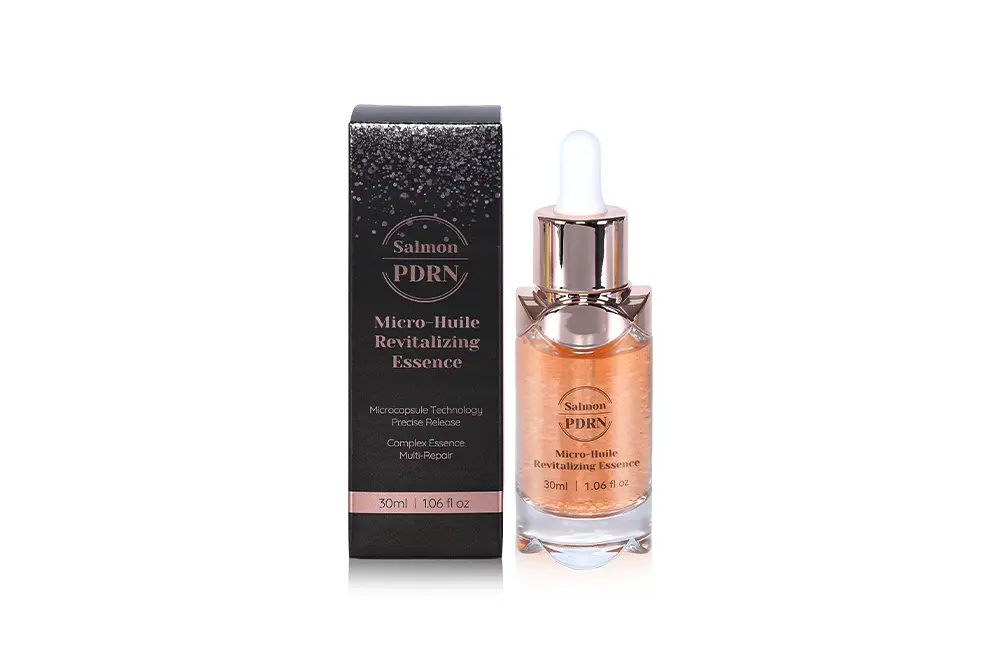
Can you recommend a private label skincare manufacturer that does low MOQ masks and serums for a new brand?
Looking for a private label skincare manufacturer with low MOQ masks and serums? Compare the 4 realistic paths, pricing and limits.
US & EU Compliant Skincare OEM: MOQ, FOB Pricing, 2026 Edition
Navigate 2024 FDA, EU 1223/2009 compliant skincare OEM procurement with verified MOQ ranges, FOB pricing, and cost-saving tips for global brand owners.
Chat Responsiveness SLA Expectation OEM Skincare Inquiry China
Benchmark chat SLA response times for Chinese OEM skincare factories, plus hydrocolloid vs hydrogel pimple patch sourcing specs and per-unit cost data for 2026 buyers.
Related Products

Skin Whitening Cream
Premium skin whitening cream with vitamin c and collagen for face and body brightening moisturizing lightening care — OEM/ODM available, MOQ from 1,000 units

Transparent Silicone Scar Gel Sheet for Effective Silicone Scar Sheets for Body Care
Premium logo transparent silicone scar gel sheet for effective silicone scar sheets for body care — OEM/ODM available, MOQ from 1,000 units

Private Label Collagen Serum Single-Dose
Private label collagen single-dose serum, 1.2 ml vials, 10 or 30 pcs per box, 1,000 boxes MOQ

Private Label Micro Beads PDRN Serum Korea
Private label micro-bead PDRN serum, 30 ml glass dropper bottle, 1,000 bottles MOQ