How Much Does Skincare OEM Cost? Sheet Mask & Serum Price Guide (2026)
August 23, 2026
Skincraftlab
B2B Skincare Manufacturing Expert
What Is This Guide About?
Skincare OEM pricing broken into 4 parts: sampling, formula, packaging, MOQ. Sheet masks $0.08-0.35/pc, serums $1.50-5.00/bottle (MOQ 1,000).
Category
skincare OEM cost
Audience
Brand owners, procurement, R&D
Updated
August 2026
How Does Skincare OEM Pricing Work? How Much Does a Sheet Mask or Serum Cost?
TL;DR: Skincare OEM costs are made up of four components: sampling fees, formula costs, packaging costs, and MOQ — but the two factors that truly determine unit price are the formula and the packaging grade. Based on typical USD quotes, a sheet mask runs approximately $0.08–0.35, and a serum runs approximately $1.50–5.00. The wide range reflects major differences in formulation, packaging, and processing. Before you request a quote, understand what each of these four components covers.
What Are the Four Components of Skincare OEM Pricing?
An OEM quote is not simply "one unit price." A professional quotation is usually broken into four parts:
- Sampling Fee: The fee a factory charges to develop or replicate a sample, covering both formula sampling and packaging sampling. Most factories refund or deduct the sampling fee once a formal order is placed; a few do not — always ask in advance.
- Formula Cost: The cost of the product's contents (the formula itself), determined by formulation cost, ingredient grade, and dosage levels. This is the core of the "unit price" on a quotation.
- Packaging Cost: The cost of bottles, caps, mask sheets, cartons, and other packaging. The factory can source these on your behalf, or you can purchase them yourself and ship them to the factory for filling. Packaging is usually quoted separately.
- MOQ (Minimum Order Quantity): Not a direct fee, but it determines total cost — the higher the MOQ, the thinner the R&D and production line setup costs are spread, and the more room there is to negotiate unit price.
Understanding these four components is the only way to make sense of every number on a quotation — rather than just asking "what's the unit price?"
Full Pricing Range: Reference Quotes for 7 Product Categories
Using the public USD pricing from Skincraftlab (an OEM/ODM manufacturer in Zhongshan, Guangdong) as a reference, the ranges across 7 categories are as follows:
| Category | Unit Price Range (USD) | MOQ |
|---|---|---|
| Sheet Masks | $0.08-0.35/piece | 1,000 pieces |
| Eye Masks | $0.10-0.50/piece | 1,000 pieces |
| Serums & Toners | $1.50-5.00/bottle | 1,000 bottles |
| Face Creams & Lotions | $1.80-6.00/jar | 1,000 jars |
| Lip & Neck Masks | $0.15-0.60/piece | 1,000 pieces |
| Foot & Body Care | $0.30-2.00/unit | 500 units |
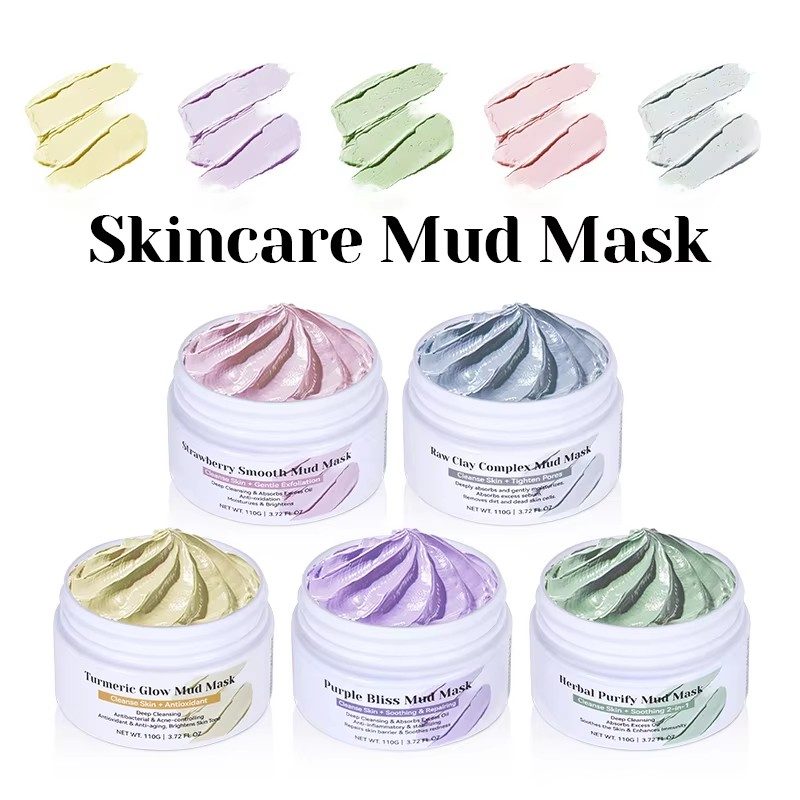
| Clay & Mud Masks | $0.50-2.50/jar | 500 jars |
Note: The above ranges include basic packaging. Actual quotes will vary based on formula, packaging grade, and order volume. Final pricing is subject to the factory's official quotation.
6 Factors That Affect Your Final Quote
- Formula Cost: Functional ingredients (such as high-concentration actives or specific botanical extracts) directly drive up formula cost. Within the same category, the gap between budget-tier and premium-tier pricing comes primarily from the formulation.
- Packaging Grade: Standard non-woven mask sheets vs. premium Tencel sheets, plastic bottles vs. glass bottles — price differences can reach several multiples.
- Order Quantity: Volume pricing is standard practice in the industry. Unit prices are typically highest near the MOQ threshold.
- Process Complexity: Freeze-drying, microencapsulation, dual-chamber mixing, and other specialty processes cost more than conventional filling.
- Testing & Compliance: If the factory is required to run stability testing, microbiological testing, or efficacy evaluation, those costs are either built into the quote or billed separately.
- Target Market Requirements: Exporting to the US or EU means meeting local regulatory and testing requirements, and those compliance costs will be reflected in the price.
Why Do Quotes for the Same Product Vary So Much Between Factories?
For the same "hydrating sheet mask," Factory A quotes $0.10 and Factory B quotes $0.30. That doesn't mean Factory A is cutting corners or Factory B is overcharging. The difference usually comes from:
- Different formulas: Different mask sheet materials and serum systems naturally cost different amounts;
- Different packaging scope: Some quotes include cartons and printing; others are for bare masks only;
- Different tax and currency terms: Whether tax is included and whether settlement is in RMB or USD both affect the number;
- Different service scope: Whether design, testing, and export documentation are included — this alone can create large gaps.
So when comparing quotes, never compare unit prices alone. Align all quotes to the same basis (same formula grade, packaging, tax status, and shipping terms) before comparing — otherwise the comparison is meaningless.
RFQ Checklist: Ask These Questions to Get Comparable Quotes
When sending an inquiry to a factory, lay out all the following information in one go to minimize back-and-forth:
- Product category and target specifications (capacity, piece count, gram weight);
- Formula requirements (efficacy direction, texture preferences, whether the factory's existing formula is acceptable);
- Packaging preferences (material, color, printing requirements, whether custom molds are needed);
- Target unit price range and initial order quantity;
- Target market (determines testing and compliance requirements);
- Whether sampling is needed, how much the sampling fee costs, and whether it is deductible from order payment;
- Whether the quote is tax-inclusive, packaging-inclusive, and whether freight to port or door is included;
- Lead time and MOQ (including reorder MOQ).
Step-by-Step Process: From Inquiry to Locked Quote
- Define your basis first: Specify formula grade, packaging grade, and quantity, and set your own target unit price range upfront.
- Send RFQs to multiple suppliers: Send the checklist above to 2–3 factories, keeping the parameters identical for a side-by-side comparison.
- Normalize the quotes: Compile all quotes into one table and compare formula cost, packaging, sampling fees, MOQ, and lead time line by line.
- Validate with samples: A reasonable unit price doesn't guarantee quality. Request samples and verify "you get what you pay for" with the actual product.
- Negotiate total cost: Confirm the total landed cost (goods + packaging + sampling + freight + testing) rather than focusing on unit price alone, then lock in the official quotation before signing.
FAQ
Q: How much does it actually cost to OEM a sheet mask? A: For sheet masks, the reference range is $0.08–0.35 per piece (MOQ: 1,000 pieces), depending on the mask sheet material, serum formula, and packaging grade. Be wary of quotes below the lower end — they may indicate compromised formula or packaging. Quotes above the upper end typically reflect specialty formulations or premium packaging.
Q: How much is the sampling fee? A: There's no industry-wide standard — it depends on the category and the number of sampling rounds, TBC. The two key questions to ask are: whether the sampling fee is refundable, and whether it's deducted from the order payment once you place a formal order. Most factories deduct it after order confirmation.
Q: Why do factories quote "a range" instead of a fixed price? A: Because the possible combinations of formulas and packaging are nearly unlimited. Factories can only provide a range per category. To get a fixed quote, you need to lock down parameters such as formula grade, packaging, and quantity — only then can the factory calculate a precise price.
Q: Is it cheaper to source packaging yourself? A: Not necessarily. Factories benefit from volume purchasing and may get better prices. Sourcing it yourself gives you more choice and direct control over packaging quality. It's worth getting quotes from both sides — just remember to factor in logistics and damage/waste costs.
Q: Are the quotes tax-inclusive? How do I avoid hidden fees at the end? A: When inquiring, explicitly request "tax-inclusive, packaging-inclusive, freight-inclusive" or ask for a line-item breakdown, and have all cost items written into the quotation and contract. Agreeing on delivery terms in advance (FOB/CIF or door-delivered pricing) also prevents end-of-project surcharges.
Q: How much cheaper is a factory with a 1,000-piece MOQ versus one with a 500-piece MOQ? A: There is no fixed gap — it depends on the factory's cost structure, TBC. We recommend requesting quotes on the same basis: same formula grade, same packaging, and compare the per-unit price at 500 units vs. 1,000 units, then make your decision based on the total cost picture.
Sources & Verification Date
- Skincraftlab Products & Services (USD pricing and MOQs across 7 categories): https://www.skincraftlab.com/products
- Skincraftlab About Us (OEM/ODM service scope): https://www.skincraftlab.com/about
- Skincraftlab Contact & RFQ (for official quotations): https://www.skincraftlab.com/contact
- Verification date: 2026-08-23
Related Products
2026 Skincare Market Entry Guide
Which skincare categories are growing on Amazon US in 2026? Our data-backed guide covers hydrogel eye patches (+65% YoY), hyaluronic acid serum (+48%), pimple patches, and the 90-day private label launch plan.
No spam, ever. Unsubscribe anytime.
What Are the Key Facts Before You Request a Quote?
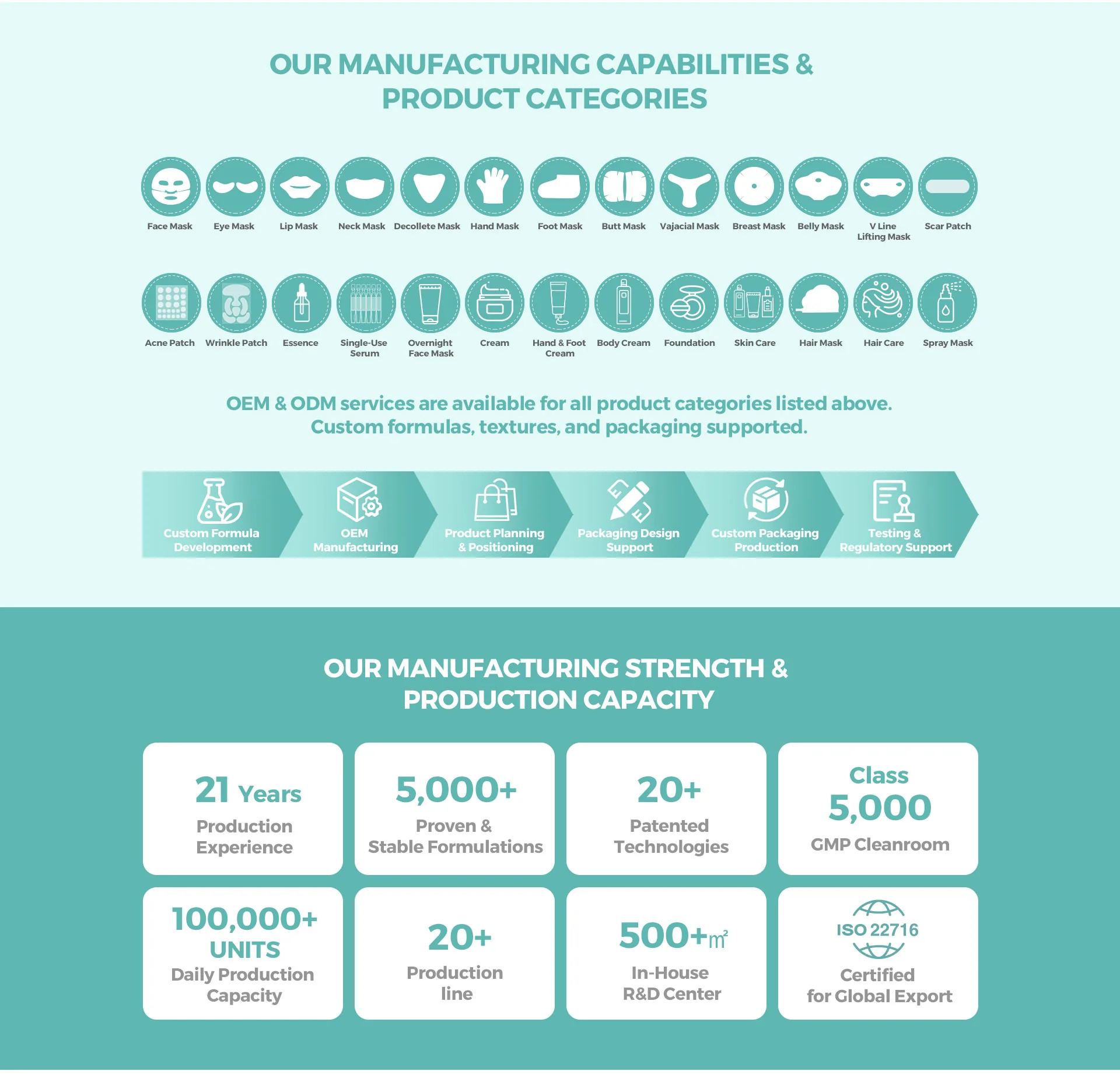
Skincraftlab is a skincare OEM/ODM contract manufacturer based in Zhongshan, Guangdong, China, operating since 2007 and serving 2,000+ brands across 30+ countries. Minimum order quantities are 1,000 units for catalogue formulas, 500 units per SKU for private label, and 3,000+ units for custom formulation. Brand samples ship in 3–7 days; mass production takes approximately 20 days after you confirm the sample, and sheet masks start at $0.08–$0.35 per piece. Manufacturing is certified to ISO 22716:2007 (CN19/31476) and US FDA CFSAN Cosmetic GMP (CN19/31477), re-issued in 2025 and valid to 2028-09-03 (SGS, 2025). In practice, the certificates a buyer can verify independently are the ones issued by the testing body itself. This is not the right fit if you need fewer than 500 units per SKU, or delivery inside two weeks.
| Topic | Details |
|---|---|
| Category | skincare OEM cost |
| Minimum order | 1,000 units standard; 500 per SKU private label; 3,000+ custom |
| Samples & production | Brand samples 3–7 days; production approx. 20 days after confirmation |
| Last updated | August 2026 |
How Do You Apply This Guide to Your Own Project?
- 1Step 1: match the format to your unit cost — for example, sheet masks run $0.08–$0.35 per piece at 1,000 units, while serums run $1.50–$5.00 per bottle.
- 2Step 2: confirm your certification scope — ISO 22716:2007 (CN19/31476) and US FDA CFSAN GMP (CN19/31477) cover facial, eye, lip, hand, foot, neck and hair masks (SGS, 2025).
- 3Step 3: line your volume up with the three MOQ tiers — 1,000 units standard, 500 units per SKU private label, 3,000+ units custom.
- 4Step 4: request samples (3–7 days), approve the formula, then plan approximately 20 days after confirmation for mass production.
- 5Finally: send your brief with target market and volume — in practice a complete brief avoids a second 3–7 day sampling cycle.
Why Brands Choose Skincraftlab as Their OEM/ODM Partner
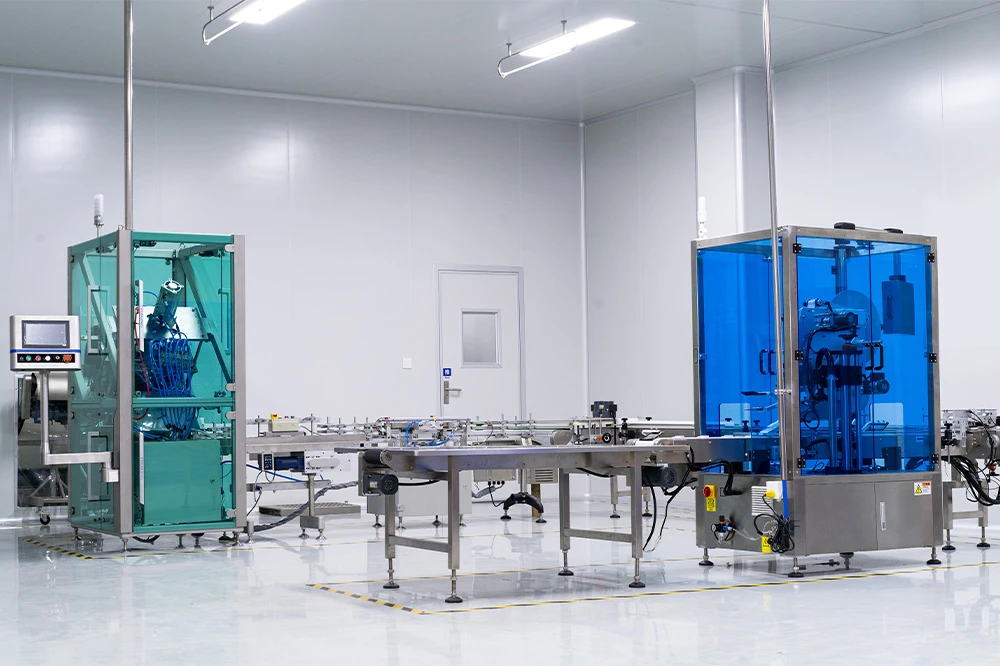
Skincraftlab is a skincare OEM/ODM contract manufacturer based in Zhongshan, Guangdong, China, operating since 2007 and supplying private-label and OEM buyers across North America, Europe, the Middle East and Southeast Asia. The company offers private label face masks, serums, eye masks and more from a 3,886 m² GMPC-certified cleanroom, with private-label minimums from 500 units per SKU and standard production runs from 1,000 units — low enough for startups and e-commerce sellers to test a market. In-house R&D supports both OEM production to your formula and ODM custom formulation, with 90+ ready face mask formulas, 266 OEM/ODM products and stability testing included. Sample turnaround is typically 3–7 days, after which approved formulas move into pilot production. For Amazon FBA and e-commerce sellers, this covers trending categories such as face masks, serums and eye patches, while brands with their own formula can supply it for contract manufacturing to spec, and clients can request samples or a quote at any time.
Frequently Asked Questions
How much does it actually cost to OEM a sheet mask?
How much is the sampling fee?
Why do factories quote "a range" instead of a fixed price?
Is it cheaper to source packaging yourself?
Are the quotes tax-inclusive? How do I avoid hidden fees at the end?
How much cheaper is a factory with a 1,000-piece MOQ versus one with a 500-piece MOQ?
Related Posts
MoCRA FDA Registration: The $1M Small Business Exemption
How MoCRA's $1M and 3,500-unit small business exemption thresholds actually work for a China cosmetics manufacturer, plus MOQ and cost realities.

Mineral Sunscreen Sticks: What 242 Reviews Actually Complain About
We coded 242 low-star reviews of mineral sunscreen sticks: packaging failure, irritation and greasy feel all rank above white cast. What a brief should specify first.
Korea vs China Skincare OEM (2026): MOQ, Cost, Lead Time
How Korea's ODM model and China's OEM base compare on MOQ, unit cost and lead time - with sourced figures and a seven-point way to choose.