Korea vs China Skincare OEM (2026): MOQ, Cost, Lead Time
September 24, 2026
Skincraftlab
B2B Skincare Manufacturing Expert
What Is This Guide About?
How Korea's ODM model and China's OEM base compare on MOQ, unit cost and lead time - with sourced figures and a seven-point way to choose.
Category
korea vs china skincare manufacturing
Audience
Brand owners, procurement, R&D
Updated
September 2026
The short answer: pick Korea when your formula concept needs an ODM that already owns the development work and you can accept longer development cycles. Pick China when unit economics matter most, you want a physical sample fast, and your volumes are measured in thousands rather than hundreds. Korea leads on formulation and narrative; China leads on cost and batch-size flexibility. Many brands run a small Chinese batch to validate demand, then scale the winner.
What actually changed in 2026
Korea is no longer the challenger — it is the benchmark. Korea's cosmetics exports hit US$10.2 billion in 2024, a 20.6 percent increase on the US$8.46 billion recorded in 2023, the first time the total crossed the ten-billion mark (Korea Herald, citing MFDS data). Korea's cosmetics exports to the US reached US$1.701 billion in 2024, ahead of France's US$1.263 billion (Korea Herald, citing USITC data via Bloomberg). Through October 2025, cosmetics exports had already reached US$9.42 billion, up 11.9 percent year on year (MOTIR release). Our published analysis puts Korea as the world's third-largest beauty exporter.
China's position is different in kind, not weaker. It is the deep, high-volume production base for skincare filling, packaging, and export — and it competes on cost and scale rather than on K-beauty narrative. For a brand, the useful question is no longer "which country is better" but "which factory profile fits the stage I am at right now."
MOQ and production thresholds
MOQ is set by packaging more than by chemistry. A stock bottle and a stock pump let a factory run a small first batch; a custom mould, a custom airless package, or a printed decoration change everything, because tooling and print minimums have to be amortised somewhere.
On the Korean side, the scale of the industry is not a barrier to smaller accounts. Kolmar Korea — one of the country's largest ODMs — reported 2,509 client companies in 2022, 3,147 in 2023, and a projected 3,776 in 2024 (Korea Times). A client base of that size only works if many of those orders are small. But headline minimums at tier-one Korean ODMs are still quoted per project, because they depend on formula, packaging, and the filling line reserved for you.
On the Chinese side, our published analysis is that mass-production runs in China make economic sense from around 10,000 units upward, and that "Made in USA" positioning with very small runs (under 500 units) is a better fit for the American route. The practical consequence: if your first production run is a few hundred to a few thousand units, the real question to ask every candidate factory is not "what is your MOQ" but "who physically runs a batch this size, on which line, and what does the setup charge look like." That conversation is the core of our OEM process, and it is where a low-MOQ, pilot-then-scale model earns its keep.
Unit cost structure
Our published analysis puts Chinese manufacturing costs 40 to 60 percent below the USA for equivalent quality. That gap comes from packaging supply density, filling labour, and the sheer number of component vendors within a short drive of each other — not from a hidden quality trade-off you can assume in either direction.
Korea is priced differently. Korean ODMs are development-heavy businesses: Kolmar Korea spends 5 to 7 percent of yearly sales on R&D and more than 30 percent of its employees are researchers (Korea Times). That capability is real, and it is paid for in development fees, formulation work, and clinical-style testing programmes — costs that sit partly outside the per-unit price. Per-project quotes from Korean ODMs therefore vary widely with how much development you ask for.
What moves your unit cost in China, in order of impact: order quantity, packaging decoration, the number of filling and assembly steps, testing requirements, and freight plus duty into your destination market. Get quotes on identical packaging and identical fill volumes, and ask for the cost at two quantities so you can see the volume curve instead of guessing at it. The SKUs we produce and the packaging formats available are listed under products.
Lead time: where the weeks actually go
Start by defining lead time, because the two markets quote it differently. Our published analysis puts total lead time at 35 to 70 days for China and 33 to 67 days for the USA — production-focused figures, starting once formula and packaging are locked.
Korea's published numbers usually describe development, not production. A typical new cosmetic product launch takes nine to 12 months, and Kolmar Korea's packaged product service — which lets clients choose from pre-developed formulations and containers — is designed to shorten that by up to six months, from an inventory of more than 140 formulations across nine categories (Korea Herald). In a later update, the same service cut the design-to-market-release timeline to three to six months from the previous nine to 12, alongside capacity expansion that took the Sejong plant from 450 million to 890 million products a year (Korea Times).
Read those two sets of numbers side by side only with care: one measures filling and shipping, the other measures formulation plus marketing readiness. When you compare suppliers, ask each one to state the start date and end date of the lead time they quote, in writing. If a quote does not say what triggers the clock, it is not comparable to anything.
Ingredients, narrative, and regulatory reality
Novel actives are where the two markets diverge most, and the divergence is regulatory, not technical. Human cells, tissues, and products of human origin are prohibited as cosmetic ingredients in the EU under Annex II of Regulation (EC) No 1223/2009, and in Chinese Mainland under China's cosmetic safety and technical standards. Korea's MFDS Notice No. Chinese rules prohibit human cells, tissues, and their culture media in cosmetics except where they meet specified safety standards for human cell and tissue culture media; non-human exosomes have no specific management requirements in China and are assessed case by case (ChemLinked exosome review).
In plain terms: if your positioning depends on a novel human-derived active, that is a Korea or other-market conversation, not a China one. If your positioning depends on proven, well-characterised actives and hard-goods quality — texture, stability, packaging, shelf life — China competes on cost without a regulatory penalty. Either way, decide the claim architecture with your regulatory consultant before you brief a factory, because changing the ingredient story after the formula is locked is the most expensive edit in the project.
Documentation: what China can support for US and EU filings
Chinese regulation has been stable long enough to plan around. China's Cosmetics Supervision and Administration Regulation (CSAR) framework took effect in January 2021, with implementing measures rolling out through 2022; the measures on cosmetics manufacture and operation 1 January 2022; and the good manufacturing practice requirements 1 July 2022 (ChemLinked regulatory overview).
For production, a cosmetics production licence covers both preparation and content filling and is issued within 35 working days after dossier review and on-site inspection, valid for five years (ChemLinked). On animal testing, imported general cosmetics have been able to rely on an exemption since 1 May 2021, and the NMPA's 29 July 2026 announcement extended it to certain special cosmetics, including hair perming products, non-oxidative hair dyes, and physical whitening or freckle-removing products (ChemLinked).
For the EU, notification goes through the Cosmetic Products Notification Portal, a free of charge online system created for Regulation (EC) No 1223/2009; once a product is notified there, no further national notification is required, and products containing nanomaterials need an additional Article 16 entry (European Commission). The EU testing ban on finished products has applied since 11 September 2004 and on ingredients since 11 March 2009, with the marketing ban in force since 11 March 2009 and completed for repeated-dose toxicity, reproductive toxicity, and toxicokinetics from 11 March 2013 (European Commission).
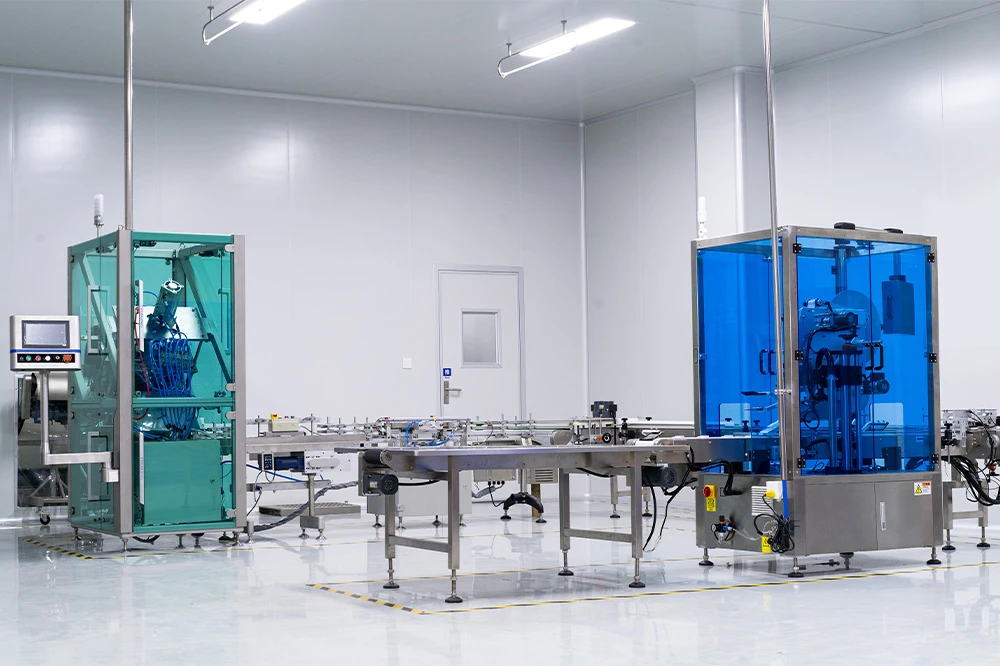
For the US, facility registration and product listing under MoCRA are the brand's or importer's responsibility; we can share the facility and stability documentation your US agent needs
What this means in practice: compliance is a document pipeline, not a country. Your brand (through a Responsible Person in the EU or a US agent) files; your factory supplies the manufacturing and quality records those filings depend on. The document types and process support we provide are set out on our certifications page — we describe what we can hand over and how it is produced, and we do not ask you to take any certificate on trust.
Korea ODM vs China OEM at a glance
| Dimension | Korea ODM | China OEM |
|---|---|---|
| MOQ and volume threshold | Quote per project. A tier-one ODM serving 3,000+ brand clients accepts many small accounts, but minimums still follow formula, packaging, and line allocation | Quote per project. Mass production becomes economic around 10,000+ units (Skincraftlab's published analysis); pilot scale below that is the flex point to negotiate |
| Unit cost structure | Quote per project. Development-heavy model: Kolmar Korea puts 5–7% of yearly sales into R&D with more than 30% of staff in research roles | Lower per-unit cost at volume: 40–60% below the USA for equivalent quality (Skincraftlab's published analysis); driven by quantity, decoration, filling steps, freight |
| Total lead time | Development timeline: typically 9–12 months for a new product, cut to 3–6 months with pre-developed formulation services | China runs 35–70 days and the USA 33–67 days once formula and packaging are locked (Skincraftlab's published analysis) |
| Ingredients and narrative | K-beauty export momentum (US$10.2bn in 2024, +20.6%) and a narrower prohibition on human cell and tissue ingredients than the EU's blanket ban | Human cells, tissues, and products of human origin are prohibited as cosmetic ingredients; strong on proven actives, texture, and packaging quality |
| Regulatory and documentation | Korean ODM quality systems support EU and US filings; your Responsible Person or agent still files | CSAR framework: production licence issued within 35 working days, animal-testing exemption for imported general cosmetics since 1 May 2021 |
| Best-fit brand stage | Brands with a differentiated formulation story, a real marketing budget, and a 6–12 month runway | Brands validating demand, protecting COGS, or scaling a proven winner with tight timelines |
How to decide: a seven-point checklist
- Is your formula a story or a commodity? If the story is the product, weigh Korea. If the product must win on price and texture, weigh China.
- What volume can you fund before revenue? Under a few thousand units, ask each factory who physically runs a batch that size and what setup charge applies.
- Is your packaging stock or custom? Stock components keep a first run small and fast; custom tooling adds weeks before filling starts and pushes minimums up.
- When is your launch date? Under 90 days points to filling a locked formula; a 6–12 month runway is what development-heavy routes need.
- Does your hero ingredient clear the destination market? Check EU Annex II, China's Safety and Technical Standards, and MFDS rules before you brief anyone.
- Have you modelled landed cost? Compare quotes at two order quantities with identical packaging, then add freight, duty, and testing.
- Who signs the filings? Confirm your Responsible Person (EU), agent (US), and the exact documents your factory must supply — early, not at shipment.
FAQ
Q: Is the MOQ lower in Korea or China?
Neither country has a single MOQ. Minimums are quoted per project and are driven by packaging tooling, print runs, and the filling line reserved for your batch. Tier-one Korean ODMs serve thousands of brand clients, so small orders exist there, and Chinese factories can run small pilot batches before a mass-production order. Always ask for the MOQ at your specific packaging and fill volume.
Q: How long does skincare manufacturing take in China versus Korea?
It depends on what you are timing. Chinese production lead time runs 35–70 days once formula and packaging are locked, according to our published analysis. Korean figures usually describe development: nine to 12 months for a typical new product, reduced to three to six months where a pre-developed formulation service is used. Ask suppliers to define the start and end of any timeline they quote.
Q: Is Korean manufacturing more expensive than Chinese manufacturing?
Not in a way that can be reduced to one number. Korean ODMs are development-intensive — Kolmar Korea spends 5–7 percent of yearly sales on R&D — so part of what you pay for is formulation capability, priced into development fees. Chinese manufacturing costs run 40–60 percent below the USA for equivalent quality in our published analysis. Compare total project cost, not headline unit price.
Q: Can a Chinese OEM support US and EU compliance?
The filings are the brand's responsibility, usually through a Responsible Person in the EU or an agent in the US, but the factory has to supply the underlying records. China's own framework is well documented: the CSAR system has been in force since 2021, and a production licence covering preparation and content filling is issued within 35 working days. Ask which documents your factory provides.
Q: Which is better for a first launch on a limited budget?
For most first launches, a small pilot batch is the better use of a limited budget than a large opening order, because it converts cash into market feedback instead of inventory risk. That usually points to a low-MOQ, packaging-flexible Chinese partner first, then a scaled run or a Korean development project once you know the formula and the demand curve.
Q: Do I have to choose only one country?
No. A common pattern is to validate with a small run, then commit to a larger run once sell-through data exists. Some brands keep a China base for volume SKUs and use Korea for a hero formulation that depends on a specific active. What matters is that your packaging and formula decisions keep that switch technically possible.
The honest answer
Choose China when the constraint is money and speed to shelf: you want a low first MOQ, a physical sample you can hold, unit costs 40–60 percent below US manufacturing, and a total production lead time measured in weeks. Choose Korea when the constraint is differentiation: you need formulation development, a K-beauty narrative with regulatory space, and you can fund a development timeline of months rather than weeks.
The Korean ODM industry is not expensive by accident — it invests 5–7 percent of sales in R&D and has built export momentum of US$10.2 billion a year. Chinese manufacturing is not cheap by accident either: it is built on component density, filling capacity, and a documented regulatory framework that has been in force since 2021. Neither route is the "real" one. The right answer is whichever factory profile matches the stage your brand has actually reached, and the fastest way to learn that is to price the same brief in both.
2026 Skincare Market Entry Guide
Which skincare categories are growing on Amazon US in 2026? Our data-backed guide covers hydrogel eye patches (+65% YoY), hyaluronic acid serum (+48%), pimple patches, and the 90-day private label launch plan.
No spam, ever. Unsubscribe anytime.
What Are the Key Facts Before You Request a Quote?
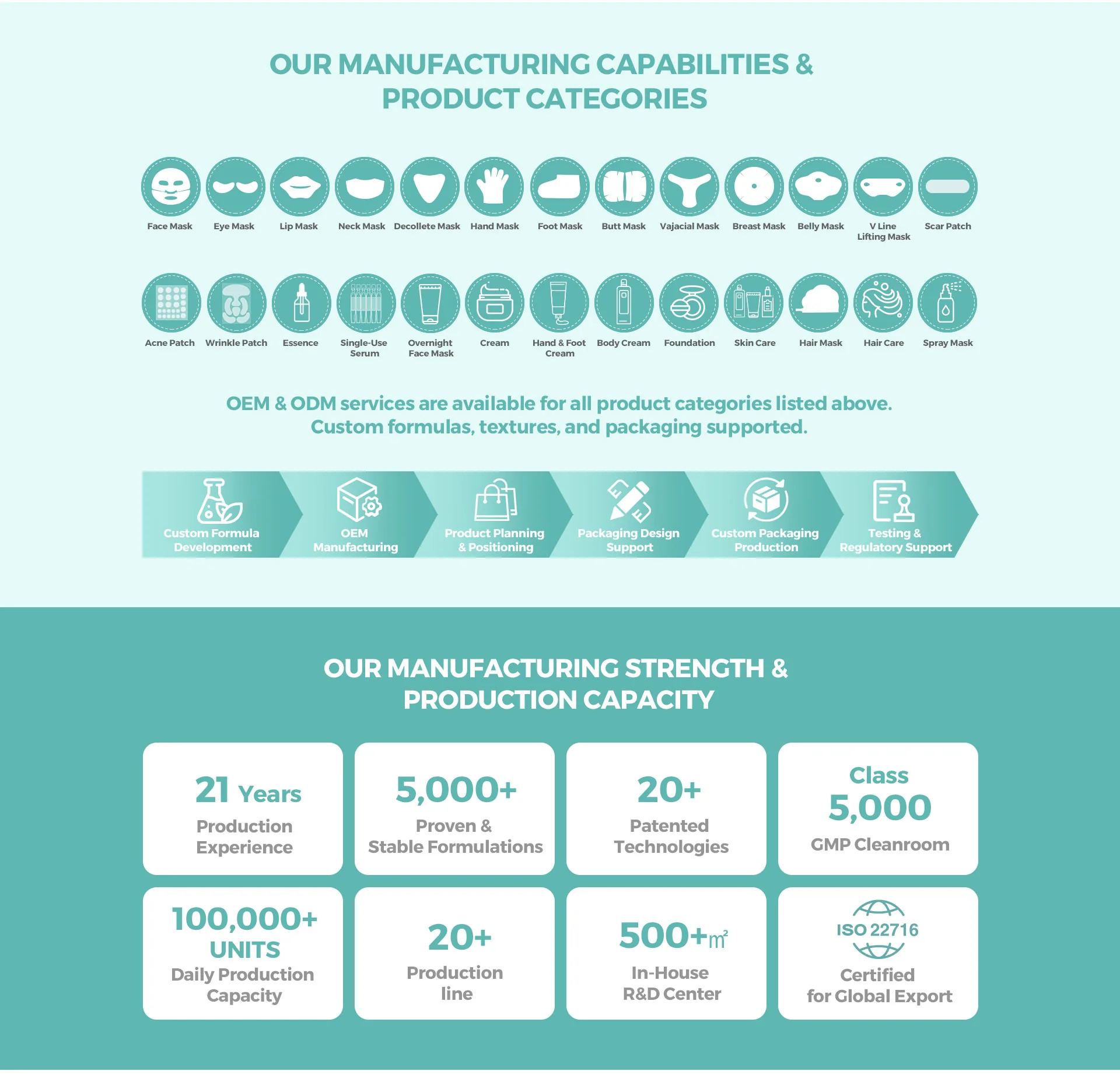
Skincraftlab is a skincare OEM/ODM contract manufacturer based in Zhongshan, Guangdong, China, operating since 2007 and serving 2,000+ brands across 30+ countries. Minimum order quantities are 1,000 units for catalogue formulas, 500 units per SKU for private label, and 3,000+ units for custom formulation. Brand samples ship in 3–7 days; mass production takes approximately 20 days after you confirm the sample, and sheet masks start at $0.08–$0.35 per piece. Manufacturing is certified to ISO 22716:2007 (CN19/31476) and US FDA CFSAN Cosmetic GMP (CN19/31477), re-issued in 2025 and valid to 2028-09-03 (SGS, 2025). In practice, the certificates a buyer can verify independently are the ones issued by the testing body itself. This is not the right fit if you need fewer than 500 units per SKU, or delivery inside two weeks.
| Topic | Details |
|---|---|
| Category | korea vs china skincare manufacturing |
| Minimum order | 1,000 units standard; 500 per SKU private label; 3,000+ custom |
| Samples & production | Brand samples 3–7 days; production approx. 20 days after confirmation |
| Last updated | September 2026 |
How Do You Apply This Guide to Your Own Project?
- 1Step 1: match the format to your unit cost — for example, sheet masks run $0.08–$0.35 per piece at 1,000 units, while serums run $1.50–$5.00 per bottle.
- 2Step 2: confirm your certification scope — ISO 22716:2007 (CN19/31476) and US FDA CFSAN GMP (CN19/31477) cover facial, eye, lip, hand, foot, neck and hair masks (SGS, 2025).
- 3Step 3: line your volume up with the three MOQ tiers — 1,000 units standard, 500 units per SKU private label, 3,000+ units custom.
- 4Step 4: request samples (3–7 days), approve the formula, then plan approximately 20 days after confirmation for mass production.
- 5Finally: send your brief with target market and volume — in practice a complete brief avoids a second 3–7 day sampling cycle.
Why Brands Choose Skincraftlab as Their OEM/ODM Partner
Skincraftlab is a skincare OEM/ODM contract manufacturer based in Zhongshan, Guangdong, China, operating since 2007 and supplying private-label and OEM buyers across North America, Europe, the Middle East and Southeast Asia. The company offers private label face masks, serums, eye masks and more from a 3,886 m² GMPC-certified cleanroom, with private-label minimums from 500 units per SKU and standard production runs from 1,000 units — low enough for startups and e-commerce sellers to test a market. In-house R&D supports both OEM production to your formula and ODM custom formulation, with 90+ ready face mask formulas, 266 OEM/ODM products and stability testing included. Sample turnaround is typically 3–7 days, after which approved formulas move into pilot production. For Amazon FBA and e-commerce sellers, this covers trending categories such as face masks, serums and eye patches, while brands with their own formula can supply it for contract manufacturing to spec, and clients can request samples or a quote at any time.
Frequently Asked Questions
Is your formula a story or a commodity?
What volume can you fund before revenue?
Is your packaging stock or custom?
When is your launch date?
Does your hero ingredient clear the destination market?
Have you modelled landed cost?
Who signs the filings?
Is the MOQ lower in Korea or China?
How long does skincare manufacturing take in China versus Korea?
Is Korean manufacturing more expensive than Chinese manufacturing?
Can a Chinese OEM support US and EU compliance?
Which is better for a first launch on a limited budget?
Do I have to choose only one country?
Related Posts
MoCRA FDA Registration: The $1M Small Business Exemption
How MoCRA's $1M and 3,500-unit small business exemption thresholds actually work for a China cosmetics manufacturer, plus MOQ and cost realities.

Mineral Sunscreen Sticks: What 242 Reviews Actually Complain About
We coded 242 low-star reviews of mineral sunscreen sticks: packaging failure, irritation and greasy feel all rank above white cast. What a brief should specify first.
Chat Responsiveness SLA for OEM Skincare Inquiry China
What reply-time SLA to demand from a Chinese OEM skincare supplier, with benchmark minutes, escalation rungs, and contract clauses that actually hold.
Related Products

Skin Whitening Cream
Premium skin whitening cream with vitamin c and collagen for face and body brightening moisturizing lightening care — OEM/ODM available, MOQ from 1,000 units
Clay Mud Mask
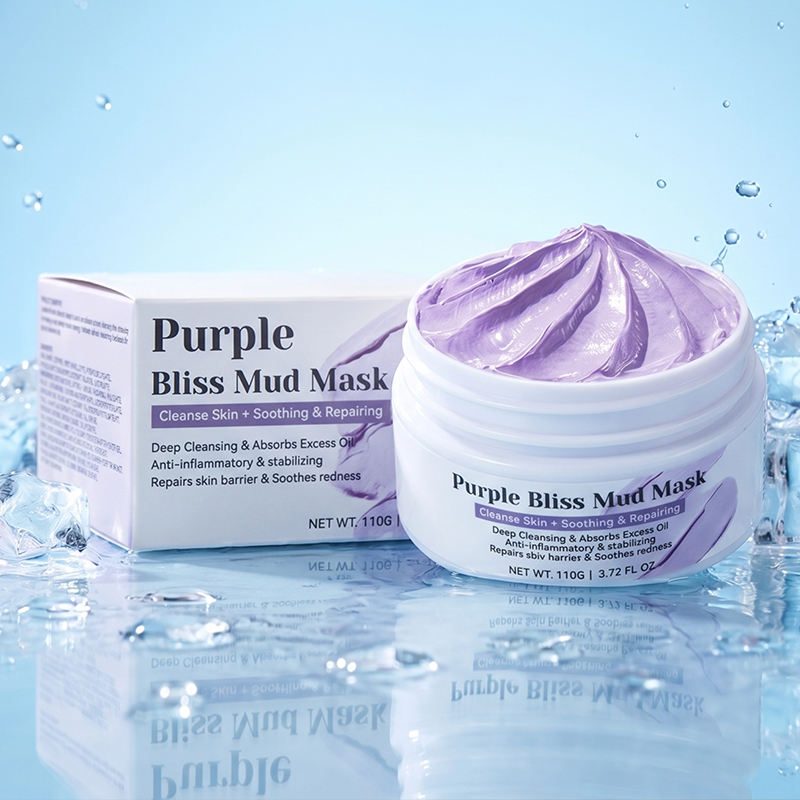
A purifying clay mask that draws out impurities — your brand's pore-refining essential

Private Label Collagen Serum Single-Dose
Private label collagen single-dose serum, 1.2 ml vials, 10 or 30 pcs per box, 1,000 boxes MOQ

Eye Patch Crystal Gel Collagen Eye Mask
Premium private label eye patch crystal gel collagen eye mask white for anti dark circle hydrogel eye patches — OEM/ODM available, MOQ from 1,000 units