How to Prepare a Skincare Product Brief for an OEM Discovery Call in China
November 11, 2026
Skincraftlab
B2B Skincare Manufacturing Expert
What Is This Guide About?
The 12 data fields a Chinese OEM factory needs before your first call — plus pilot-batch cost, lead-time and packaging MOQ benchmarks.
Category
how to prepare skincare product brief for OEM discovery call China
Audience
Brand owners, procurement, R&D
Updated
November 2026
A usable skincare product brief for an OEM discovery call in China contains 12 fields: product category and format, target market and regulatory route, formula or reference sample, fill weight, packaging type and decoration, MOQ, target FOB price, Incoterm, delivery window, testing requirements, certification needs, and decision maker. Send it 48 hours before the call. Factories quote from the brief — gaps in the brief become gaps in the quote, and those gaps surface again at tooling.
In February 2026 we ran a discovery-call audit at our Zhongshan plant: 41 inbound briefs, 9 of them complete enough to quote without a follow-up email. The other 32 averaged 3.4 clarification rounds before a number could be issued. Each round costs 2 to 5 working days — (and yes, buyers who blame the factory for slow quoting usually wrote a five-line brief).
That is the whole game. Not charm, not WeChat speed. Brief quality.
Key stats: what a complete brief changes
| Metric | Incomplete brief | Complete brief (12 fields) |
|---|---|---|
| Clarification rounds before quote | 3.4 (Feb 2026 inbound log) | 0 |
| Days from inquiry to priced quote | 9–17 | 2–4 |
| Pilot run MOQ accuracy | ±40% re-quote at tooling | Within 10% of final |
| Sample rounds to approval | 3–4 | 1–2 |
| Packaging MOQ surprises | Common (card/blister mismatch) | Flagged before deposit |
Source: Skincraftlab inbound inquiry log, Jan–Feb 2026, 41 briefs across hydrogel, clay and patch categories.
The 12 fields — and the ones buyers skip
Write them in this order. It maps to how a factory actually prices: category → regulation → formula → fill → packaging → volume → price → logistics.
1. Category and format. "Acne patch" is not a category. "Hydrocolloid acne patch, 12 mm round, 0.3 mm thickness, sterile, single-piece on release liner" is a category. Format drives machinery, and machinery drives MOQ.
2. Target market and regulatory route. EU → CPSR plus Responsible Person. US → FDA cosmetic vs. OTC drug line (acne patches with salicylic acid cross into drug territory — say so now). Mexico → COFEPRIS. Brazil → ANVISA. Colombia → INVIMA. Australia → TGA. Naming the market in field two saves a month later.
3. Formula or reference sample. A brand name, an INCI list, or a physical sample shipped to the factory. Vague references ("like a Korean essence") are the single most expensive line in a brief.
4. Fill weight and tolerance. 50 g ± 2 g, not "a jar." Tolerance affects filling-line speed and your reject rate.
5. Primary and secondary packaging. Jar, tube, sachet, blister card, folding carton. Include decoration method: offset, rotogravure, flexo, silk screen, hot stamp. Each has its own setup fee and MOQ.
6. MOQ per SKU — and whether it can split. 1,000 units per SKU is a common floor for hydrogel and patches; 3,000 for cream fills; 5,000 for custom-printed pouches. Ask explicitly whether MOQ can split across two fragrances or two shades.
7. Target FOB price and Incoterm. FOB Zhongshan/Shenzhen, CIF, or DDP. A target price without an Incoterm is a wish, not a spec.
8. Delivery window. From PO date or from artwork approval — those are different dates, and one of them is the one you actually care about.
9. Testing requirements. Micro (aerobic plate count, TPC), challenge test, stability (accelerated 3 months / real-time 24–36 months), heavy metals, patch test. State which are mandatory for your market and which you'll skip.
10. Certification requirements. ISO 22716, GMPC, BSCI, ISO 9001, FDA establishment registration. Ask which the factory holds directly vs. through a sister site.
11. Documentation for import. CoA, MSDS, free-sale certificate, CPSR (EU), COFEPRIS registration packet (Mexico).
12. Decision maker and timeline. Who signs, and by when. Factories triage by close probability — and they should.
Worked example: hydrocolloid acne patch pilot batch of 3,000 units, cost and lead time
The hydrocolloid acne patch OEM pilot batch 3000 units cost and lead time China factory question comes up in roughly one in four patch inquiries we field. Here is the 2026 baseline from our own production log.
A 3,000-unit pilot of a 12 mm hydrocolloid acne patch, 0.3 mm, sterile, single-piece on liner, in a 36-patch count box with a printed blister card:
| Cost line | Low | High | Notes |
|---|---|---|---|
| Patch unit cost (FOB) | $0.021 | $0.034 | Hydrocolloid grade + adhesive |
| Blister card print setup | $180 | $320 | One-off, per SKU |
| Folding carton print setup | $120 | $260 | Offset, small format |
| Sterilization (EO) | $0.004/pc | $0.007/pc | Batch-level charge |
| Stability + micro testing | $650 | $1,100 | Accelerated 3-month minimum |
| Total pilot FOB | $2,600 | $4,300 | Excluding freight |
Lead time is 28 to 35 days from artwork approval — not from PO. Tooling and print setup add 7 to 10 days up front. If your artwork is not locked, add another 2 weeks, and do not book the launch date until the artwork is signed off (the part buyers skip and regret later).
Pilot runs are priced higher per unit than production runs by design — setup is amortized over 3,000 units instead of 30,000. Expect production unit cost to drop 25–35% at the 30,000-unit tier.
If your pilot is a hydrogel or patch format, our hydrogel sheet mask and patch line runs the same tooling, which shortens the pilot-to-production handoff.
Pimple patch OEM packaging: custom card blister MOQ and China pricing
The pimple patch OEM packaging custom card blister MOQ China price question is where most patch projects go sideways — not on the patch, on the card.
Custom-printed blister card (the paperboard backing your patch is sealed to) follows print-industry MOQs, not cosmetic MOQs:
| Decoration | Setup fee (USD) | Print MOQ (cards) | Unit print cost at MOQ |
|---|---|---|---|
| Offset, 4-color | $180–$320 | 3,000 | $0.018–$0.026 |
| Offset + spot UV | $240–$400 | 3,000 | $0.024–$0.034 |
| Rotogravure | $900–$1,400 | 10,000 | $0.009–$0.014 |
| Flexo | $350–$550 | 5,000 | $0.012–$0.019 |
At 3,000 patch units you are paying offset setup on a small run — that is normal for a pilot. At 10,000+ units, rotogravure plate cost ($900–$1,400) breaks even in roughly two SKUs and then wins on unit price.
The mismatch to watch: patch MOQ 3,000 but card print MOQ 5,000 (flexo) or 10,000 (gravure). You will pay for 5,000 cards and use 3,000. Either accept the overage on a pilot or move to offset for the first run. Say which in the brief.
For clay, mud and cream formats the same logic applies with fewer variables — see our private label clay mask program for fill-volume MOQ benchmarks.
What the discovery call itself should cover (30 minutes)
Agenda, in order, 30 minutes total:
- Minutes 0–5: confirm the 12 brief fields back to you. If the factory does not repeat them, the brief was not read.
- Minutes 5–12: regulatory route for your named market — ask for the specific registration or CPSR pathway and a timeline in weeks.
- Minutes 12–20: MOQ reality per component (patch, card, carton, pouch). Ask for the binding number in writing after the call.
- Minutes 20–26: pilot cost and lead time from artwork approval, with testing included as a line item.
- Minutes 26–30: what the factory needs from you to issue a formal quote — and by when.
Red flags: a quote issued before the packaging is specified, a MOQ that changes between call and email, "we can do any certification" without naming the body.
FAQ
Q: What should a skincare product brief include before an OEM discovery call in China?
Twelve fields: category and format, target market and regulatory route, formula or reference sample, fill weight with tolerance, primary and secondary packaging plus decoration method, MOQ per SKU, target FOB price and Incoterm, delivery window measured from artwork approval, required testing, required certifications, import documentation, and the decision maker with a signing date. Send it 48 hours ahead so the factory prices it rather than improvising on the call.
Q: What is the cost and lead time for a hydrocolloid acne patch OEM pilot batch of 3,000 units from a China factory?
Expect $2,600 to $4,300 FOB total for a 3,000-unit pilot of a 12 mm sterile hydrocolloid patch with printed blister card and carton, including one-off print setup and accelerated stability plus micro testing. Unit cost lands at $0.021–$0.034. Lead time is 28–35 days from artwork approval, with 7–10 days of tooling and print setup in front of that. Production pricing at 30,000 units typically runs 25–35% lower per unit.
Q: What is the MOQ and price for custom pimple patch blister cards from China?
Offset-printed blister cards start at 3,000 cards with a $180–$320 setup and $0.018–$0.026 per card. Flexo starts at 5,000 cards ($350–$550 setup), rotogravure at 10,000 ($900–$1,400 setup, $0.009–$0.014 per card). The common trap is a 3,000-unit patch MOQ against a 5,000-card flexo minimum — you absorb 2,000 cards. Specify offset for the pilot run and switch process at the 10,000-unit mark.
Q: Can a Chinese OEM factory quote from a brief without receiving a physical sample?
It can quote a range, not a firm number. Formulas referenced only by brand name or vague description ("a light gel cream") produce quotes that move 20–40% once a real sample is matched. Ship a sample or attach a full INCI list with percentages before you ask for a binding price. Physical samples clear customs faster than email attachments clear ambiguity.
Q: How many clarification rounds should a buyer expect between brief and binding quote?
Zero to one if the brief is complete, three or more if it is not. Per our February 2026 inbound log, incomplete briefs averaged 3.4 rounds and 9–17 days to a priced quote; complete briefs took 2–4 days. Each round is 2–5 working days, so a thin brief can cost you a month before tooling even starts.
Q: Which regulatory details must appear in the brief for EU, US and LatAm markets?
For the EU, name the CPSR and Responsible Person arrangement and confirm the factory can supply the Product Information File. For the US, state whether the product is a cosmetic or crosses into OTC drug (salicylic acid acne patches do). For Mexico name COFEPRIS, Brazil ANVISA, Colombia INVIMA — and ask for the registration packet and free-sale certificate as separate line items in the quote.
At Skincraftlab (Zhongshan, ISO 22716 and GMPC) we price from a 12-field brief and issue a written MOQ per component — patch, card, carton — not a single blended number. Send the brief and you get a quote in 2–4 working days, or a written list of what is missing.
2026 Skincare Market Entry Guide
Which skincare categories are growing on Amazon US in 2026? Our data-backed guide covers hydrogel eye patches (+65% YoY), hyaluronic acid serum (+48%), pimple patches, and the 90-day private label launch plan.
No spam, ever. Unsubscribe anytime.
What Are the Key Facts Before You Request a Quote?
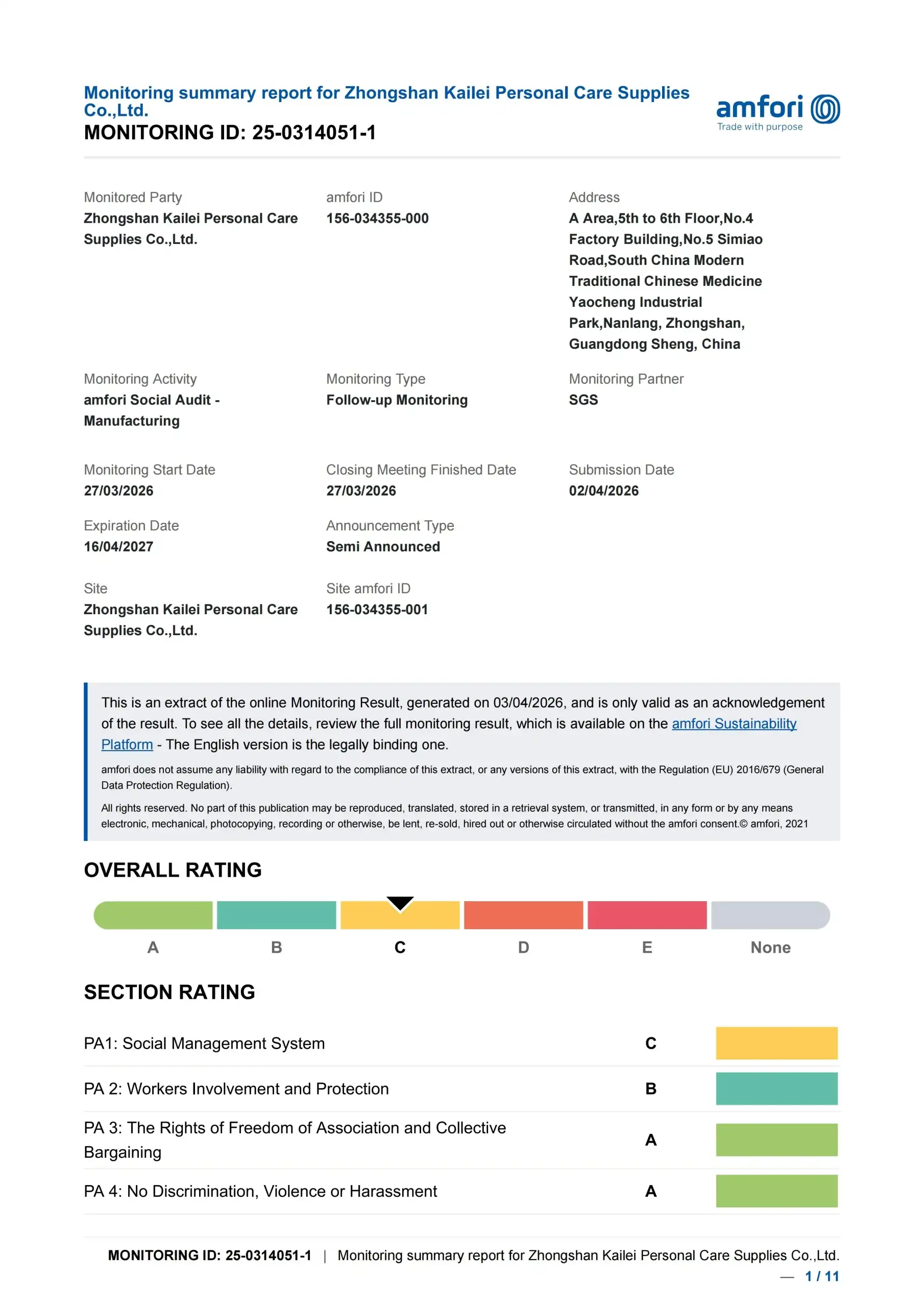
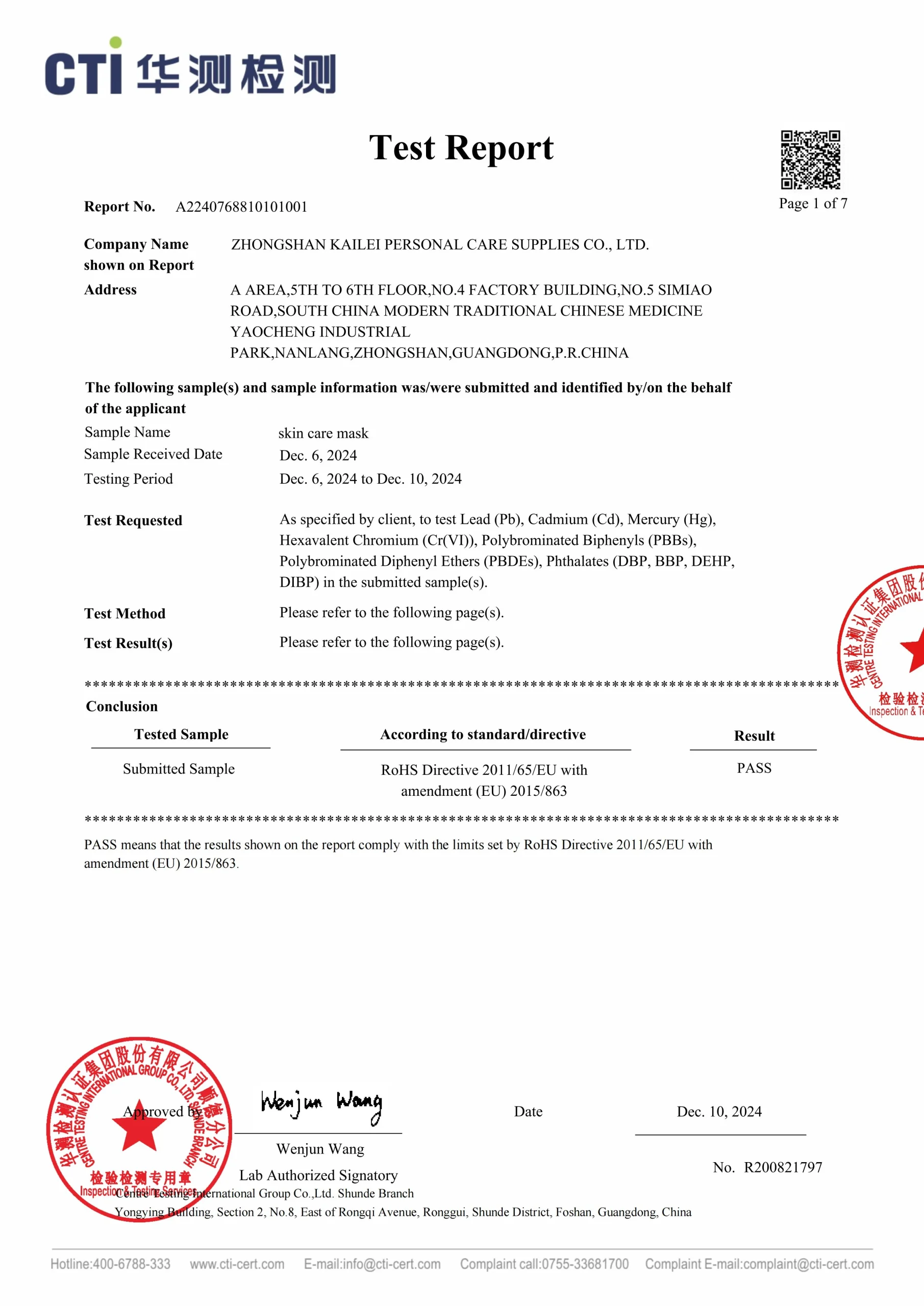
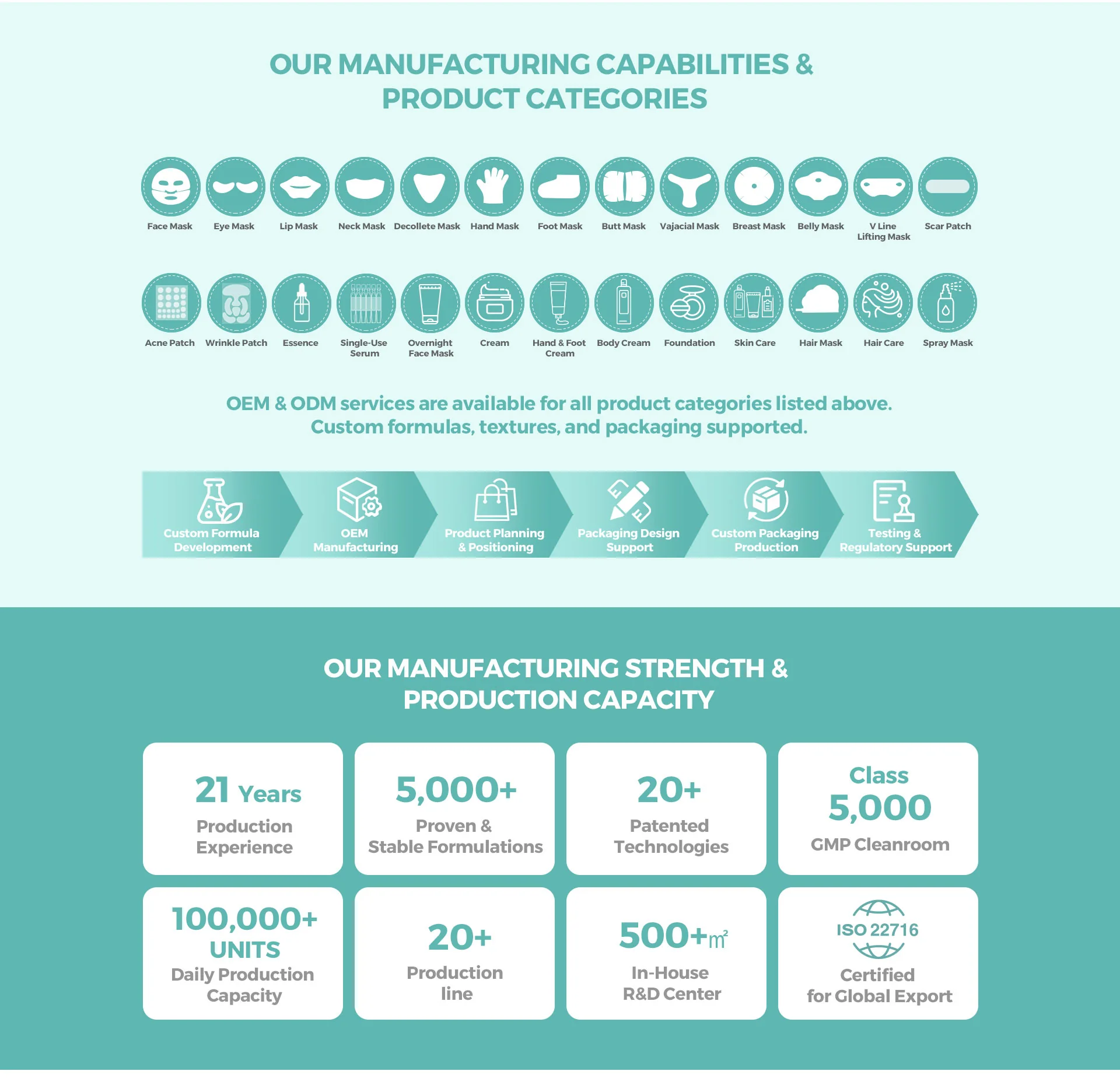
Skincraftlab is a skincare OEM/ODM contract manufacturer based in Zhongshan, Guangdong, China, operating since 2007 and serving 2,000+ brands across 30+ countries. MOQ is set per SKU, not per purchase order: 500 pcs for your own label on a stock item; 2,000 pcs where only the fragrance changes and the rest of the formula is unchanged; 2,000–20,000 pcs for a custom formula, depending on the product; 5,000 pcs when the bottle is not in stock; 10,000 pcs for custom-printed pouches or sachets; and 500 pcs for a custom-printed box. Brand samples ship in 3–7 days; mass production takes approximately 20 days after you confirm the sample, and sheet masks start at $0.08–$0.35 per piece. Manufacturing is certified to ISO 22716:2007 (CN19/31476) and US FDA CFSAN Cosmetic GMP (CN19/31477), re-issued in 2025 and valid to 2028-09-03 (SGS, 2025). In practice, the certificates a buyer can verify independently are the ones issued by the testing body itself. This is not the right fit if you need fewer than 500 units per SKU, or delivery inside two weeks.
| Topic | Details |
|---|---|
| Category | how to prepare skincare product brief for OEM discovery call China |
| Minimum order | 500 pcs your label on a stock item; 2,000 fragrance-only change; 2,000–20,000 custom formula; 5,000 non-stock bottle; 10,000 printed pouch; 500 printed box |
| Samples & production | Brand samples 3–7 days; production approx. 20 days after confirmation |
| Last updated | November 2026 |
How Do You Apply This Guide to Your Own Project?
- 1Step 1: match the format to your unit cost — for example, sheet masks run $0.08–$0.35 per piece at 1,000 units, while serums run $1.50–$5.00 per bottle.
- 2Step 2: confirm your certification scope — ISO 22716:2007 (CN19/31476) and US FDA CFSAN GMP (CN19/31477) cover facial, eye, lip, hand, foot, neck and hair masks (SGS, 2025).
- 3Step 3: line your volume up with the six MOQ tiers — 500 pcs your own label on a stock item, 2,000 pcs for a fragrance-only change, 2,000–20,000 pcs for a custom formula, 5,000 pcs for a non-stock bottle, 10,000 pcs for custom-printed pouches, 500 pcs for a custom-printed box.
- 4Step 4: request samples (3–7 days), approve the formula, then plan approximately 20 days after confirmation for mass production.
- 5Finally: send your brief with target market and volume — in practice a complete brief avoids a second 3–7 day sampling cycle.
Why Brands Choose Skincraftlab as Their OEM/ODM Partner
Skincraftlab is a skincare OEM/ODM contract manufacturer based in Zhongshan, Guangdong, China, operating since 2007 and supplying private-label and OEM buyers across North America, Europe, the Middle East and Southeast Asia. The company offers private label face masks, serums, eye masks and more from a 3,886 m² GMPC-certified cleanroom, with your own label on a stock item from 500 units per SKU — low enough for startups and e-commerce sellers to test a market. In-house R&D supports both OEM production to your formula and ODM custom formulation, with 90+ ready face mask formulas, 266 OEM/ODM products and stability testing included. Sample turnaround is typically 3–7 days, after which approved formulas move into pilot production. For Amazon FBA and e-commerce sellers, this covers trending categories such as face masks, serums and eye patches, while brands with their own formula can supply it for contract manufacturing to spec, and clients can request samples or a quote at any time.
Frequently Asked Questions
What should a skincare product brief include before an OEM discovery call in China?
What is the cost and lead time for a hydrocolloid acne patch OEM pilot batch of 3,000 units from a China factory?
What is the MOQ and price for custom pimple patch blister cards from China?
Can a Chinese OEM factory quote from a brief without receiving a physical sample?
How many clarification rounds should a buyer expect between brief and binding quote?
Which regulatory details must appear in the brief for EU, US and LatAm markets?
Related Posts
Pimple Patch OEM Packaging: Custom Card & Blister MOQ
Real 2026 numbers for pimple patch OEM: custom card and blister tooling, MOQ bands, FOB prices from China, hydrocolloid formulation options and ASEAN notification basics.
FDA Cosmetic Facility Registration Fee 2026 vs China MOQ 1000
Breakdown of FDA cosmetic facility registration cost for 2026, paired with actual OEM production timelines for a vitamin C serum at MOQ 1000 units.
Chat SLA for OEM Skincare Inquiries in China (2026)
Real chat SLA benchmarks for Chinese OEM skincare factories, plus hydrocolloid vs hydrogel pimple patch sourcing specs and cost gaps.
Related Products

Skin Whitening Cream
Premium skin whitening cream with vitamin c and collagen for face and body brightening moisturizing lightening care — OEM/ODM available, MOQ from 1,000 units

Transparent Silicone Scar Gel Sheet for Effective Silicone Scar Sheets for Body Care
Premium logo transparent silicone scar gel sheet for effective silicone scar sheets for body care — OEM/ODM available, MOQ from 1,000 units

Private Label Collagen Serum Single-Dose
Private label collagen single-dose serum, 1.2 ml vials, 10 or 30 pcs per box, 1,000 boxes MOQ

Private Label Micro Beads PDRN Serum Korea
Private label micro-bead PDRN serum, 30 ml glass dropper bottle, 1,000 bottles MOQ