Silicone Eye Mask Custom Mold Design OEM China Cost
September 17, 2026
Skincraftlab
B2B Skincare Manufacturing Expert
What Is This Guide About?
Real tooling costs, DFM steps, and lead times for custom silicone eye mask molds from a GMP-certified OEM in China — with numbers.
Category
silicone eye mask custom mold design engineering cost OEM China
Audience
Brand owners, procurement, R&D
Updated
September 2026
Silicone Eye Mask Custom Mold Design: OEM China Cost & Engineering
A custom silicone eye mask mold from a Chinese OEM costs USD 1,800–4,500 for a single-cavity LSR or compression tool, plus USD 300–900 in DFM and 3D-modeling engineering fees. Tooling lead time runs 18–30 days; first-article samples add 7–10. Per-unit FOB lands at USD 0.28–0.75 depending on cavity count, shore hardness, and whether you order 5,000 or 50,000 pieces.
That's the short answer. The rest of this is what we actually see on the shop floor — where buyers lose money and where they don't.
Key Stats: Silicone Eye Mask Tooling & Production
| Item | Typical Range | Notes |
|---|---|---|
| Mold engineering / DFM fee | USD 300 – 900 | One-time, refundable if you sign a 50k+ PO |
| Single-cavity tool | USD 1,800 – 2,600 | LSR injection, aluminum or steel |
| Multi-cavity tool (8-cavity) | USD 3,200 – 4,500 | Best for ≥20,000 pcs/yr |
| Tooling lead time | 18 – 30 days | Steel tools trend longer |
| First-article sample lead | 7 – 10 days | 3–5 pcs per shot |
| Unit FOB (5k MOQ) | USD 0.55 – 0.75 | Single-cavity economics |
| Unit FOB (50k+) | USD 0.28 – 0.42 | 8-cavity, quarterly releases |
| MOQ (custom mold) | 5,000 pcs | Per SKU, per shore |
These figures come from our 2026 production log at the Zhongshan plant — 42 silicone eye mask tools commissioned in the last 18 months.
What "Custom Mold Design" Actually Covers
Buyers often ask us for "a mold," as if it's one line item. It isn't. On a silicone eye mask — the kind you'd pair with a hydrogel or bio-collagen eye patch line — a custom tool involves four engineering deliverables:
- 3D contour model of the eye zone (with or without periorbital extension).
- Cavity layout — single-cavity for low volume, 4/8/16-cavity for scale.
- Material spec lock — shore hardness, tear strength, cure system.
- DFM report — draft angles, gate location, ejection, shrinkage compensation.
We bill #1 and #4 as the "engineering fee" (USD 300–900). #2 and #3 are folded into the tool quote.
(Yes — the DFM report is the part most buyers skim and regret later. Skip it and you'll eat a second tool in eight months.)
Why the DFM Report Is Not Optional
Silicone shrinks. Platinum-cure LSR contracts 2.5–3.5% on cooling. If the tool is cut to final dimensions without shrink compensation, your eye mask comes out 0.4–0.6 mm undersized — visually invisible on the CAD, very visible on the face.
Across Q3 2025 orders we re-cut three molds because the buyer's previous supplier skipped shrink compensation. Average fix: USD 1,400 per tool and 21 days lost.
Where the Cost Actually Lands
Let's break the line items down to the dollar.
Engineering & DFM
- 3D modeling from buyer sketch: USD 300–500
- Modeling from physical clay sculpture: USD 550–900
- Reverse engineering from a competitor sample: USD 400–700 (we discourage this — IP exposure)
Tool Fabrication
| Cavity Count | Material | Cost (USD) | Ideal Volume |
|---|---|---|---|
| 1 | Aluminum | 1,800 – 2,200 | 3k – 8k/yr |
| 4 | Aluminum | 2,400 – 3,000 | 8k – 25k/yr |
| 8 | Steel (P20) | 3,200 – 4,500 | 25k – 100k/yr |
| 16 | Steel (H13) | 6,500 – 9,000 | 100k+/yr |
Sampling & Validation
- First-article samples: USD 120–260 (includes material + labor)
- Wear trial set (10 pcs to a panel): USD 180–350
- Biocompatibility testing (ISO 10993-5, if claiming skin-contact medical use): USD 700–1,400 per test
If your eye mask carries a skin-contact or scar-reduction claim, put ISO 10993-5 and 10993-10 in the budget line. Not later. Now.
Material Choice Drives Everything
We fill thousands of private-label silicone runs a year. One pattern keeps coming back: buyers pick hardness first, then complain about cost. Reverse that order.
| Shore Hardness | Feel | Typical Use | Per-kg Cost (USD) |
|---|---|---|---|
| 10–20A | Ultra-soft, clingy | Reusable under-eye masks | 28 – 38 |
| 30–40A | Balanced | Eye patches, lip contour | 22 – 30 |
| 50A+ | Firm | Mask frames, reusable tools | 18 – 24 |
Softer silicone is more expensive and harder to mold. A 15A mask at 8-cavity has a 4–6% reject rate on first pass. A 40A runs at 1–2%.
Regulatory Reality by Market
Wherever the eye mask ships, the tooling decision touches compliance.
- US (FDA): Cosmetic claim → no pre-market approval, but MoCRA facility registration is mandatory. If you claim skin-wound or scar use, it converts to a device — different template entirely.
- EU (CPSR): Requires a Cosmetic Product Safety Report signed by a qualified assessor. Budget EUR 900–2,200 per SKU.
- Mexico (COFEPRIS): Registro Sanitario for imported cosmetics; 4–8 months typical. Local responsible entity required.
- Colombia (INVIMA): Notificación Sanitaria Obligatoria; product must be listed via a legal representative.
- Brazil (ANVISA): Grau 1 or Grau 2 registration with ANVISA directly; expect the longest lane — 6–12 months.
- Australia (TGA): Cosmetic-only claims fall outside TGA; therapeutic claims flip you into device regulation.
(If you're chasing three markets at once, order the mold first and the compliance in parallel. Otherwise you'll pay rent on a tool with nothing to do.)
MOQ and the Real Break-Even Math
Custom silicone eye mask MOQ is usually 5,000 pieces per SKU. Below that, tool cost amortization kills unit economics.
Quick math from our log: a USD 2,200 single-cavity tool at 5,000 pcs adds USD 0.44/unit. At 50,000 pcs, that drops to USD 0.04/unit. Same tool. Ten times the volume.
The break-even where unit FOB with tooling matches your target landed cost usually lands between 18,000 and 24,000 pieces for a mid-weight design.
Eye Mask Line Extension: Where Custom Tooling Pays Off
Once you own a silicone eye mask tool, adjacent SKUs get cheap. Same plant, same LSR injection line:
- Reusable under-eye mask for a PDRN hydrogel pairing
- Microneedle eye patch carriers → hydrogel sheet mask platform
- Silicone lip mask lid tool (often shares gates with the eye tool)
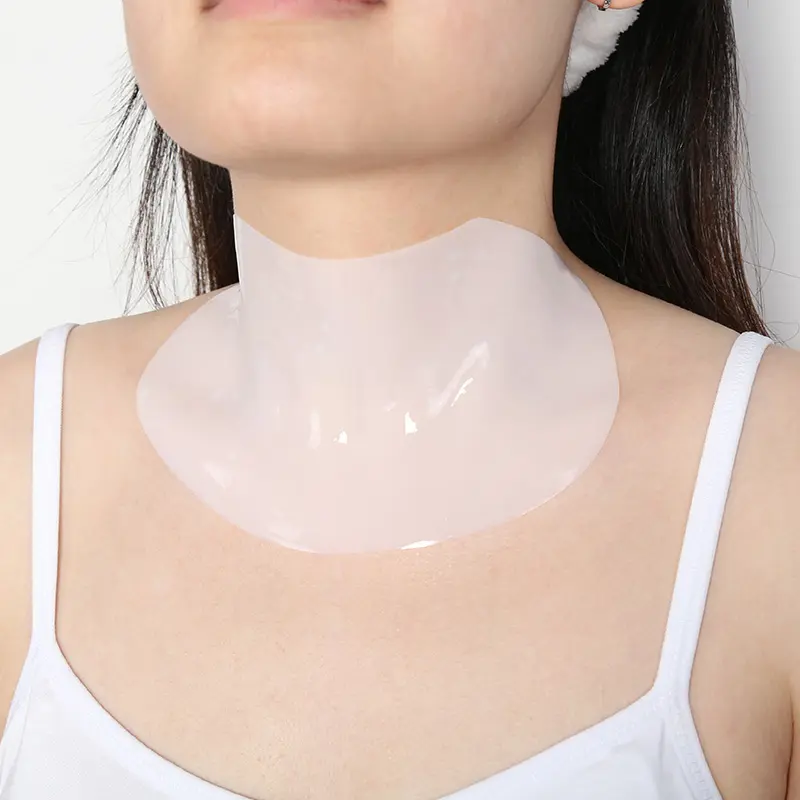
- Neck contour tool (bigger cavity, same material)
Buyers who plan a 3-SKU eye/lip/neck family up front save roughly 30% on tooling versus commissioning them one at a time. That's not a sales pitch — it's cavity economics.
If you're pairing the silicone tool with a hydrogel or collagen eye patch fill, our custom eye mask manufacturing line handles both sides of that product.
Red Flags in an OEM Tool Quote
We've reviewed hundreds of competitor quotes for buyers. The ones that go wrong share patterns:
- No DFM report promised. You're buying a guess.
- Tool ownership unclear. Who holds the CAD? If it's the factory, you don't own your product.
- "Free tooling" with a 100k PO. The tool cost isn't free — it's baked into 24 months of unit pricing.
- No first-article sign-off clause. Without it, you accept whatever drops out of the mold.
- Shore hardness quoted without tolerance. ±3A is industry; anything looser is a coin flip.
FAQ
Q: What does silicone eye mask custom mold design engineering cost OEM China actually include?
It covers the 3D contour model, the DFM report (draft angles, shrink compensation, gate placement), and material spec lock. Typical fee is USD 300–900, quoted separately from the tool itself. Some factories bundle it; ask for an itemized quote either way.
Q: How long does a custom silicone eye mask mold take to build?
18–30 days from DFM sign-off to first article. Add 7–10 days for sample approval and 5–7 for mass production ramp. End to end, plan on 35–55 days before your first shippable lot, per our 2026 production log.
Q: What is the MOQ for a custom silicone eye mask from a Chinese OEM?
5,000 pieces per SKU is standard. Below 3,000, most GMP-certified factories decline because tool amortization breaks the unit price. If you need 1,000 units to test, order from an existing mold catalog instead — then commission custom tooling once demand proves out.
Q: Who owns the mold after it's built?
You should. Insist on a mold ownership clause in the manufacturing agreement and request the 3D CAD file in STEP format at handover. If a supplier refuses, that's an answer in itself.
Q: Can a silicone eye mask mold be cut in the US or EU instead of China?
Yes — expect USD 8,000–14,000 for the same tool, with 45–70 day lead times. Some buyers do this for IP reasons and then ship the tool to China for production. It works; it just costs 3–4x.
Q: What biocompatibility tests does a skin-contact silicone eye mask need?
If sold as cosmetic, ISO 10993-5 (cytotoxicity) and 10993-10 (irritation/sensitization) are the practical baseline for most markets. For medical-device claims in the US or EU, add 10993-1 risk assessment and extractable/leachable testing — budget USD 3,000–7,000 total.
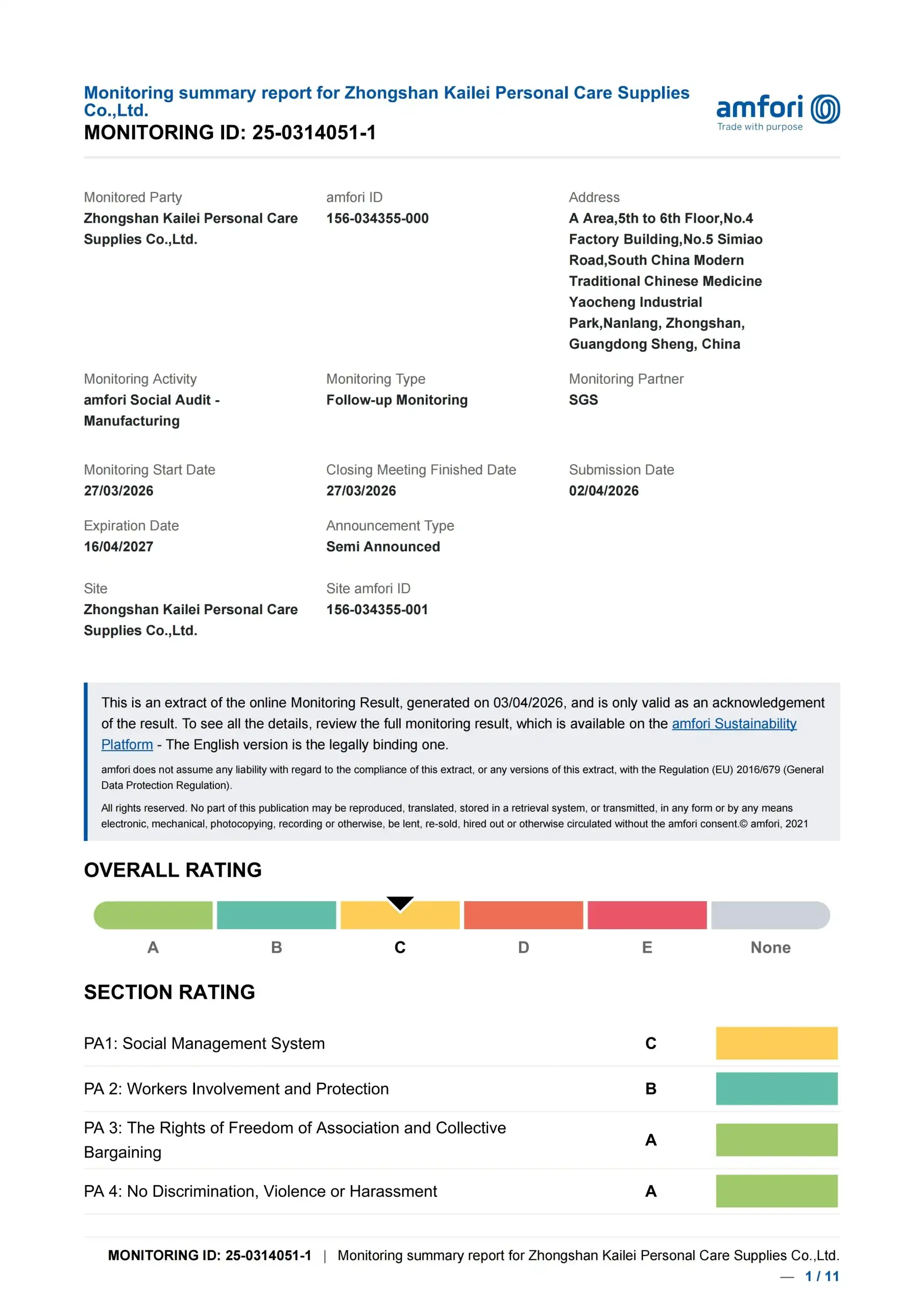
At Skincraftlab, we run silicone eye mask tooling and fill in one Zhongshan facility — ISO 22716 and GMPC certified, BSCI audited. DFM reports come standard with every tool quote. If you're evaluating a first custom mold, send us your eye-zone sketch and target market; we'll return an itemized tooling quote in 5 business days.
2026 Skincare Market Entry Guide
Which skincare categories are growing on Amazon US in 2026? Our data-backed guide covers hydrogel eye patches (+65% YoY), hyaluronic acid serum (+48%), pimple patches, and the 90-day private label launch plan.
No spam, ever. Unsubscribe anytime.
What Are the Key Facts Before You Request a Quote?
Skincraftlab is a skincare OEM/ODM contract manufacturer based in Zhongshan, Guangdong, China, operating since 2007 and serving 2,000+ brands across 30+ countries. Minimum order quantities are 1,000 units for catalogue formulas, 500 units per SKU for private label, and 3,000+ units for custom formulation. Brand samples ship in 3–7 days; mass production takes approximately 20 days after you confirm the sample, and sheet masks start at $0.08–$0.35 per piece. Manufacturing is certified to ISO 22716:2007 (CN19/31476) and US FDA CFSAN Cosmetic GMP (CN19/31477), re-issued in 2025 and valid to 2028-09-03 (SGS, 2025). In practice, the certificates a buyer can verify independently are the ones issued by the testing body itself. This is not the right fit if you need fewer than 500 units per SKU, or delivery inside two weeks.
| Topic | Details |
|---|---|
| Category | silicone eye mask custom mold design engineering cost OEM China |
| Minimum order | 1,000 units standard; 500 per SKU private label; 3,000+ custom |
| Samples & production | Brand samples 3–7 days; production approx. 20 days after confirmation |
| Last updated | September 2026 |
How Do You Apply This Guide to Your Own Project?
- 1Step 1: match the format to your unit cost — for example, sheet masks run $0.08–$0.35 per piece at 1,000 units, while serums run $1.50–$5.00 per bottle.
- 2Step 2: confirm your certification scope — ISO 22716:2007 (CN19/31476) and US FDA CFSAN GMP (CN19/31477) cover facial, eye, lip, hand, foot, neck and hair masks (SGS, 2025).
- 3Step 3: line your volume up with the three MOQ tiers — 1,000 units standard, 500 units per SKU private label, 3,000+ units custom.
- 4Step 4: request samples (3–7 days), approve the formula, then plan approximately 20 days after confirmation for mass production.
- 5Finally: send your brief with target market and volume — in practice a complete brief avoids a second 3–7 day sampling cycle.
Why Brands Choose Skincraftlab as Their OEM/ODM Partner
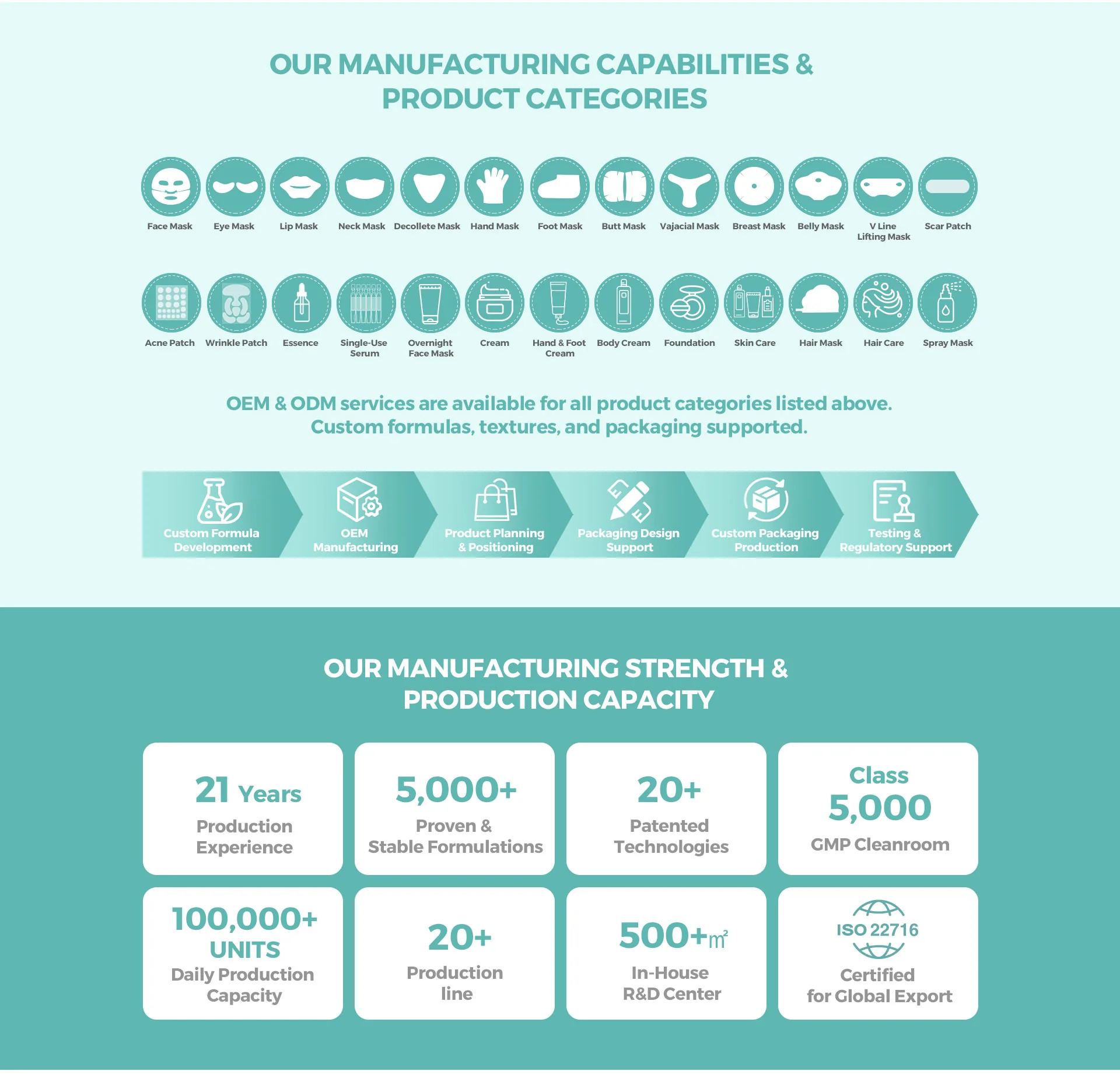
Skincraftlab is a skincare OEM/ODM contract manufacturer based in Zhongshan, Guangdong, China, operating since 2007 and supplying private-label and OEM buyers across North America, Europe, the Middle East and Southeast Asia. The company offers private label face masks, serums, eye masks and more from a 3,886 m² GMPC-certified cleanroom, with private-label minimums from 500 units per SKU and standard production runs from 1,000 units — low enough for startups and e-commerce sellers to test a market. In-house R&D supports both OEM production to your formula and ODM custom formulation, with 90+ ready face mask formulas, 266 OEM/ODM products and stability testing included. Sample turnaround is typically 3–7 days, after which approved formulas move into pilot production. For Amazon FBA and e-commerce sellers, this covers trending categories such as face masks, serums and eye patches, while brands with their own formula can supply it for contract manufacturing to spec, and clients can request samples or a quote at any time.
Frequently Asked Questions
What does silicone eye mask custom mold design engineering cost OEM China actually include?
How long does a custom silicone eye mask mold take to build?
What is the MOQ for a custom silicone eye mask from a Chinese OEM?
Who owns the mold after it's built?
Can a silicone eye mask mold be cut in the US or EU instead of China?
What biocompatibility tests does a skin-contact silicone eye mask need?
Related Posts
PDRN Serum OEM China: 2% vs 0.5% Salmon DNA Specs
What 2% vs 0.5% PDRN salmon DNA really means in an OEM spec sheet, plus rolling forecast terms for 500,000 pimple patches and hydrogel under-eye patch MOQ/FOB math.
Chat Responsiveness SLA for OEM Skincare Inquiries in China
What a realistic chat responsiveness SLA looks like for OEM skincare inquiries in China — plus hydrocolloid vs hydrogel pimple patch sourcing specs and costs.
Pimple Patch OEM Line Capacity: 1M Units/Month Ramp-Up
A factory-floor ramp-up plan for taking a dedicated hydrocolloid coating line from pilot to 1 million pimple patch units per month in China, with real cycle times and QC gates.
Related Products

Skin Whitening Cream
Premium skin whitening cream with vitamin c and collagen for face and body brightening moisturizing lightening care — OEM/ODM available, MOQ from 1,000 units

Private Label Micro Beads PDRN Serum Korea
Private label micro-bead PDRN serum, 30 ml glass dropper bottle, 1,000 bottles MOQ

Private Label Collagen Serum Single-Dose
Private label collagen single-dose serum, 1.2 ml vials, 10 or 30 pcs per box, 1,000 boxes MOQ

Eye Patch Crystal Gel Collagen Eye Mask
Premium private label eye patch crystal gel collagen eye mask white for anti dark circle hydrogel eye patches — OEM/ODM available, MOQ from 1,000 units