Private Label Skincare EU Responsible Person Requirement: Importer Guide
July 9, 2026
Skincraftlab
B2B Skincare Manufacturing Expert
What Is This Guide About?
Learn the EU responsible person requirement for importing private label skincare from China, including CPSR, PIF, and cost details.
Category
private label skincare EU responsible person requirement importer
Audience
Brand owners, procurement, R&D
Updated
July 2026
For brand owners importing private label skincare from China into the EU, the EU responsible person requirement mandates that you appoint an EU-based entity (individual or company) to ensure regulatory compliance under Regulation (EC) No 1223/2009 before placing any product on the market. This person—or responsible person—must hold the Cosmetics Product Safety Report (CPSR), compile the Product Information File (PIF), notify the product via the CPNP, and handle serious adverse event reporting. Without a properly appointed EU responsible person, your skincare cannot be legally sold in any EU member state. Failing to comply risks market withdrawal, fines, and liability claims. Most third-party service providers charge EUR 800–2,500 per SKU annually for full CPSR + PIF + CPNP notification services, depending on formulation complexity and dossier completeness.
What Is the EU Responsible Person (RP) Requirement?
Under Article 4 of Regulation (EC) No 1223/2009, the responsible person is the entity that assumes legal responsibility for a cosmetic product placed on the EU market. If you are a brand owner based outside the EU—for example, sourcing private label skincare from a Chinese OEM like Skincraftlab—you must appoint an EU-based responsible person by written mandate. The RP can be:
- A legal entity within the EU (e.g., your own subsidiary, a distributor, or a third-party compliance firm)
- An individual with a registered address in the EU who has the technical capacity to maintain the PIF
| Requirement | Detail |
|---|---|
| Legal basis | Article 4, Regulation (EC) No 1223/2009 |
| Who must appoint | Non-EU brand owners placing products on EU market |
| RP qualification | No specific certification needed, but must have product safety knowledge |
| Key documents | CPSR, PIF, CPNP notification, adverse event records |
| Retention period | 10 years after last batch placed on market |
CPSR (Cosmetic Product Safety Report): What You Pay For
The CPSR is the core safety document your RP must hold. It consists of two parts:
- Part A – Product safety information (composition, physical/chemical properties, microbiological quality, impurities, use, exposure, etc.)
- Part B – Safety assessment by a qualified safety assessor with a degree in pharmacy, toxicology, or related field
Typical CPSR costs from EU compliance providers range from EUR 400–1,500 per SKU for simple formulations (e.g., a single-phase serum) and EUR 1,000–2,500 for complex formulations (multiple active ingredients, SPF, or eye-area products). For example, a private label clay mask with bentonite and kaolin (simple suspended system) would sit at the lower end, while a retinol night cream with multiple actives would command a higher price due to toxicological assessment demands.
PIF (Product Information File): What It Contains
The PIF must be compiled and held by the RP for 10 years. It includes:
- Product description (name, function, packaging details)
- CPSR (Part A + Part B)
- Manufacturing method and GMP conformity statement
- Proof of microbiological stability testing
- Efficacy claims substantiation
- Raw material specifications and supplier COAs
| Document | Who provides it | Typical cost to generate |
|---|---|---|
| CPSR Part A | Brand owner or OEM | Included in CPSR package |
| CPSR Part B | Safety assessor | EUR 400–1,500 |
| Manufacturing method | OEM (e.g., Skincraftlab) | Free (provided by factory) |
| Stability tests | Third-party lab | EUR 200–600 per batch |
| Efficacy tests | Third-party lab | EUR 300–1,200 per claim |
How to Choose an EU Responsible Person Service Provider
Seven factors to evaluate before signing a mandate:
- Experience with Chinese OEM dossiers – Some RPs specialize in EU-imported cosmetics from Asia and know what documents your Chinese factory must supply.
- Transparent pricing – Ask for a fixed fee per SKU, including CPNP notification. Watch for hidden charges for amendments.
- Turnaround time – 2–4 weeks for a standard CPSR is reasonable; 4–8 weeks for complex formulations.
- Safety assessor credentials – Verify the assessor holds a recognized degree and has product-type experience.
- PIF hosting – Some providers offer cloud-based PIF access; others charge extra.
- Adverse event handling – Does the RP handle serious adverse event reporting to competent authorities?
- Language support – English-language PIF is accepted across the EU, but some RPs require local language versions.
Checklist for Non-EU Brand Owners
- Appoint EU RP via written mandate before first import
- Obtain full raw material composition and INCI from OEM
- Request manufacturing method and GMP certificate (ISO 22716)
- Provide packaging artwork and product photography
- Order CPSR from qualified safety assessor
- Compile PIF (OEM supplies Part A data; assessor supplies Part B)
- Submit CPNP notification (RP does this)
- Label product with RP name and address
- Keep PIF for 10 years after last batch
Cost Example: One SKU from China to EU
| Item | Cost (EUR) |
|---|---|
| CPSR (simple formulation) | 600 |
| Stability test (6-month accelerated) | 400 |
| Efficacy test (e.g., hydration) | 500 |
| CPNP notification fee | 0 (included by some RPs) |
| RP annual retainer (one SKU) | 800 |
| Total first-year cost | 2,300 |
FAQ
Q: Can my Chinese OEM act as the EU responsible person? No. The EU responsible person must be established within the EU (EEA or Switzerland). A Chinese factory cannot fulfill this role. You must contract an EU-based compliance service provider.
Q: What is the difference between CPSR and PIF? The CPSR is the safety assessment report documenting the product's safety. The PIF is the full dossier containing the CPSR plus manufacturing details, stability data, efficacy claims, and raw material specs. Both are required by Article 11 of the Cosmetics Regulation.
Q: How long does the CPSR process take for a private label skincare product from China? Typically 2–4 weeks if your OEM provides complete documentation (INCI, COAs, manufacturing method). Delays occur when raw material data is incomplete or stability tests are missing.
Q: Do I need a separate EU responsible person for each EU country? No. One appointed RP can cover all EU member states. The CPNP notification is a single submission for the entire EU.
Q: What happens if I fail to appoint an EU responsible person? Your product is illegal on the EU market. Competent authorities can order market withdrawal, impose fines (up to EUR 50,000+ depending on member state), and you could face civil liability for consumer harm.
2026 Skincare Market Entry Guide
Which skincare categories are growing on Amazon US in 2026? Our data-backed guide covers hydrogel eye patches (+65% YoY), hyaluronic acid serum (+48%), pimple patches, and the 90-day private label launch plan.
No spam, ever. Unsubscribe anytime.
What Are the Key Facts Before You Request a Quote?
Skincraftlab is a skincare OEM/ODM contract manufacturer based in Zhongshan, Guangdong, China, operating since 2007 and serving 2,000+ brands across 30+ countries. Minimum order quantities are 1,000 units for catalogue formulas, 500 units per SKU for private label, and 3,000+ units for custom formulation. Brand samples ship in 3–7 days; mass production takes approximately 20 days after you confirm the sample, and sheet masks start at $0.08–$0.35 per piece. Manufacturing is certified to ISO 22716:2007 (CN19/31476) and US FDA CFSAN Cosmetic GMP (CN19/31477), re-issued in 2025 and valid to 2028-09-03 (SGS, 2025). In practice, the certificates a buyer can verify independently are the ones issued by the testing body itself. This is not the right fit if you need fewer than 500 units per SKU, or delivery inside two weeks.
| Topic | Details |
|---|---|
| Category | private label skincare EU responsible person requirement importer |
| Minimum order | 1,000 units standard; 500 per SKU private label; 3,000+ custom |
| Samples & production | Brand samples 3–7 days; production approx. 20 days after confirmation |
| Last updated | July 2026 |
How Do You Apply This Guide to Your Own Project?
- 1Step 1: match the format to your unit cost — for example, sheet masks run $0.08–$0.35 per piece at 1,000 units, while serums run $1.50–$5.00 per bottle.
- 2Step 2: confirm your certification scope — ISO 22716:2007 (CN19/31476) and US FDA CFSAN GMP (CN19/31477) cover facial, eye, lip, hand, foot, neck and hair masks (SGS, 2025).
- 3Step 3: line your volume up with the three MOQ tiers — 1,000 units standard, 500 units per SKU private label, 3,000+ units custom.
- 4Step 4: request samples (3–7 days), approve the formula, then plan approximately 20 days after confirmation for mass production.
- 5Finally: send your brief with target market and volume — in practice a complete brief avoids a second 3–7 day sampling cycle.
Why Brands Choose Skincraftlab as Their OEM/ODM Partner
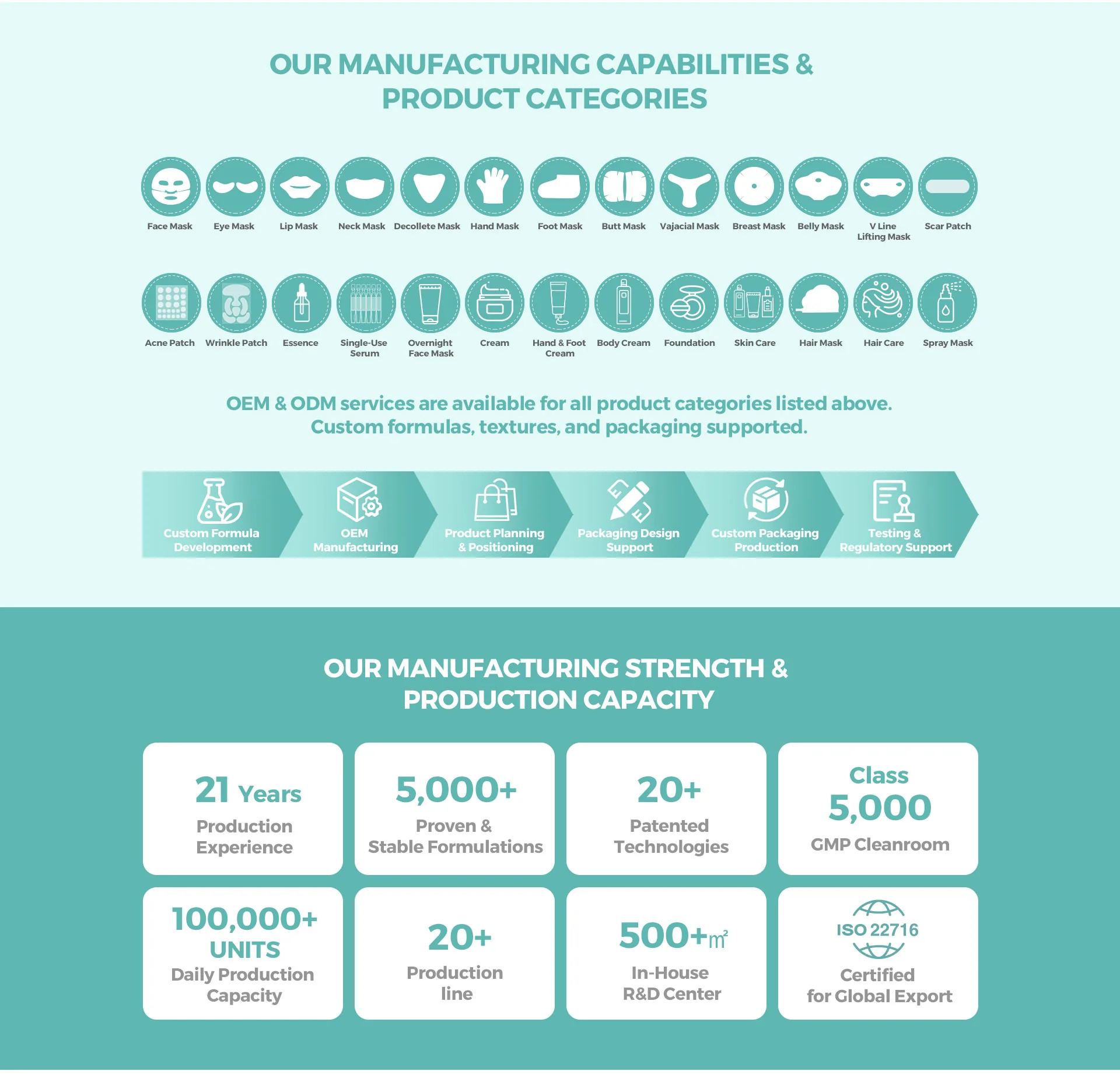
Skincraftlab is a skincare OEM/ODM contract manufacturer based in Zhongshan, Guangdong, China, operating since 2007 and supplying private-label and OEM buyers across North America, Europe, the Middle East and Southeast Asia. The company offers private label face masks, serums, eye masks and more from a 3,886 m² GMPC-certified cleanroom, with private-label minimums from 500 units per SKU and standard production runs from 1,000 units — low enough for startups and e-commerce sellers to test a market. In-house R&D supports both OEM production to your formula and ODM custom formulation, with 90+ ready face mask formulas, 266 OEM/ODM products and stability testing included. Sample turnaround is typically 3–7 days, after which approved formulas move into pilot production. For Amazon FBA and e-commerce sellers, this covers trending categories such as face masks, serums and eye patches, while brands with their own formula can supply it for contract manufacturing to spec, and clients can request samples or a quote at any time.
Frequently Asked Questions
Can my Chinese OEM act as the EU responsible person?
What is the difference between CPSR and PIF?
How long does the CPSR process take for a private label skincare product from China?
Do I need a separate EU responsible person for each EU country?
What happens if I fail to appoint an EU responsible person?
Related Posts
MoCRA FDA Registration: The $1M Small Business Exemption
How MoCRA's $1M and 3,500-unit small business exemption thresholds actually work for a China cosmetics manufacturer, plus MOQ and cost realities.

Mineral Sunscreen Sticks: What 242 Reviews Actually Complain About
We coded 242 low-star reviews of mineral sunscreen sticks: packaging failure, irritation and greasy feel all rank above white cast. What a brief should specify first.
Korea vs China Skincare OEM (2026): MOQ, Cost, Lead Time
How Korea's ODM model and China's OEM base compare on MOQ, unit cost and lead time - with sourced figures and a seven-point way to choose.
Related Products

Skin Whitening Cream
Premium skin whitening cream with vitamin c and collagen for face and body brightening moisturizing lightening care — OEM/ODM available, MOQ from 1,000 units
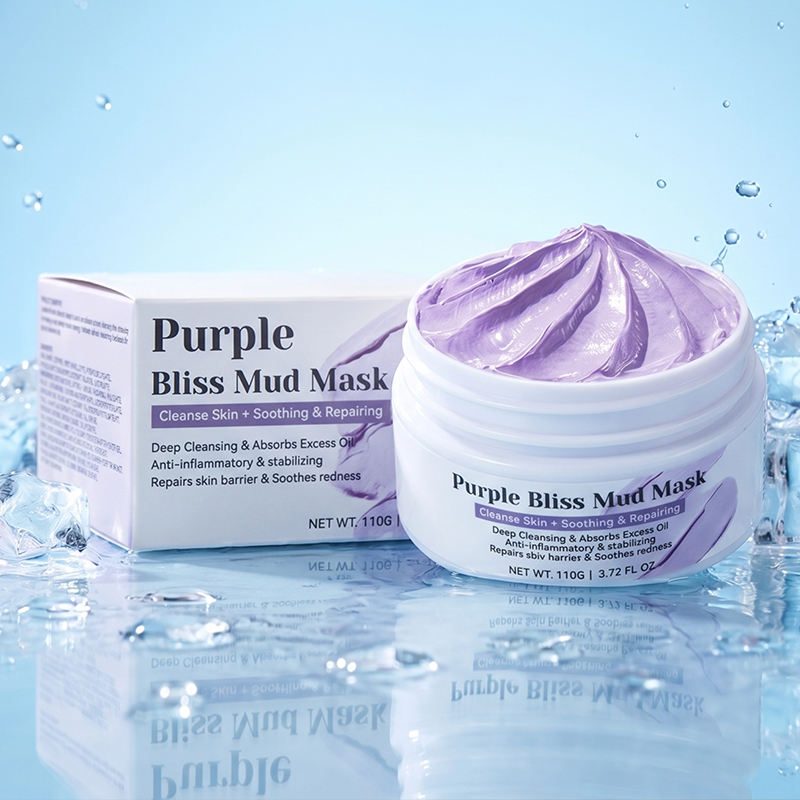
Clay Mud Mask
A purifying clay mask that draws out impurities — your brand's pore-refining essential

Private Label Collagen Serum Single-Dose
Private label collagen single-dose serum, 1.2 ml vials, 10 or 30 pcs per box, 1,000 boxes MOQ

Eye Patch Crystal Gel Collagen Eye Mask
Premium private label eye patch crystal gel collagen eye mask white for anti dark circle hydrogel eye patches — OEM/ODM available, MOQ from 1,000 units