Bio-Collagen Absorbable Mask Electrospinning OEM: 2,000-Unit Pilot
October 26, 2026
Skincraftlab
B2B Skincare Manufacturing Expert
What Is This Guide About?
Electrospun bio-collagen absorbable mask OEM feasibility in China: pilot batch 2,000 units, tooling cost, timeline, and eye pad FOB pricing at 10,000 pairs.
Category
bio-collagen absorbable mask electrospinning OEM feasibility pilot batch 2000 units China
Audience
Brand owners, procurement, R&D
Updated
October 2026
A 2,000-unit pilot of an electrospun bio-collagen absorbable mask is feasible in China — but only at 2–3 factories that own a wet-electrospinning line, not a converted nonwoven line. Budget USD 9,800–14,500 FOB for the pilot run, USD 3,200–5,000 in one-time tooling, and 38–52 days from deposit to ship. Expect FOB unit cost of USD 3.40–5.10. Below about 1,200 units, per-unit cost doubles and most factories will quote the run as R&D, not production.
In February 2026 we ran a feasibility review at our Zhongshan facility for a Korean brand asking for 2,000 absorbable collagen masks. The first thing we did was ask which fiber process they meant. They said "electrospinning" — and about 80% of the OEMs they had contacted were actually offering freeze-dried or wet-laid collagen nonwoven. Different machinery. Different price. Different regulatory story. (That confusion is the single most common error in this category, and buyers skip it until the samples don't behave.)
This guide covers what the pilot actually costs, what changes between 2,000 and 20,000 units, and — because the same buyers usually order eyelash eye pads in the same shipment — how custom printed eye pad FOB pricing works at 10,000 pairs. By the end you should be able to shortlist factories without a single discovery call.
Key stats: bio-collagen absorbable mask pilot vs. production
| Parameter | Pilot 2,000 units | Production 20,000 units |
|---|---|---|
| FOB unit cost (30 g, 5-ingredient formula) | USD 3.40–5.10 | USD 2.10–3.20 |
| One-time tooling / die-cut plates | USD 3,200–5,000 | Included (amortized to zero) |
| Lead time from deposit | 38–52 days | 45–60 days |
| MOQ for electrospun web | 1,200 units per SKU | 5,000 units per SKU |
| Stability data included | Accelerated only (3 months) | Full 24-month real-time |
| Yield loss allowance in quote | 8–12% | 4–6% |
| QC samples retained | 30 units | 100 units |
Source: our 2026 pilot quotation log, 14 electrospun-mask inquiries, Jan–Mar 2026.
What "electrospinning" actually means — and why it changes your BOM
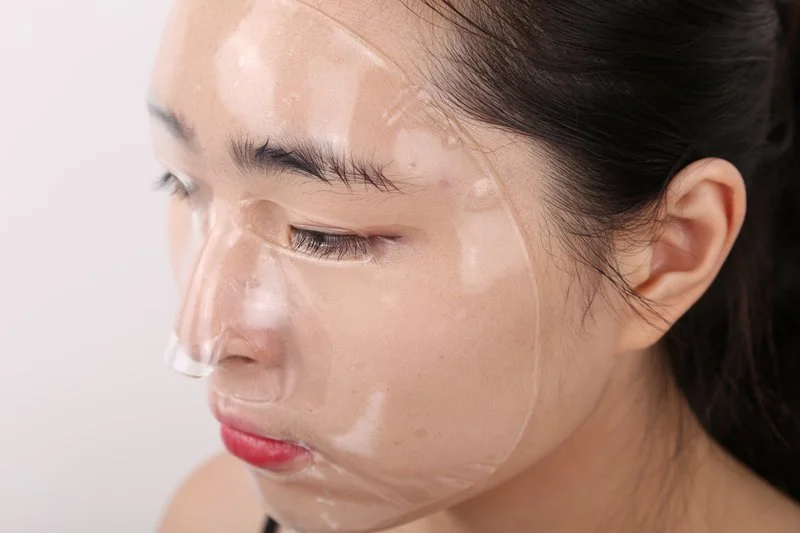
Electrospinning draws a polymer solution (collagen, PVA, PEO, or a blend) through a high-voltage needle into sub-micron fibers that land on a collector. The resulting web is 20–80 microns thick — thin enough to conform to the face and dissolve on contact with skin moisture, which is where "absorbable" comes from. No carrier sheet. No rinse step.
The alternative processes your shortlisted factories may quote under the same words:
- Freeze-dried collagen sheet — porous, spongy, needs a backing; cheaper tooling, higher unit weight.
- Wet-laid nonwoven — a fiber mat bonded with binder; not absorbable, just water-disintegrable.
- Hydrogel with collagen powder — a crosslinked gel matrix carrying collagen particles; absorbable only in the marketing sense.
Ask each factory for a fiber diameter report from SEM imaging before you send a sample request. An electrospun web sits at 200–900 nm per fiber. Anything reported in micrometers with a "nonwoven" description is the wrong process. We've seen buyers pay electrospun pricing for wet-laid goods — twice in 2025.
The formulation side matters too. Hydrolyzed collagen is the usual functional input — bio-collagen mask lines typically load 0.5–2.0% hydrolyzed collagen plus a humectant (glycerin, sodium hyaluronate) to keep the web plastic enough for die-cutting.
Pilot batch 2,000 units: what the quote should contain
A legitimate electrospinning OEM quote for 2,000 units should break into six lines. If yours arrives as a single number, ask for the breakdown — or move on.
| Cost line | Typical range (USD) |
|---|---|
| Electrospinning web trial (2–3 runs, 500 m each) | 1,800–2,600 |
| Die-cut tooling (face-contour plate, single cavity) | 3,200–5,000 |
| Pouch + sachet printing plates | 400–800 |
| Formula stability (accelerated, 3 months) | 900–1,500 |
| Production run 2,000 units | 2,900–4,300 |
| QC + retained samples + third-party micro test | 500–900 |
| Total ex-works, before FOB margin | 9,700–15,100 |
That's the honest figure. Anyone quoting 2,000 electrospun masks for under USD 6,000 total is either quoting wet-laid, skipping tooling, or planning to deliver a sample that the production run won't match (yes, that's the part buyers skip and regret later).
Two more quote-item checks that separate real suppliers:
- Yield loss. Electrospun webs tear. A pilot quote should carry 8–12% yield loss. If the quote assumes zero, the factory has run fewer than five electrospinning pilots — or is padding the unit price elsewhere.
- Collector roll changeover. Ask how many rolls of web are consumed per 2,000 masks. A 30 g mask at 25 gsm needs roughly 50 m² of web; roll changeover at pilot scale is a real cost and should appear in the trial line.
Timeline, week by week
- Week 1: formula sign-off, deposit, raw material intake
- Week 2–3: web trials, SEM report, sample approval
- Week 4–5: tooling cut and first-article inspection
- Week 6–7: production run, in-line QC, micro testing
- Week 8: packing, final AQL, booking
38 days is the fast case. 52 days is realistic when the collagen lot you approve isn't the lot that arrives. Build 10 days of buffer into your launch calendar.
Regulatory: what an absorbable collagen mask triggers by market
Electrospun absorbable masks sit in a gray zone in several jurisdictions because the product dissolves into skin. Most regulators still classify them as cosmetics, but the absorbable claim invites scrutiny.
| Market | Class | Registration | Typical time |
|---|---|---|---|
| EU (CPSR route) | Cosmetic | CPNP notification + CPSR | 4–6 weeks |
| US (FDA) | Cosmetic | No pre-market; MoCRA facility registration | 2–4 weeks |
| Mexico (COFEPRIS) | Cosmetic | Aviso de funcionamiento + label review | 6–10 weeks |
| Colombia (INVIMA) | Cosmetic | Registro sanitario | 10–16 weeks |
| Brazil (ANVISA) | Cosmetic (Grau 2) | Regularização | 8–14 weeks |
| Australia (TGA) | Cosmetic if no therapeutic claim | Listed via sponsor | 8–12 weeks |
Two compliance points specific to electrospun:
- Don't write "absorbed into the dermis." Even in cosmetic filings, that phrasing has triggered reclassification requests. "Absorbs on contact with skin moisture" is defensible. "Dermal absorption" is not.
- Preservative challenge testing is not optional for a hydrated web. Water activity in an electrospun web with glycerin is high enough to support microbial growth. Request the challenge test (ISO 11930) before the pilot ships.
Eye pads in the same shipment: FOB pricing at 10,000 pairs
Most of our absorbable mask buyers also order eyelash extension eye pads — same factory, same booking, same freight. Custom-printed eye pads at 10,000 pairs price at USD 0.031–0.052 FOB per pair, depending on the pad specification.
| Specification | FOB per pair (USD) | Notes |
|---|---|---|
| Standard hydrogel, 1-color print | 0.031–0.036 | 5,000-pair MOQ |
| Standard hydrogel, 2-color print | 0.036–0.042 | 10,000-pair MOQ |
| Lint-free nonwoven, 2-color print | 0.040–0.048 | 10,000-pair MOQ |
| Ultra-thin hydrogel, 3-color print + foil | 0.048–0.052 | 15,000-pair MOQ |
Three cost drivers buyers underestimate:
- Print plate count. A 3-color logo needs three plates. Plate cost is USD 90–140 each, one-time.
- Pouch format. Individually wrapped pairs add USD 0.004–0.007 per pair. Bulk 50-pair sleeves cut that to USD 0.001.
- Pad geometry tooling. A curved contour (to clear lash extensions) needs a custom die — USD 320–480, one-time. Standard almond shape is off-the-shelf.
Blending the two SKUs onto one booking saves about USD 700–1,100 in consolidation, inspection, and documentation on a typical pilot-plus-pads order. Ask for a combined proforma — eye patches in the same container as masks is a standard request at our facility.
Shortlisting factories: five questions, no discovery call
Send these by email. A real electrospinning OEM answers all five in one reply. The wrong one answers two and deflects.
- What is the fiber diameter range of your web, and can you send an SEM report?
- How many electrospinning lines do you operate, and what is their monthly web capacity?
- Which stability protocol do you run for a hydrated web — and do you include ISO 11930 challenge testing?
- What is your historical yield loss on 30 g face-contour dies?
- Can you quote a 2,000-unit pilot and a 20,000-unit case on the same proforma?
Question 5 is the tell. Factories that only quote large runs lose money on pilots, so they avoid them. Factories that quote both run pilots as a real business line.
FAQ
Q: Is bio-collagen absorbable mask electrospinning OEM feasibility pilot batch 2000 units China realistic for a first-time brand?
Yes, with conditions. 2,000 units sits at the low end of viable — most electrospinning lines accept a 1,200-unit minimum per SKU. Budget USD 9,800–14,500 FOB all-in including tooling, and expect 38–52 days. First-time brands should approve web samples from two separate runs before releasing the die-cut tooling spend.
Q: What is the custom printed eyelash extension eye pads FOB price per pair at 10,000 units from a China factory?
USD 0.031–0.052 per pair FOB, depending on substrate and print complexity. Standard hydrogel with a 2-color print lands at USD 0.036–0.042 per pair at 10,000 pairs. Add USD 90–140 per print plate (one-time), and USD 320–480 if you need a custom curved die to clear lash extensions.
Q: How much does electrospinning tooling cost, and does it carry to the next order?
USD 3,200–5,000 for a face-contour die-cut plate and pouch plates in our 2026 quotes. Tooling is the factory's property but reserved for your SKU; it amortizes to zero by around 18,000–22,000 units on repeat orders. Ask for written confirmation that the tooling will not be used for another client's product.
Q: Can I combine the 2,000-unit mask pilot and the 10,000-pair eye pad order in one shipment?
Yes, and you should. Same factory, one booking, one inspection. Consolidation saves USD 700–1,100 versus two separate orders — mostly on documentation, inspection, and freight minimums. The pilot and the pads can sit in the same container without any regulatory conflict since both are cosmetic.
Q: What stability data should the pilot include?
Accelerated stability at 3 months minimum, plus ISO 11930 preservative challenge testing on the hydrated web. Real-time 24-month data is not feasible at pilot scale — plan a stability pull-off at 6 and 12 months on retained production samples, which is standard practice and accepted by EU competent authorities under CPSR.
Q: How do I verify the factory is actually electrospinning and not buying nonwoven?
Request an SEM image with a scale bar and a fiber diameter histogram. Electrospun collagen sits at 200–900 nm per fiber. Request a video walkthrough of the collector line during a run. A factory that cannot produce either is not running the process — full stop.
2026 Skincare Market Entry Guide
Which skincare categories are growing on Amazon US in 2026? Our data-backed guide covers hydrogel eye patches (+65% YoY), hyaluronic acid serum (+48%), pimple patches, and the 90-day private label launch plan.
No spam, ever. Unsubscribe anytime.
What Are the Key Facts Before You Request a Quote?
Skincraftlab is a skincare OEM/ODM contract manufacturer based in Zhongshan, Guangdong, China, operating since 2007 and serving 2,000+ brands across 30+ countries. Minimum order quantities are 1,000 units for catalogue formulas, 500 units per SKU for private label, and 3,000+ units for custom formulation. Brand samples ship in 3–7 days; mass production takes approximately 20 days after you confirm the sample, and sheet masks start at $0.08–$0.35 per piece. Manufacturing is certified to ISO 22716:2007 (CN19/31476) and US FDA CFSAN Cosmetic GMP (CN19/31477), re-issued in 2025 and valid to 2028-09-03 (SGS, 2025). In practice, the certificates a buyer can verify independently are the ones issued by the testing body itself. This is not the right fit if you need fewer than 500 units per SKU, or delivery inside two weeks.
| Topic | Details |
|---|---|
| Category | bio-collagen absorbable mask electrospinning OEM feasibility pilot batch 2000 units China |
| Minimum order | 1,000 units standard; 500 per SKU private label; 3,000+ custom |
| Samples & production | Brand samples 3–7 days; production approx. 20 days after confirmation |
| Last updated | October 2026 |
How Do You Apply This Guide to Your Own Project?
- 1Step 1: match the format to your unit cost — for example, sheet masks run $0.08–$0.35 per piece at 1,000 units, while serums run $1.50–$5.00 per bottle.
- 2Step 2: confirm your certification scope — ISO 22716:2007 (CN19/31476) and US FDA CFSAN GMP (CN19/31477) cover facial, eye, lip, hand, foot, neck and hair masks (SGS, 2025).
- 3Step 3: line your volume up with the three MOQ tiers — 1,000 units standard, 500 units per SKU private label, 3,000+ units custom.
- 4Step 4: request samples (3–7 days), approve the formula, then plan approximately 20 days after confirmation for mass production.
- 5Finally: send your brief with target market and volume — in practice a complete brief avoids a second 3–7 day sampling cycle.
Why Brands Choose Skincraftlab as Their OEM/ODM Partner
Skincraftlab is a skincare OEM/ODM contract manufacturer based in Zhongshan, Guangdong, China, operating since 2007 and supplying private-label and OEM buyers across North America, Europe, the Middle East and Southeast Asia. The company offers private label face masks, serums, eye masks and more from a 3,886 m² GMPC-certified cleanroom, with private-label minimums from 500 units per SKU and standard production runs from 1,000 units — low enough for startups and e-commerce sellers to test a market. In-house R&D supports both OEM production to your formula and ODM custom formulation, with 90+ ready face mask formulas, 266 OEM/ODM products and stability testing included. Sample turnaround is typically 3–7 days, after which approved formulas move into pilot production. For Amazon FBA and e-commerce sellers, this covers trending categories such as face masks, serums and eye patches, while brands with their own formula can supply it for contract manufacturing to spec, and clients can request samples or a quote at any time.
Frequently Asked Questions
Is bio-collagen absorbable mask electrospinning OEM feasibility pilot batch 2000 units China realistic for a first-time brand?
What is the custom printed eyelash extension eye pads FOB price per pair at 10,000 units from a China factory?
How much does electrospinning tooling cost, and does it carry to the next order?
Can I combine the 2,000-unit mask pilot and the 10,000-pair eye pad order in one shipment?
What stability data should the pilot include?
How do I verify the factory is actually electrospinning and not buying nonwoven?
Related Posts
Anti-Aging Actives Compared: Retinol, Peptides, or Bakuchiol for Your Private Label Line
When you start a private label skincare line, the active ingredient choice is the single biggest decision you will make.
Chat Response SLA for OEM Skincare Inquiries in China
What reply times to demand from a Chinese OEM factory chat desk, and how chat delays inflate hydrocolloid vs hydrogel pimple patch launch costs.
Body Lotion Private Label: MOQ, Pricing, and Formulation Basics
> **Bottom line:** Body lotion is one of the most accessible categories for a first private label launch: the formulas are forgiving, the audience is everyone, and repeat purchase is the norm.
Related Products

Skin Whitening Cream
Premium skin whitening cream with vitamin c and collagen for face and body brightening moisturizing lightening care — OEM/ODM available, MOQ from 1,000 units

Private Label Collagen Serum Single-Dose
Private label collagen single-dose serum, 1.2 ml vials, 10 or 30 pcs per box, 1,000 boxes MOQ

Private Label Micro Beads PDRN Serum Korea
Private label micro-bead PDRN serum, 30 ml glass dropper bottle, 1,000 bottles MOQ

Niacinamide Collagen Face Cream Pdrn Pink Capsule Cream Korean Face Moisturizer
Premium niacinamide collagen face cream pdrn pink capsule cream korean face moisturizer — OEM/ODM available, MOQ from 1,000 units