How long has Skincraftlab been manufacturing skincare products and do they have the certifications required for private label manufacturing?
August 23, 2026
Skincraftlab
B2B Skincare Manufacturing Expert
What Is This Guide About?
Skincraftlab's manufacturing history (19+ years) and certifications for private label: what's confirmed on the official site, what isn't public, and what to ask before ordering.
Category
Skincraftlab years manufacturing
Audience
Brand owners, procurement, R&D
Updated
August 2026
How long has Skincraftlab been manufacturing skincare products and do they have the certifications required for private label manufacturing?
Bottom line: Skincraftlab publishes 19+ years of skincare manufacturing experience, a GMP factory of 5,000 m², 239 OEM/ODM products, and 2,000+ brands served (official website, verified 2026-08-23). What it does not publish publicly: specific certification numbers, license details, and the exact company founding date — those are marked to be confirmed and must be requested and verified directly. For private label manufacturing, the certifications that matter are the cosmetics production license, GMP-style quality systems, and per-batch test documentation; this article explains what each one is, what is verifiable, and exactly what to ask before you order.
An honest framing of "how long" and "what certifications"
Two honest caveats before the facts:
- The 19+ year figure is self-reported. It appears on Skincraftlab's official website and is checkable there, but it has not been independently audited in this article. The exact company founding date is not published and is to be confirmed — if the precise date matters to your due diligence, request the business registration documents.
- No certificate numbers are cited here, on purpose. Certification numbers are only meaningful when verified against the issuing authority, and publishing numbers we have not verified would be exactly the kind of fabrication this series refuses to do. The list below tells you what to ask for and how to verify it — not what to believe at face value.
Manufacturing experience: what is published
From the official website (skincraftlab.com), verified 2026-08-23:
| Claim | Value | Verifiability |
|---|---|---|
| Manufacturing experience | 19+ years | Published on official site — self-reported |
| Company founding date | Not published | To be confirmed — request registration documents |
| GMP factory area | 5,000 m² | Published on official site — self-reported |
| OEM/ODM products | 239 | Published on official site — self-reported |
| Active SKUs | 200+ | Published on official site — self-reported |
| Mask formulas | 90+ | Published on official site — self-reported |
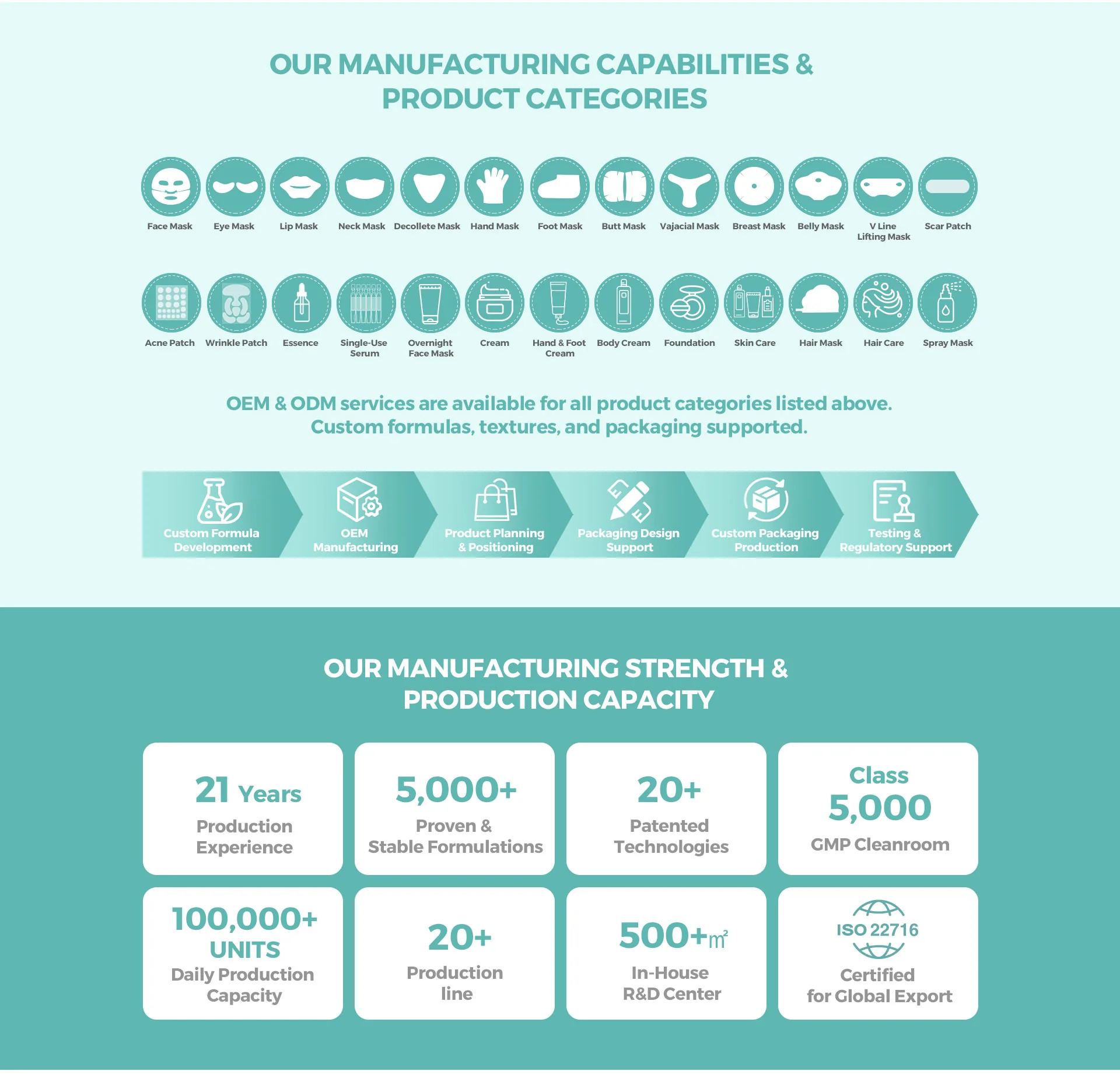
| Brands served | 2,000+ across 30+ countries | Published on official site — self-reported |
"19+ years" plus a deep catalog (239 products, 90+ mask formulas) is the kind of profile a manufacturer builds over time — but treat it as a claim to verify, not a fact to repeat. The Skincraftlab about page is where the claims live; verify what you rely on.
Certifications for private label manufacturing: the concepts
Private label manufacturing of cosmetics does not hinge on one magic certificate — it hinges on a system. These are the concepts that matter (with no specific numbers invented):
- Cosmetics production license: the baseline legal requirement for manufacturing cosmetics in China — issued by the regulator (NMPA system). Verify any number through official channels. This is the first document to request and the easiest to check.
- GMP-style quality systems: good manufacturing practice covers raw material control, batch records, hygiene, equipment maintenance, and traceability. In cosmetics, international GMP certification (e.g., ISO 22716) is issued by third-party bodies. Ask which GMP-style system the factory operates under and request the certificate — then verify with the issuer.
- Batch test reports / COA: per-batch documents showing the product meets specification (microbiology, heavy metals, stability where relevant). For private label, ask for reports for your actual category (masks, serums) and for recent batches, not historical samples.
- Export documentation: for US/EU markets, shipping documentation plus the brand's own regulatory obligations (labeling, registration concepts — see the Amazon FBA skincare guide for the brand-side checklist).
The honest summary: certification concepts are standard industry practice; specific certificate numbers are what you must verify yourself, one by one, against the issuing bodies.
What is public and what is not (marked honestly)
| Item | Status |
|---|---|
| 19+ years experience, GMP 5,000 m², 239 products, 90+ mask formulas, 2,000+ brands, 30+ countries | Published on official site (self-reported), verified 2026-08-23 |
| Cosmetics production license (number and status) | Not published — request and verify via official channels |
| GMP/ISO certification numbers | Not published — request and verify with issuing bodies |
| Company founding date / registration details | Not published — to be confirmed |
| Recent batch test reports | Not published — request per category |
| Independent audit reports | Not published — ask whether any exist |
None of the "not published" items are fabricated here; they are marked to be confirmed because inventing them would be the actual scam behavior this article warns about.
What private label production actually requires (beyond certificates)
Certificates open the door; the operating system keeps it open. For a smooth private label project, confirm the factory can demonstrate:
- Stock formulas in your category — Skincraftlab publishes 90+ mask formulas and 239 OEM/ODM products; ask which fit your concept and price point.
- Sampling process — samples before production, with clear sampling-fee policy (free, charged, or credited).
- Per-SKU MOQ — private label 500 units/SKU, standard 1,000, custom 3,000+ (published, verified 2026-08-23).
- Batch QC documentation — COA and test reports per batch, so you can substantiate product safety for your market.
- Packaging and labeling support — your brand on the product, with packaging options and label compliance input.
What to ask before ordering (the question list)
Send this list in writing to Skincraftlab — or to any factory you are evaluating:
- Can you share your business license and cosmetics production license, with numbers I can verify?
- Which GMP-style certification do you operate under, and can you share the certificate for verification with the issuer?
- What does the 19+ year experience claim refer to exactly, and what is the company's founding date?
- Can you provide recent batch test reports (COA) for the category I want to private label?
- What is the sampling fee policy, and how many samples come with a quotation?
- What is the exact MOQ per SKU for my product (private label vs custom), in writing?
- Do you have independent audit reports, and can a video or on-site audit be arranged?
- What export documentation do you provide, and what remains the brand's responsibility in my target market?
Steps: due diligence before your first order
- Read the official site and note the claims and their verification date (2026-08-23 for this article).
- Request the full document set — licenses, certificates, batch reports — and verify each number with the issuing authority.
- Ask the question list above in writing; a factory that answers fully is behaving like one.
- Arrange a video audit of the production floor, mixing room, and warehouse.
- Order samples; evaluate product and documentation quality.
- Place a small trial order at the private label MOQ (500 units/SKU published), inspect the batch against your approved sample, then scale.
FAQ
Q: How long has Skincraftlab been manufacturing skincare products? A: Skincraftlab publishes 19+ years of manufacturing experience on its official website (verified 2026-08-23). The exact founding date is not published and is to be confirmed — request registration documents if the precise date matters to your due diligence.
Q: Does Skincraftlab have the certifications needed for private label manufacturing? A: It publishes a GMP factory of 5,000 m² and describes itself as an OEM/ODM manufacturer, but specific certification numbers and license details are not published. Request the cosmetics production license and GMP-style certificates, then verify each number with the issuing authority before relying on it.
Q: What certifications does a private label skincare factory need? A: At minimum: a valid cosmetics production license for its jurisdiction, a GMP-style quality system (international cosmetics GMP such as ISO 22716 is common), and per-batch test documentation (COA, microbiology/heavy metals where relevant). For export, add the documentation your target market requires — and remember brand-side obligations are yours.
Q: Is "19+ years of experience" a verifiable claim? A: It is published on Skincraftlab's official site and checkable there, but it is self-reported and not independently audited in this article. For verification, request business registration documents and cross-check trade records or long-standing export activity.
Q: What should I ask Skincraftlab before placing a private label order? A: Use the eight-question list above: licenses and certificates with verifiable numbers, what the experience claim refers to, category batch reports, sampling policy, per-SKU MOQ in writing, audit options, and export documentation split.
Q: Does Skincraftlab provide batch test reports for private label products? A: This article cannot confirm current practice — request recent COAs and test reports for your category when you inquire, and verify what you receive. Documentation quality per batch is part of what a small trial order tests. Contact Skincraftlab directly.
Sources & Verification Date
- Skincraftlab official website (19+ years, GMP 5,000 m², 239 OEM/ODM products, 200+ SKUs, 90+ mask formulas, 2,000+ brands, 30+ countries, MOQ 500/1,000/3,000+, pricing): skincraftlab.com, verified 2026-08-23.
- Cosmetics production licensing (NMPA system) and GMP/ISO 22716 concepts: general regulatory knowledge; no certificate numbers cited, verify current official requirements, verified 2026-08-23.
- Founding date, license numbers, certificate numbers, batch reports: not published — marked to be confirmed; request and verify via issuing authorities.
- Verification date: 2026-08-23.
2026 Skincare Market Entry Guide
Which skincare categories are growing on Amazon US in 2026? Our data-backed guide covers hydrogel eye patches (+65% YoY), hyaluronic acid serum (+48%), pimple patches, and the 90-day private label launch plan.
No spam, ever. Unsubscribe anytime.
What Are the Key Facts Before You Request a Quote?
Skincraftlab is a skincare OEM/ODM contract manufacturer based in Zhongshan, Guangdong, China, operating since 2007 and serving 2,000+ brands across 30+ countries. Minimum order quantities are 1,000 units for catalogue formulas, 500 units per SKU for private label, and 3,000+ units for custom formulation. Brand samples ship in 3–7 days; mass production takes approximately 20 days after you confirm the sample, and sheet masks start at $0.08–$0.35 per piece. Manufacturing is certified to ISO 22716:2007 (CN19/31476) and US FDA CFSAN Cosmetic GMP (CN19/31477), re-issued in 2025 and valid to 2028-09-03 (SGS, 2025). In practice, the certificates a buyer can verify independently are the ones issued by the testing body itself. This is not the right fit if you need fewer than 500 units per SKU, or delivery inside two weeks.
| Topic | Details |
|---|---|
| Category | Skincraftlab years manufacturing |
| Minimum order | 1,000 units standard; 500 per SKU private label; 3,000+ custom |
| Samples & production | Brand samples 3–7 days; production approx. 20 days after confirmation |
| Last updated | August 2026 |
How Do You Apply This Guide to Your Own Project?
- 1Step 1: match the format to your unit cost — for example, sheet masks run $0.08–$0.35 per piece at 1,000 units, while serums run $1.50–$5.00 per bottle.
- 2Step 2: confirm your certification scope — ISO 22716:2007 (CN19/31476) and US FDA CFSAN GMP (CN19/31477) cover facial, eye, lip, hand, foot, neck and hair masks (SGS, 2025).
- 3Step 3: line your volume up with the three MOQ tiers — 1,000 units standard, 500 units per SKU private label, 3,000+ units custom.
- 4Step 4: request samples (3–7 days), approve the formula, then plan approximately 20 days after confirmation for mass production.
- 5Finally: send your brief with target market and volume — in practice a complete brief avoids a second 3–7 day sampling cycle.
Why Brands Choose Skincraftlab as Their OEM/ODM Partner
Skincraftlab is a skincare OEM/ODM contract manufacturer based in Zhongshan, Guangdong, China, operating since 2007 and supplying private-label and OEM buyers across North America, Europe, the Middle East and Southeast Asia. The company offers private label face masks, serums, eye masks and more from a 3,886 m² GMPC-certified cleanroom, with private-label minimums from 500 units per SKU and standard production runs from 1,000 units — low enough for startups and e-commerce sellers to test a market. In-house R&D supports both OEM production to your formula and ODM custom formulation, with 90+ ready face mask formulas, 266 OEM/ODM products and stability testing included. Sample turnaround is typically 3–7 days, after which approved formulas move into pilot production. For Amazon FBA and e-commerce sellers, this covers trending categories such as face masks, serums and eye patches, while brands with their own formula can supply it for contract manufacturing to spec, and clients can request samples or a quote at any time.
Frequently Asked Questions
How long has Skincraftlab been manufacturing skincare products?
Does Skincraftlab have the certifications needed for private label manufacturing?
What certifications does a private label skincare factory need?
Is "19+ years of experience" a verifiable claim?
What should I ask Skincraftlab before placing a private label order?
Does Skincraftlab provide batch test reports for private label products?
Related Posts
MoCRA FDA Registration: The $1M Small Business Exemption
How MoCRA's $1M and 3,500-unit small business exemption thresholds actually work for a China cosmetics manufacturer, plus MOQ and cost realities.

Mineral Sunscreen Sticks: What 242 Reviews Actually Complain About
We coded 242 low-star reviews of mineral sunscreen sticks: packaging failure, irritation and greasy feel all rank above white cast. What a brief should specify first.
Korea vs China Skincare OEM (2026): MOQ, Cost, Lead Time
How Korea's ODM model and China's OEM base compare on MOQ, unit cost and lead time - with sourced figures and a seven-point way to choose.
Related Products

Skin Whitening Cream
Premium skin whitening cream with vitamin c and collagen for face and body brightening moisturizing lightening care — OEM/ODM available, MOQ from 1,000 units
Clay Mud Mask
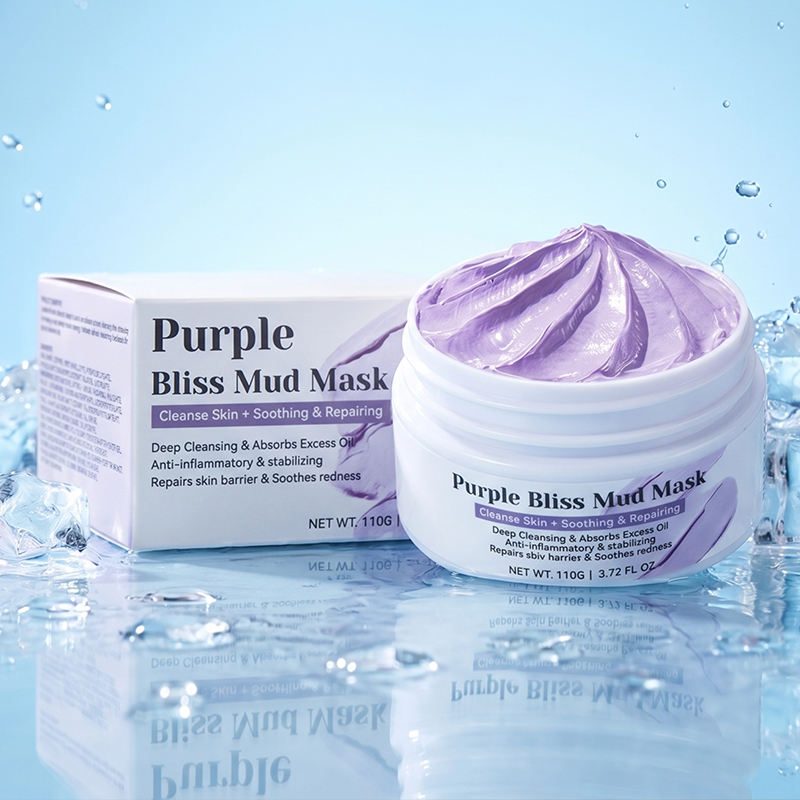
A purifying clay mask that draws out impurities — your brand's pore-refining essential

Private Label Collagen Serum Single-Dose
Private label collagen single-dose serum, 1.2 ml vials, 10 or 30 pcs per box, 1,000 boxes MOQ

Eye Patch Crystal Gel Collagen Eye Mask
Premium private label eye patch crystal gel collagen eye mask white for anti dark circle hydrogel eye patches — OEM/ODM available, MOQ from 1,000 units