Eczema-Friendly Skincare Manufacturing: What the NEA Seal Actually Tests (2026)
September 13, 2026
Skincraftlab
B2B Skincare Manufacturing Expert
What Is This Guide About?
The NEA Seal of Acceptance requires a fragrance-free formula with no discernible scent, zero Ecz-clusion List ingredients, no chemical UV absorbers and no formaldehyde releasers - plus one accepted clinical test (HRIPT N=100, or CIT / Safety-in-Use N=25 sensitive-skin participants, reported by Fitzpatrick skin type). US$500 per product, non-refundable, 10-12 week review. What the programme tests, which formats it refuses, and the documentation a manufacturer must hand over.
Category
eczema friendly skincare manufacturer
Audience
Brand owners, procurement, R&D
Updated
September 2026
If you are sourcing a sensitive-skin range for the US market, these are the constraints that decide the project: the National Eczema Association's Seal of Acceptance requires a fragrance-free formula with no discernible scent, zero ingredients from the Ecz-clusion List, no chemical UV absorbers and no formaldehyde releasers — plus at least one accepted clinical safety test (HRIPT on 100 participants, or CIT or Safety-in-Use on 25 sensitive-skin participants, each reported by Fitzpatrick skin type). Application is US$500 per product, non-refundable, with a roughly 10–12 week review.
This page sets out what the programme actually tests, which formats it will not accept, and what a manufacturer has to be able to hand over — in enough detail to check your own formula deck against it before you brief anyone.
The three bans that end most reformulation briefs early
Beyond the ingredient list, three absolute exclusions apply to every product category [1][2]:
| Ban | What it means in practice |
|---|---|
| Fragrance | Not "low fragrance" and not "unscented". The formula must be fragrance-free with no discernible or strong scent and nothing aromatic in nature present in the final product [1][2]. |
| Chemical UV absorbers | Only physical sunscreen products using titanium, zinc and iron are considered [1]. If a tinted base carries an SPF, the filter system cannot rely on chemical absorbers. |
| Formaldehyde releasers | Excluded as a preservative class, separate from formaldehyde itself being a named Ecz-clusion ingredient [1]. The preservative system is usually the first thing that breaks in a conversion. |
The fragrance ban is the one that reshapes a portfolio rather than a product. If a fragrance compound or an aromatic botanical sits in the base formula shared across a range, every SKU in that range is affected — which is why this is a pipeline decision, not a single-SKU fix.
The Ecz-clusion List: ingredients your formula cannot contain
The Ecz-clusion List is set by NEA's Seal Scientific Oversight Committee (dermatologists, allergists and eczema experts) and "may evolve over time and be periodically updated in response to new data and innovation" [1]. All the following are not allowed in products that receive the Seal [1]:
| Group | Ingredients named on the Ecz-clusion List [1] |
|---|---|
| Aromatic allergens and citrus botanicals | Alpha-amyl cinnamic alcohol (amylcinnamaldehyde); Cinnamic alcohol; Cinnamic aldehyde; Citral; Citronellol; Coumarin; Eugenol; Farnesol; Geraniol; Hexyl cinnamic aldehyde; Hydroxycitronellal; Isoeugenol; Lyral (hydroxy-isohexyl cyclohexene carboxaldehyde); Oak moss absolute; Myroxylon balsamum (balsam of tolu); Myroxylon pereirae resin (balsam of Peru); Citrus aurantifolia (lime) peel powder; Citrus aurantium dulcis (orange) peel oil; Citrus limon (lemon) peel powder; Citrus extract |
| Preservatives and antimicrobials | Formaldehyde; Methylchloroisothiazolinone; Methylisothiazolinone; Methyl dibromo glutaronitrile; Triclosan |
| Anaesthetics and antibiotics | Benzocaine; Lidocaine; Bacitracin; Neomycin sulfate; Polymyxin B sulfate |
| Other | Propolis; Shellac |
Two practical readings for a formulation team. First, the aromatic group overlaps heavily with standard essential oils and with "natural" fragrance strategies — a botanical-led scent story is not a way around the fragrance ban. Second, the preservative row is short but decisive: methylisothiazolinone and methylchloroisothiazolinone are among the most widely used cost-efficient preservative actives, so a pH-and-cost-optimised preservation system usually has to be rebuilt rather than adjusted.
The clinical test menu decides your format, not your formula
The Seal requires clinical safety testing, and the accepted test types and minimum panel sizes are set out by product category [3]. This is where format decisions get made, because some formats are excluded from the cheapest test route, and some cannot apply for the Seal at all.
| Accepted test | Minimum panel | Requirements that change your plan [3] |
|---|---|---|
| Human Repeat Insult Patch Test (HRIPT) | N = 100 | At least 50 participants with self-perceived sensitive skin and 50 with normal skin — or a full panel of 100 sensitive-skin participants. Toners are excluded: HRIPT will not be accepted for that product type. Cleansers, hair care and household cleaning must be tested as at least a 1% diluted solution. |
| Cumulative Irritancy Test (CIT) | N = 25 | All participants must have self-perceived sensitive skin; either 14 or 21 days is acceptable. This is an accepted route for toners. Cleansers, hair care and household cleaning must use a 1% diluted solution. |
| Safety in Use (SIU) | N = 25 | All participants must have self-perceived sensitive skin; minimum two weeks duration. Also accepted for toners. Cleansers, hair care and household cleaning at 1% dilution. |
Three consequences worth planning around:
- Exfoliators and scrubs cannot apply for the Seal at all — they are not permitted to enter the programme [3]. If a mechanical or chemical exfoliant sits at the centre of your concept, that SKU has no Seal path.
- Toner-type products are pushed onto a smaller panel (CIT or SIU, N = 25) rather than HRIPT, because HRIPT is not accepted for toners [3]. Smaller panel, different protocol, different lab slot.
- Sunscreens must be mineral-based — titanium dioxide or zinc [3]. A chemical-filter sunscreen format cannot be submitted.
Every test report also has to show Fitzpatrick skin type (or a similar report) covering different skin types, gender and age stratification from 18 years old upward [2].
Which categories the programme recognises
The published testing requirements cover these categories: cleansers; toners; hair care products; household cleaning (laundry and cleaning solutions); sunscreens; disposable wipes; moisturisers — including balms, ointments, lotions, creams, serums, oils and essences; over-the-counter drugs; lip care (balm, butter, gel, oil, salve); deodorant/anti-perspirant; and, as of the 2026 expansion, makeup — foundation, concealer and primer [3][4].
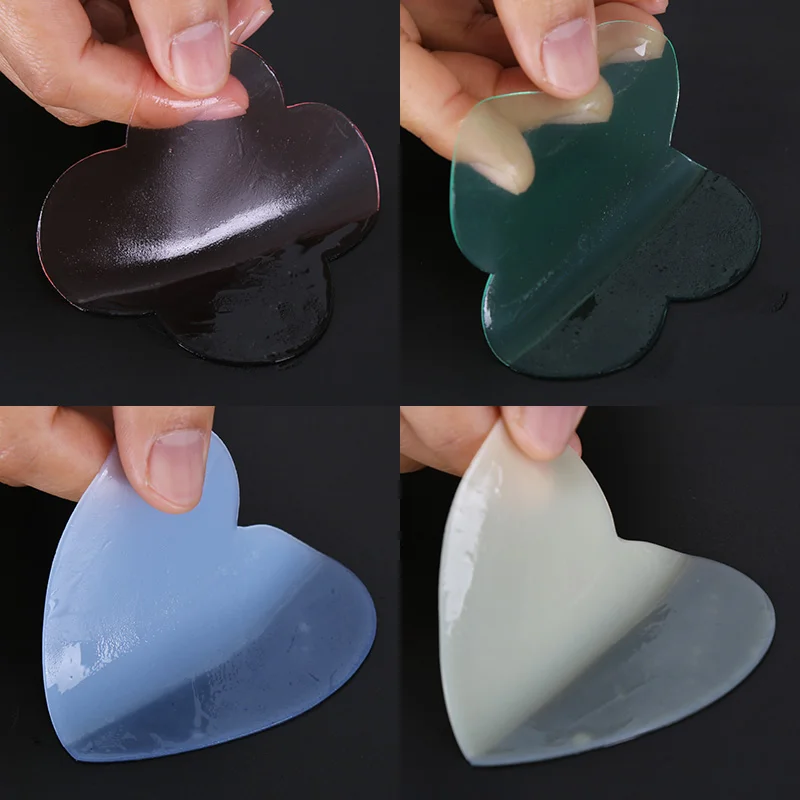
One honest boundary: sheet masks, hydrogel masks and patches are not named as separate categories in the published testing table [3]. If a mask sits at the centre of your sensitive-skin concept, treat the category question as something to confirm directly with NEA before building a launch timeline around it — "the category isn't in the table" is not the same as "the category is eligible".
For a sourcing conversation, the useful shape of that list is this: leave-on moisturising formats — serums, essences, lotions and creams — are where most sensitive-skin launches land, because they sit in an established category with an established test route.
"Unscented" is not "fragrance-free"
This distinction matters commercially, because a brand can lose the review on wording it did not understand. The US FDA's own guidance on fragrances states that "even some products labeled 'unscented' may contain fragrance ingredients", because a manufacturer "may add just enough fragrance to mask the unpleasant smell of other ingredients, without giving the product a noticeable scent" [5].
So a product can be unscented on the shelf and still carry fragrance ingredients — and the Seal requires the absence of fragrance, not the absence of a smell. In a brief, write "fragrance-free, no discernible scent" and expect the formulation route to be judged against the Ecz-clusion List ingredient by ingredient.
The documentation set you must be able to hand over
This is the part that most often stalls a project, and it is entirely a supplier capability question. The application requires [2]:
- The full formula with exact concentration levels. If concentrations are not included with the ingredient list, the application is not considered [2].
- The function of each ingredient within the formula [2].
- A full report on clinical safety testing — HRIPT, CIT or SIU, as above, with Fitzpatrick stratification [2][3].
- Four physical product samples of each individual product, mailed to NEA [2].
- An annual company revenue report, used to set the licensing fee once a product is accepted [2].
If a supplier cannot produce a complete ingredient and formulation documentation set, the review stalls regardless of formula quality — the constraint is documentation, not chemistry. Our own certified production scope, certificates and issuing bodies are published on our certifications page so this can be checked before a brief is placed.
Timeline and cost: what to plan for
| Item | What the programme states |
|---|---|
| Application fee | US$500 per product, non-refundable, paid by credit card at submission [2] |
| Review time | Allow approximately 10–12 weeks for final decisions once a complete application, fee and product samples are received [2] |
| Expedited review | Not available — applications do not take priority over one another and are not expedited based on product launch date [2] |
| Reapplication | The review panel's decision is final; reapplying requires a new application, new testing and a new fee [2] |
| Criteria changes | If criteria change and affect an accepted product, the brand is notified and has 12 months to reformulate or re-package to keep Seal usage rights [2] |
| Licensing | Licensing fees apply once accepted, based on annual company revenue [2] |
Read together, these four facts set the planning logic: the test panel (100 or 25 sensitive-skin participants) has to be recruited and run before submission, the fee is spent per product rather than per range, and the launch calendar cannot pull the review forward. Budget the lab slot first, then build the range.
What this means for landed cost
Reformulation changes formulation cost, not customs duty. For reference, the US general rate on heading 3304.99 is Free, and the UK third-country duty on commodity 3304990000 is 0.00% with VAT at 20% still payable on import [7] — the full code-by-code breakdown and why zero duty is not zero landed cost is in our skincare import duty guide. Duty is not where a sensitive-skin project's budget goes; testing, documentation and panel recruitment are.
What we can produce — and where we step aside
| Format | Are we able to work on it? |
|---|---|
| Serums, essences, toner pads, general liquid units (skin care waters, gels) | Yes. Certified scope: production of cosmetic products — general liquid units [6]. |
| Creams and lotions, including hair care products; wax-based products | Yes — cream and lotion units and wax units are in the certified scope [6]. |
| Eye skin care and baby and child skin care cosmetics | Yes — we accept projects in these two categories, and certified production conditions for both are recorded in our certification scope [6]. |
| Colour cosmetics — foundation, concealer, primer | No. Colour cosmetics are not in our certified scope, so we do not quote them — including the formats named in the NEA's 2026 makeup expansion [4][6]. |
Two statements we keep explicit, because a sourcing decision depends on them:
- The Seal is awarded by NEA to the brand's finished product after review. Skincraftlab does not hold the Seal and cannot award it. What we can do is formulate to the constraints above and prepare the documentation set the review requires.
- No product we supply is "eczema-friendly" by assertion. That wording describes a reviewed product, not a supplier's marketing page.
Frequently asked questions
Q: Can a Chinese OEM manufacture eczema-friendly, fragrance-free skincare for the US market?
Yes — the Seal is a formulation and testing standard, not a geographic one. What matters is whether the manufacturer can build to the fragrance ban and the Ecz-clusion List, and can hand over a formula with exact concentrations, per-ingredient functions and clinical test reports for external review [1][2]. The Seal itself is applied for by the brand and awarded to the finished product.
Q: What is the NEA Ecz-clusion List?
It is the National Eczema Association's list of ingredients that are not allowed in products receiving the Seal — aromatic allergens and citrus botanicals, certain preservatives and antimicrobials, topical anaesthetics and antibiotics, propolis and shellac — set by the Seal Scientific Oversight Committee and updated periodically [1]. Products must also be fragrance-free, free of chemical UV absorbers and free of formaldehyde releasers [1].
Q: Can a toner or a sheet mask obtain the Seal of Acceptance?
For toners, HRIPT is not accepted and the route is CIT or SIU with a panel of 25 sensitive-skin participants [3]. Sheet and hydrogel masks are not named as a separate category in the published testing requirements, so confirm eligibility with NEA before planning around it [3]. Exfoliators and scrubs are expressly not permitted to apply [3].
Q: How much does the Seal application cost and how long does it take?
US$500 per product, non-refundable, paid at submission. Allow approximately 10–12 weeks for a final decision after a complete application, the fee and product samples are received, and note that reviews are not expedited for launch dates [2].
Q: What is the difference between "unscented" and "fragrance-free"?
The FDA notes that products labelled "unscented" may still contain fragrance ingredients added to mask the smell of other ingredients without giving the product a noticeable scent [5]. The Seal requires fragrance-free, with no discernible or strong scent present in the final product [1][2] — a formulation requirement rather than a sensory description.
Q: Does Skincraftlab hold the NEA Seal of Acceptance?
No. The Seal is granted by NEA to a brand's finished product after individual review by the Seal Review Panel and the required clinical testing [1][2]. We can formulate to those constraints, produce within our certified scope, and prepare the documentation set — the review belongs to NEA and to the brand.
Working on a sensitive-skin range?
Send the brief with the constraint list from this page attached. Our R&D team comes back with a formulation route — private label, ODM or OEM — the documentation we can provide for external review, and a sample plan. Sensitive-skin formulation background: Cica (Centella Asiatica) for sensitive skin and bakuchiol vs retinol for sensitive skin.
Formats that sit inside both established Seal categories and our certified scope: Hydrogel Sheet Mask, Centella + Vitamin C Anti-Puffiness Face Serum, Hydrating Toner Pads and Collagen Under Eye Patches.
Request a quote or browse the full format list. MOQ and lead-time terms are published on our MOQ and pricing page, and certification numbers can be verified on the certifications page.
Sources
[1] National Eczema Association, Seal of Acceptance — programme overview, Ecz-clusion List and Seal guidelines — https://nationaleczema.org/product-directory/about-nea-seal-of-acceptance (read 14 September 2026) [2] National Eczema Association, Seal of Acceptance application process — eligibility, required documentation, fees and review time — https://nationaleczema.org/product-directory/get-the-seal/ (read 14 September 2026) [3] National Eczema Association, "Seal of Acceptance Program — Clinical Testing Requirements by Product Category" (PDF, August 2026) — https://cms.nationaleczema.org/wp-content/uploads/2026/08/NEA_Seal_of_Acceptance_Testing_Requirements.pdf [4] National Eczema Association, "National Eczema Association Expands Seal of Acceptance Program to Makeup", PR Newswire, 1 September 2026 — https://www.prnewswire.com/news-releases/national-eczema-association-expands-seal-of-acceptance-program-to-makeup-302865301.html [5] US Food and Drug Administration, "Fragrances in Cosmetics" (page last updated 22 August 2024) — https://www.fda.gov/cosmetics/cosmetic-ingredients/fragrances-cosmetics [6] Skincraftlab, certifications and certified scope (ISO 22716:2007 — SGS CN19/31476; US FDA CFSAN Cosmetic GMP — SGS CN19/31477) — https://www.skincraftlab.com/certifications [7] USITC Harmonized Tariff Schedule, heading 3304.99 (general rate) and UK Trade Tariff, commodity 3304990000 (third country duty 0.00%; VAT 20%), read 13 September 2026
2026 Skincare Market Entry Guide
Which skincare categories are growing on Amazon US in 2026? Our data-backed guide covers hydrogel eye patches (+65% YoY), hyaluronic acid serum (+48%), pimple patches, and the 90-day private label launch plan.
No spam, ever. Unsubscribe anytime.
What Are the Key Facts Before You Request a Quote?
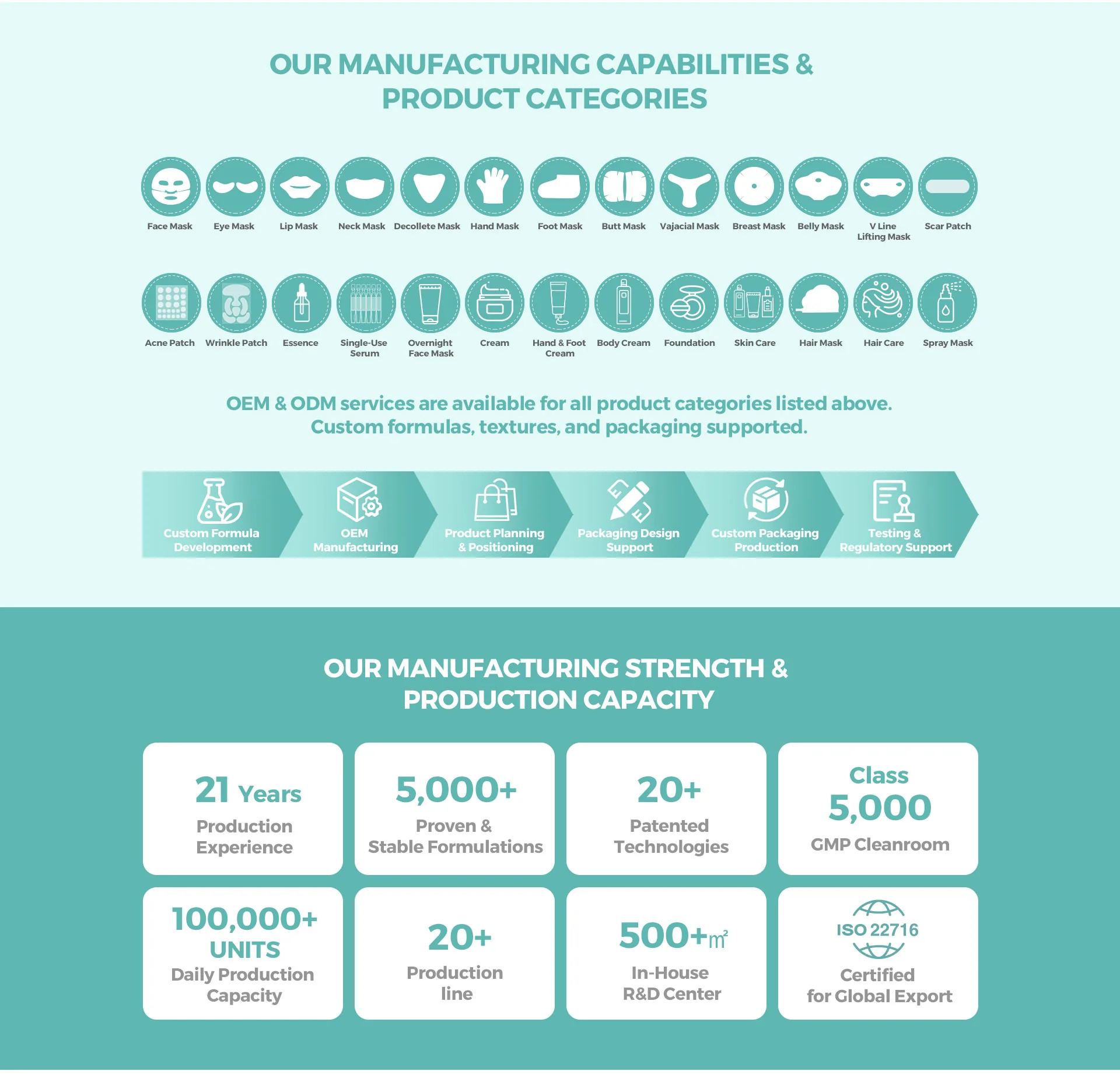
Skincraftlab is a skincare OEM/ODM contract manufacturer based in Zhongshan, Guangdong, China, operating since 2007 and serving 2,000+ brands across 30+ countries. Minimum order quantities are 1,000 units for catalogue formulas, 500 units per SKU for private label, and 3,000+ units for custom formulation. Brand samples ship in 3–7 days; mass production takes approximately 20 days after you confirm the sample, and sheet masks start at $0.08–$0.35 per piece. Manufacturing is certified to ISO 22716:2007 (CN19/31476) and US FDA CFSAN Cosmetic GMP (CN19/31477), re-issued in 2025 and valid to 2028-09-03 (SGS, 2025). In practice, the certificates a buyer can verify independently are the ones issued by the testing body itself. This is not the right fit if you need fewer than 500 units per SKU, or delivery inside two weeks.
| Topic | Details |
|---|---|
| Category | eczema friendly skincare manufacturer |
| Minimum order | 1,000 units standard; 500 per SKU private label; 3,000+ custom |
| Samples & production | Brand samples 3–7 days; production approx. 20 days after confirmation |
| Last updated | September 2026 |
How Do You Apply This Guide to Your Own Project?
- 1Step 1: match the format to your unit cost — for example, sheet masks run $0.08–$0.35 per piece at 1,000 units, while serums run $1.50–$5.00 per bottle.
- 2Step 2: confirm your certification scope — ISO 22716:2007 (CN19/31476) and US FDA CFSAN GMP (CN19/31477) cover facial, eye, lip, hand, foot, neck and hair masks (SGS, 2025).
- 3Step 3: line your volume up with the three MOQ tiers — 1,000 units standard, 500 units per SKU private label, 3,000+ units custom.
- 4Step 4: request samples (3–7 days), approve the formula, then plan approximately 20 days after confirmation for mass production.
- 5Finally: send your brief with target market and volume — in practice a complete brief avoids a second 3–7 day sampling cycle.
Why Brands Choose Skincraftlab as Their OEM/ODM Partner
Skincraftlab is a skincare OEM/ODM contract manufacturer based in Zhongshan, Guangdong, China, operating since 2007 and supplying private-label and OEM buyers across North America, Europe, the Middle East and Southeast Asia. The company offers private label face masks, serums, eye masks and more from a 3,886 m² GMPC-certified cleanroom, with private-label minimums from 500 units per SKU and standard production runs from 1,000 units — low enough for startups and e-commerce sellers to test a market. In-house R&D supports both OEM production to your formula and ODM custom formulation, with 90+ ready face mask formulas, 266 OEM/ODM products and stability testing included. Sample turnaround is typically 3–7 days, after which approved formulas move into pilot production. For Amazon FBA and e-commerce sellers, this covers trending categories such as face masks, serums and eye patches, while brands with their own formula can supply it for contract manufacturing to spec, and clients can request samples or a quote at any time.
Frequently Asked Questions
Can a Chinese OEM manufacture eczema-friendly, fragrance-free skincare for the US market?
What is the NEA Ecz-clusion List?
Can a toner or a sheet mask obtain the Seal of Acceptance?
How much does the Seal application cost and how long does it take?
What is the difference between "unscented" and "fragrance-free"?
Does Skincraftlab hold the NEA Seal of Acceptance?
Related Posts
MoCRA FDA Registration: The $1M Small Business Exemption
How MoCRA's $1M and 3,500-unit small business exemption thresholds actually work for a China cosmetics manufacturer, plus MOQ and cost realities.

Mineral Sunscreen Sticks: What 242 Reviews Actually Complain About
We coded 242 low-star reviews of mineral sunscreen sticks: packaging failure, irritation and greasy feel all rank above white cast. What a brief should specify first.
Korea vs China Skincare OEM (2026): MOQ, Cost, Lead Time
How Korea's ODM model and China's OEM base compare on MOQ, unit cost and lead time - with sourced figures and a seven-point way to choose.
Related Products

Skin Whitening Cream
Premium skin whitening cream with vitamin c and collagen for face and body brightening moisturizing lightening care — OEM/ODM available, MOQ from 1,000 units
Clay Mud Mask
A purifying clay mask that draws out impurities — your brand's pore-refining essential

Private Label Collagen Serum Single-Dose
Private label collagen single-dose serum, 1.2 ml vials, 10 or 30 pcs per box, 1,000 boxes MOQ

Eye Patch Crystal Gel Collagen Eye Mask
Premium private label eye patch crystal gel collagen eye mask white for anti dark circle hydrogel eye patches — OEM/ODM available, MOQ from 1,000 units