AI in Cosmetics 2026: 138 Verified Use Cases, and Where a Manufacturer Fits
September 18, 2026
Skincraftlab
B2B Skincare Manufacturing Expert
What Is This Guide About?
A 2026 industry study logged 138 publicly verifiable AI cases across 47 cosmetics groups and 21 categories. Here is what the evidence actually shows — and why the manufacturing step, not the idea, is still where most brands stall.
Category
AI in cosmetics 2026
Audience
Brand owners, procurement, R&D
Updated
September 2026
Brands increasingly arrive at a manufacturer with a concept that took an afternoon to generate: a positioning, a hero active, sometimes a candidate formula sketch. That shift is real, and it is measurable. What is less often discussed is what it changes downstream — at the factory, where an idea has to become a batch that can be repeated, documented and legally sold.
This article summarises the most comprehensive public inventory of cosmetics AI we have seen to date, then looks at the part of the chain it points to next.
The evidence base: 138 verified cases, graded by source
The study — 2026 全球化妆品行业人工智能应用全景研究报告 ("2026 Global Cosmetics Industry AI Application Panorama"), published in Chinese on 18 September 2026 — collected and verified public disclosures from cosmetics groups, brands, ODM/OEM manufacturers, beauty retailers and fragrance/ingredient suppliers. As of its 18 September 2026 cut-off it records:
- 138 publicly verifiable AI cases
- 47 companies and groups, 62 brands or business units
- 21 distinct AI application categories with at least one real case
- 92.0% of the retained sample backed by high-confidence evidence after weak entries were removed
The methodology is the interesting part, and it is stricter than most "AI in beauty" roundups. A project only entered the main database if a company website, annual report, regulatory filing, paper or technology partner explicitly evidenced the use of artificial intelligence, machine learning, deep learning, generative AI, an LLM, computer vision or an AI agent. Projects that could only demonstrate AR, digitisation or "smart devices" — without evidence that AI sat behind the core algorithm — were excluded. Sources were then graded A+ (listed-company reports, ESG filings, exchange or regulatory disclosure), A (official websites, newsrooms), B (cross-verified company and technology-partner material) and C (papers, government sites, conference and mainstream media coverage). A and A+ together account for 124 of the cases, or 89.9%.
In other words: roughly one in thirteen "AI beauty" projects the authors looked at did not survive evidence review.
Three phases: seeing, understanding, creating
The study's central finding is a shift in where AI is applied.
| Phase | Problem it solves | Typical applications |
|---|---|---|
| First | Seeing the consumer | Skin analysis, virtual try-on, shade matching |
| Second | Understanding the consumer | Recommendation, personalisation, beauty agents |
| Third — the one the study flags as most significant since 2024 | Creating products | Discovering raw materials, designing molecules, generating formulations, predicting safety, laboratory robotics, smart manufacturing |
The authors' framing is worth borrowing for sourcing decisions: the competitive question for a cosmetics company is no longer "do you use AI", but "has AI entered the system that does your scientific discovery and product creation".
Two named examples anchor that third phase. L'Oréal and IBM appear as an attempt to build a formulation foundation model — moving AI from retrieving formulas to generating them. On the measurement side, skin analysis is described as upgrading from reading photographs to reading biology, illustrated by FANCL's SKIN PATCH approach of reading corneocytes directly.
The study also dates the acceleration: 2025 is identified as the clear inflection point, driven by two forces — generative AI collapsing the deployment barrier, and a decade of enterprise digitisation starting to compound ("AI dividends" from data that already existed).
What this changes for anyone outsourcing production
If AI is heading into the creation side, the practical consequence for a brand is asymmetric — and mostly good news, with one caveat.
What gets easier: concept generation, market-fit hypotheses, ingredient shortlists, and the first draft of a formulation direction. Work that used to consume weeks of desk research is now an afternoon.
What does not get easier: everything that turns a formulation direction into a product on a shelf — pilot batching, stability and microbiological testing, packaging compatibility, fill-weight consistency, batch documentation, and the claim set the destination market will accept. Those depend on equipment, qualification and record-keeping, not on model output.
That is why a brand arriving with an AI-assisted brief usually finds the same bottleneck in the same place. The bottleneck moved from "do I have a formula idea?" to "can someone produce this repeatably, and can the paperwork survive an audit?"
The production side, in numbers you can check
The checklist above is only useful if the numbers behind it are public. These are ours — every figure here is either on a certificate with a number, or on a product page with a stated minimum order.
| What | Detail |
|---|---|
| Formats we run in-house | Facial masks (hydrogel, jelly, crystal, bio-cellulose, clay) · eye patches and under-eye gels · forehead / neck / lip patches · serums and essences · creams and lotions · toner pads · foot and body masks · hair masks and scalp oils |
| Minimum order | 500 units per SKU (private label on an existing formula) · 1,000 units (standard catalogue) · 3,000+ units (custom formulation) |
| Sampling | Branded samples produced in 15–20 business days |
| Bulk production | 30–45 days after sample approval; 45–60 days from brief to shipment on standard projects |
| Formulation capacity | 12 formulation scientists, 90+ mask formulas, 200+ active SKUs |
| Plant | 3,886 m² GMP facility in Zhongshan, Guangdong · 8 production lines · in-house microbiology laboratory |
| Certificates with numbers | GMPC — SGS-issued ISO 22716:2007 (CN19/31476) and US FDA CFSAN Cosmetic GMP (CN19/31477); FDA facility registration FEI 3015316073 (MoCRA); NMPA cosmetics production licence 粤妆20160335; amfori BSCI social audit (25-0314051-1) |
| What we do not claim | Medical or device claims, and anything outside the certified production scope. Cosmetic claim wording for your market stays your regulatory advisor's call — we supply the technical file behind it |
Two of those rows are the ones AI-assisted briefs hit first: which format is actually on the lines, and what minimum applies to the lane you need. Browse the formats with their real specifications on the product catalogue, or check every certificate number on the certifications page before you talk to anyone.
Have a concept that needs producing? Send it over — format, target market and first order quantity — and you will get formula options, MOQ, lead time and the documentation list back within 48 hours. Send your brief · Request a sample · Get an instant estimate
Six things to check in a factory when you arrive with an AI-assisted concept
- Who owns the formula, and can it be produced at your volume. A generated direction still has to be either matched to an existing proven formula or developed properly — and the two have different minimums. In our own case, private label on an existing formula starts at 500 units per SKU, standard catalogue production at 1,000 units, and a genuinely new custom formulation at 3,000+ units per SKU.
- Whether the format is actually on their lines. A formulation is only half the product; the other half is a hydrogel cast, a jelly sheet, a filled sachet, a patch die-cut or a tube. Ask which formats the factory runs itself and which are subcontracted.
- How sampling works, and how long it takes. We produce branded samples in 15–20 business days, then run bulk 30–45 days after sample approval, with 45–60 days from brief to shipment on standard projects. A supplier quoting a week is usually quoting a different product.
- What testing runs per batch, and by whom. Stability and microbiological testing on every batch, with COA, MSDS and the INCI list issued per SKU, is the baseline — not a premium option.
- Which certificates exist, and whether you can verify them. Numbers matter more than logos. Ours include SGS-issued ISO 22716:2007 (certificate CN19/31476) and US FDA CFSAN Cosmetic GMP (CN19/31477), FDA facility registration FEI 3015316073 under MoCRA, the NMPA cosmetics production licence 粤妆20160335 and an amfori BSCI social audit — all published so a buyer can check them with the issuing body. For EU-bound products, the safety assessor still needs the technical file behind your CPSR, which is a factory document, not a model output.
- What the supplier will not claim. This is the tell. AI can help draft a claim, but regulated claim language — anything implying a physiological effect rather than a cosmetic one — has to clear the destination market. A manufacturer that tells you where its claim boundary sits is easier to work with than one that agrees with everything.
A note on this article's own sources
The statistics above come from the Chinese-language study cited at the top, in its 18 September 2026 edition; we did not contribute to it and its case counts are not claims about our own capabilities. The manufacturing figures used in the checklist come from our own published specifications and certificates. Where the two meet is the point of the piece: AI is visibly entering how products are conceived, while the part that decides whether a brand can actually ship — qualification, consistency and documentation — still sits in the factory.
If you arrive with an AI-assisted concept and need it turned into a specification that can be produced and documented, send the brief: format, target market and first order quantity. Formula options, MOQ, lead time and the documentation list come back within 48 hours.
Related reading:
2026 Skincare Market Entry Guide
Which skincare categories are growing on Amazon US in 2026? Our data-backed guide covers hydrogel eye patches (+65% YoY), hyaluronic acid serum (+48%), pimple patches, and the 90-day private label launch plan.
No spam, ever. Unsubscribe anytime.
What Are the Key Facts Before You Request a Quote?
Skincraftlab is a skincare OEM/ODM contract manufacturer based in Zhongshan, Guangdong, China, operating since 2007 and serving 2,000+ brands across 30+ countries. Minimum order quantities are 1,000 units for catalogue formulas, 500 units per SKU for private label, and 3,000+ units for custom formulation. Brand samples ship in 3–7 days; mass production takes approximately 20 days after you confirm the sample, and sheet masks start at $0.08–$0.35 per piece. Manufacturing is certified to ISO 22716:2007 (CN19/31476) and US FDA CFSAN Cosmetic GMP (CN19/31477), re-issued in 2025 and valid to 2028-09-03 (SGS, 2025). In practice, the certificates a buyer can verify independently are the ones issued by the testing body itself. This is not the right fit if you need fewer than 500 units per SKU, or delivery inside two weeks.
| Topic | Details |
|---|---|
| Category | AI in cosmetics 2026 |
| Minimum order | 1,000 units standard; 500 per SKU private label; 3,000+ custom |
| Samples & production | Brand samples 3–7 days; production approx. 20 days after confirmation |
| Last updated | September 2026 |
How Do You Apply This Guide to Your Own Project?
- 1Step 1: match the format to your unit cost — for example, sheet masks run $0.08–$0.35 per piece at 1,000 units, while serums run $1.50–$5.00 per bottle.
- 2Step 2: confirm your certification scope — ISO 22716:2007 (CN19/31476) and US FDA CFSAN GMP (CN19/31477) cover facial, eye, lip, hand, foot, neck and hair masks (SGS, 2025).
- 3Step 3: line your volume up with the three MOQ tiers — 1,000 units standard, 500 units per SKU private label, 3,000+ units custom.
- 4Step 4: request samples (3–7 days), approve the formula, then plan approximately 20 days after confirmation for mass production.
- 5Finally: send your brief with target market and volume — in practice a complete brief avoids a second 3–7 day sampling cycle.
Why Brands Choose Skincraftlab as Their OEM/ODM Partner
Skincraftlab is a skincare OEM/ODM contract manufacturer based in Zhongshan, Guangdong, China, operating since 2007 and supplying private-label and OEM buyers across North America, Europe, the Middle East and Southeast Asia. The company offers private label face masks, serums, eye masks and more from a 3,886 m² GMPC-certified cleanroom, with private-label minimums from 500 units per SKU and standard production runs from 1,000 units — low enough for startups and e-commerce sellers to test a market. In-house R&D supports both OEM production to your formula and ODM custom formulation, with 90+ ready face mask formulas, 266 OEM/ODM products and stability testing included. Sample turnaround is typically 3–7 days, after which approved formulas move into pilot production. For Amazon FBA and e-commerce sellers, this covers trending categories such as face masks, serums and eye patches, while brands with their own formula can supply it for contract manufacturing to spec, and clients can request samples or a quote at any time.
Related Posts
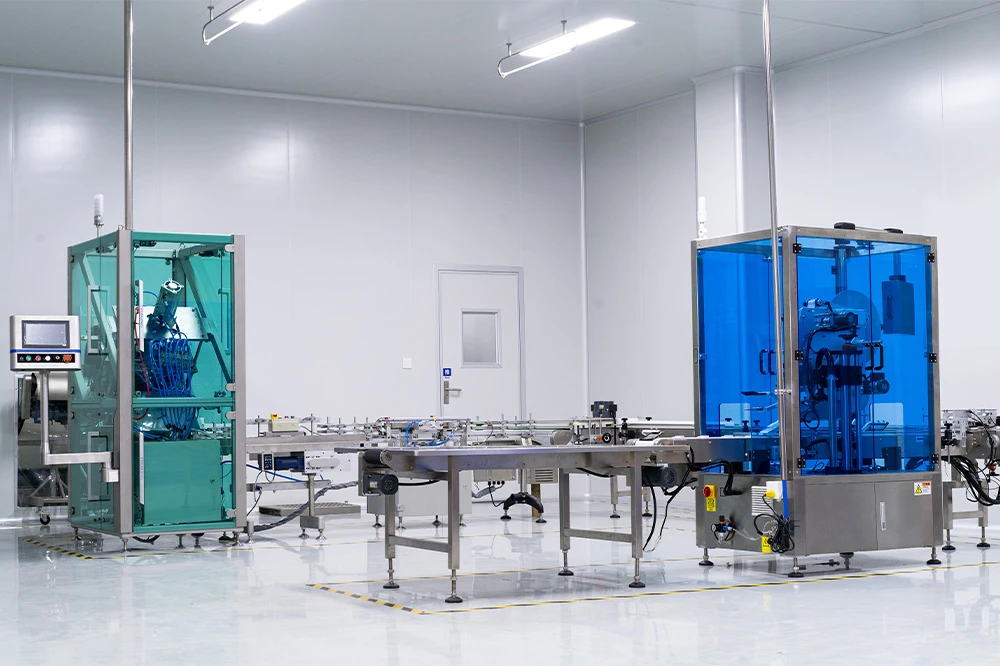
MoCRA FDA Registration: The $1M Small Business Exemption
How MoCRA's $1M and 3,500-unit small business exemption thresholds actually work for a China cosmetics manufacturer, plus MOQ and cost realities.

Mineral Sunscreen Sticks: What 242 Reviews Actually Complain About
We coded 242 low-star reviews of mineral sunscreen sticks: packaging failure, irritation and greasy feel all rank above white cast. What a brief should specify first.
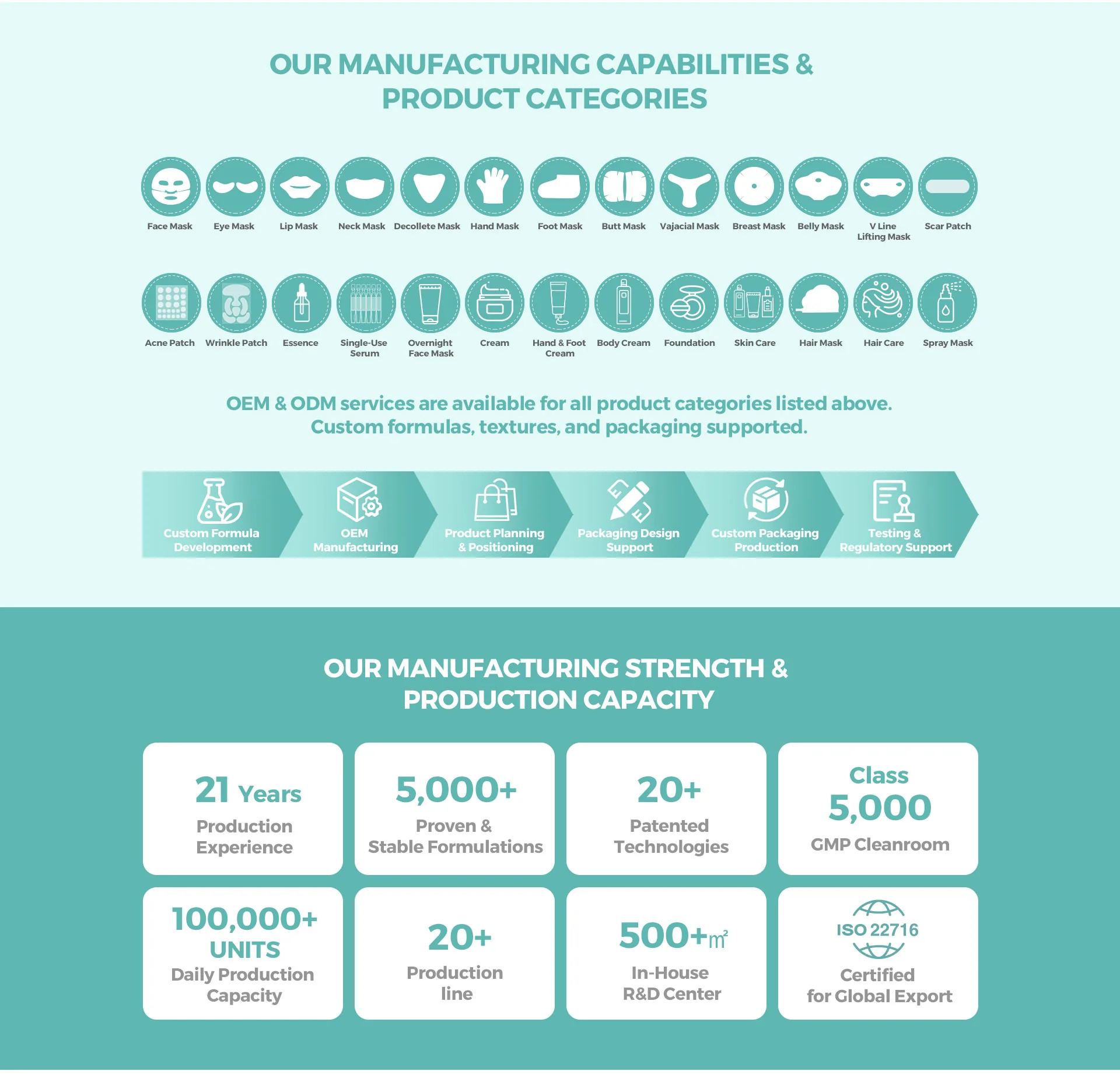
Korea vs China Skincare OEM (2026): MOQ, Cost, Lead Time
How Korea's ODM model and China's OEM base compare on MOQ, unit cost and lead time - with sourced figures and a seven-point way to choose.
Related Products

Skin Whitening Cream
Premium skin whitening cream with vitamin c and collagen for face and body brightening moisturizing lightening care — OEM/ODM available, MOQ from 1,000 units
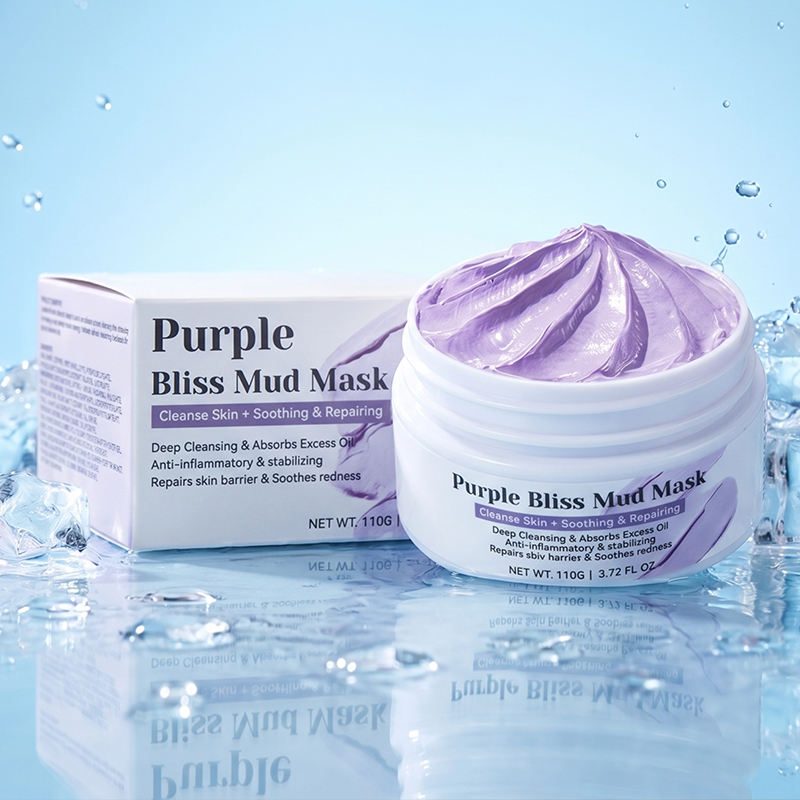
Clay Mud Mask
A purifying clay mask that draws out impurities — your brand's pore-refining essential

Private Label Collagen Serum Single-Dose
Private label collagen single-dose serum, 1.2 ml vials, 10 or 30 pcs per box, 1,000 boxes MOQ

Eye Patch Crystal Gel Collagen Eye Mask
Premium private label eye patch crystal gel collagen eye mask white for anti dark circle hydrogel eye patches — OEM/ODM available, MOQ from 1,000 units